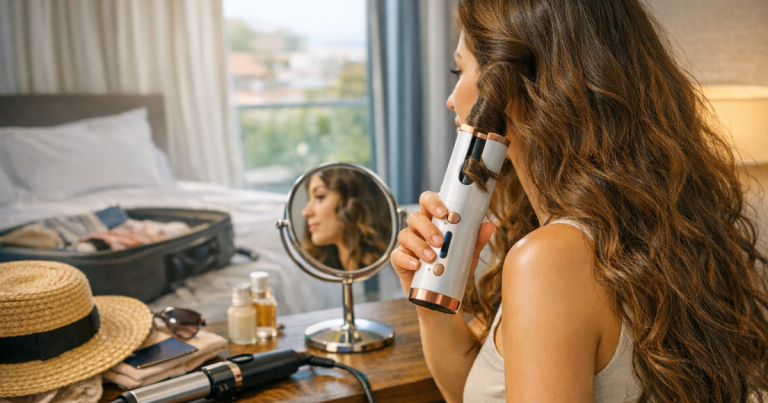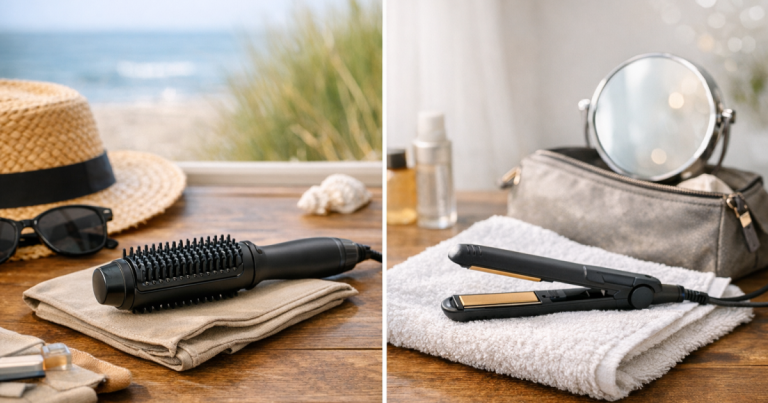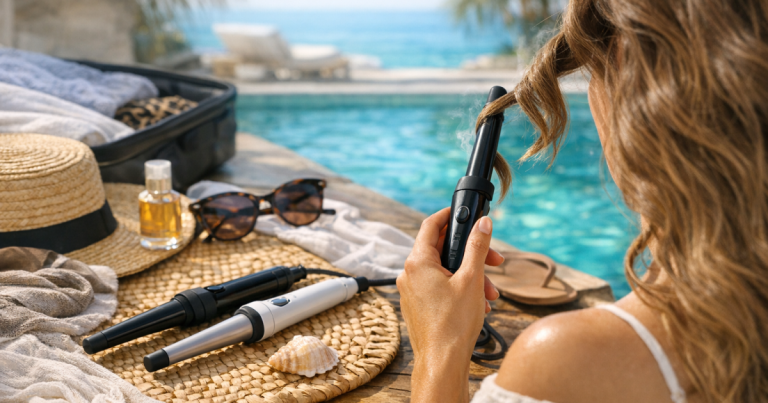
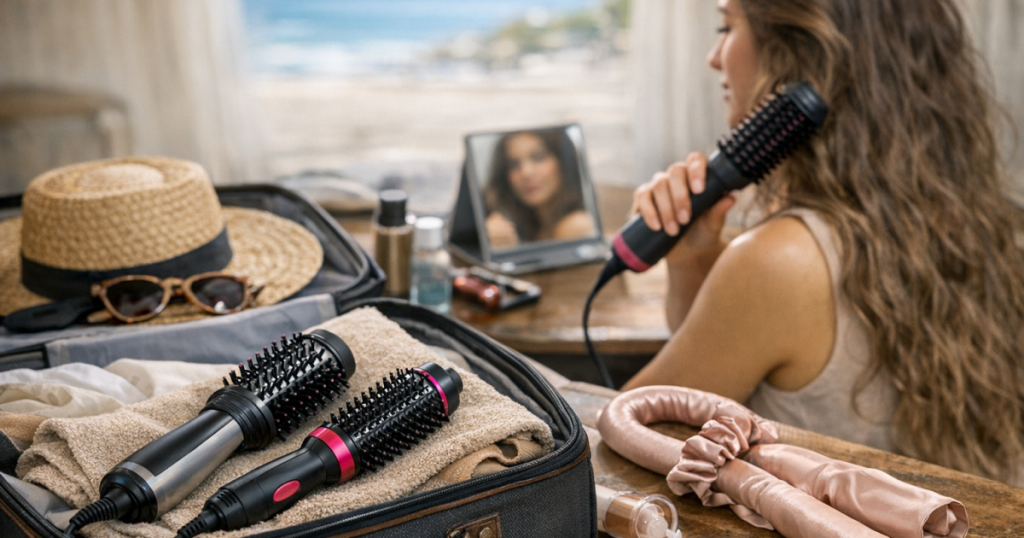
For thick hair, travel hot brushes can work, but they are usually better for smoothing, refreshing and adding shape than for transforming dense, wet hair from scratch. The real question is not only power; it is whether the brush has enough airflow, tension and surface contact for your hair density.
If your hair is thick, coarse, curly, very long or resistant to styling, a compact hot brush needs help from your prep and sectioning. Used on the right hair state, it can be a useful suitcase tool; used like a full-size dryer brush, it can feel slow and underwhelming.
The short answer for thick hair
A compact hot brush is powerful enough for thick hair when you use it on hair that is mostly dry, work in small sections and aim for polish rather than a complete blow-dry. It is less convincing if you expect it to dry dense roots, stretch tight curls fully smooth, or create long-lasting volume without any pre-drying.
Think of it as a finishing tool. It can smooth fluffy lengths, bend ends under, revive second-day hair and neaten face-framing layers. It is not always the quickest single-tool solution for a full wash-day routine, particularly if your hair holds water for ages or needs strong airflow at the roots.
- Best use: finishing thick hair that is already about dry to the touch.
- Hardest use: drying and smoothing very dense, wet roots in one pass.
- Most important technique: narrow sections with enough tension, not larger sections for speed.
- Most useful backup: a compact dryer, heatless tool or rollers for the parts the brush cannot handle well.
Why compact hot brushes can feel weak on thick hair
Thick hair creates two separate challenges: density and strand type. High-density hair simply gives the brush more hair to move through, while coarse or textured strands often need more tension and repeated contact to look smooth. A small travel tool has less space to grip, wrap or ventilate the section, so it can take longer even when the motor or heat setting looks reasonable on paper.
There is also a difference between hot air brushes and heated thermal brushes. A hot air brush uses airflow to help dry and shape. A thermal brush uses a heated barrel or surface to smooth and bend hair that is already dry. If your hair is thick and damp, a thermal brush is not the right shortcut. If your hair is thick and dry but puffy, it may be exactly the kind of tool that helps.
Power claims can be misleading because wattage, heat settings and brush size do not tell the whole story. What matters in real use is how quickly the tool gets through a section, whether the bristles hold the hair without snagging, and whether the finish lasts once your hair cools.
Step 1: Start with the right hair state
Do not ask a mini brush to do the work of a full wash-day dryer. For thick hair, towel-dry gently, detangle, apply heat protection if you are using heat, then rough-dry or air-dry until the hair is mostly dry. The roots should not feel wet, and the mid-lengths should not clump together with moisture.
If you start too wet, the brush spends most of its time evaporating water rather than shaping the hair. That is when thick hair starts to feel like it is “too much” for the tool. A compact brush performs better when it is used for the final smoothing stage, not the whole drying stage.
For travel, this often means washing hair earlier in the evening, letting it partially air-dry, then using the brush before bed or the next morning. If your hair frizzes as it air-dries, clip it loosely into sections or twist the lengths while it dries so the shape is easier to refine later.
Step 2: Section smaller than you think
Large sections are the main reason compact hot brushes disappoint on thick hair. The outer layer may look smooth while the middle stays warm, damp or bulky. Work in sections around 3–5 cm wide, and make them thinner if your hair is coarse, curly or very dense underneath.
Begin at the lower back layers, where thick hair usually holds the most moisture and bulk. Clip the top layers away, smooth the underneath first, then release more hair gradually. On holiday or before work, it is tempting to rush the visible front pieces only, but the underneath layers decide whether the style collapses or expands later.
- For dense straight hair: use long, steady passes and keep the brush moving from roots to ends.
- For thick wavy hair: twist the brush slightly through the mid-lengths to encourage a softer bend instead of a fluffy finish.
- For coarse or textured hair: use extra-small sections and add tension with your free hand, without pulling harshly at the roots.
- For layered hair: style the shortest layers last so they do not overheat or flick in the wrong direction.
Step 3: Use tension, not just heat
Thick hair usually needs controlled tension to look smooth. Place the brush under the section for lift or over the section for flattening and smoothing. Move slowly enough that the hair stays in contact with the heated or airflow surface, but not so slowly that you repeatedly heat the same area.
If the brush skims over the top of the hair, the result will be temporary. If it grips too tightly, it can tangle or create dents. The sweet spot is a firm glide where the bristles separate the hair and the section feels supported.
For face-framing pieces, turn the brush away from the face at the ends and let the section cool before touching it. Thick hair often looks styled while warm, then drops or expands as it cools. Holding the shape for a few seconds after the pass can make a noticeable difference.
Step 4: Pair it with airflow when roots are the problem
If your thick hair looks bulky at the roots, a compact hot brush may not be enough on its own. Roots often need directional airflow before you smooth the lengths. A dryer with a concentrator can flatten, lift or stretch the root area more efficiently, then the brush can polish the ends.
This is where tool pairing matters. Use a dryer first for root direction, then the hot brush for shape. If you struggle to choose attachments, the guide to which hair dryer nozzle suits your hair type explains when a concentrator, diffuser or wider nozzle makes more sense.
When packing light, decide what your hair needs most. If your thick hair naturally dries smooth but lacks shape, the brush may earn its place. If your roots dry puffy and uneven, a small dryer plus a round brush, or a dryer-brush style tool with stronger airflow, may be more practical.
Where travel hot brushes genuinely help
Once your technique is realistic, travel hot brushes can be very useful for thick hair in specific situations. They are strongest when they refine a style rather than create it from zero.
- Second-day smoothing: neatening pillow creases, fluffy ends and bends around the face.
- Holiday hair: refreshing hair after humidity, hats or a long journey without doing a full wash.
- Fringe and layers: adding direction where straighteners can make the hair look too flat.
- Soft volume: lifting the crown lightly once the roots are dry.
- End shaping: turning thick ends under so the haircut looks more intentional.
They struggle more with soaking-wet hair, very long dense lengths, tight curls that need full stretching, and styles that require strong root lift all over the head. In those cases, the brush is still useful, but only as part of the routine.
Real-world examples to understand the category
It helps to compare different brush styles before assuming one compact tool will suit every thick-hair routine. A small rotating hot air brush such as the BaByliss Big Hair Petite is typically considered for shorter layers, fringes and travel-friendly styling, while a thermal brush such as the ghd Rise Volumising Hot Brush is more about dry-hair volume and finish. A larger dryer-brush style tool such as the Revlon One-Step Volumiser Plus gives a useful reference point for the kind of size and airflow many people associate with faster at-home styling.
Do not assume those examples will all work the same way for thick hair. Check the current product details before buying or packing: voltage suitability for travel, plug type, heat settings, whether the tool is intended for wet or dry hair, brush head size, and how easily the bristles can move through dense sections. Those details matter more than the word “travel” on the box.
If you already use multi-styler attachments at home, the same principle applies: firmer smoothing attachments usually give more control on resistant hair, while softer attachments can be kinder on fine or fragile strands. The comparison of the Dyson Airwrap firm and soft smoothing brushes is useful background if you are trying to understand why bristle tension changes the result.
Pre-travel checks before you pack one
A hot brush is only travel-friendly if it suits the destination and your routine. Before packing it, check the label and manual rather than relying on the product name. Some compact tools are designed for easy storage but not necessarily for international use.
- Voltage and plug compatibility: confirm what the tool supports and whether you need the correct travel adaptor for the destination.
- Heat-resistant storage: check whether you have a mat, pouch or safe cooling space before putting it back into luggage.
- Hair state required: know whether it is for damp hair, towel-dried hair or dry hair only.
- Brush size: smaller barrels suit fringes, bobs and layers; larger heads cover long thick hair faster but take up more space.
- Detangling first: thick hair should be knot-free before you use a hot brush, otherwise the bristles can snag.
- Hotel timing: allow cooling time before packing, especially when changing accommodation.
Do not use a hot brush with a damaged cable, cracked casing or loose plug. Let the tool cool fully before storing it, keep it away from soft furnishings while hot, and avoid using it on hair products that leave sticky residue on the barrel or bristles.
When a heatless travel option is smarter
If your aim is waves, bends or volume rather than smoothness, heatless tools may travel better than a compact hot brush. A satin curling rod, silk hair wrap or Velcro rollers take up little room, do not rely on plug compatibility, and can be kinder if your hair is already dry or prone to heat fatigue.
Thick hair often holds heatless shape well once it is fully dry, but it still needs sensible sectioning. Large sections may dry unevenly or create lumpy bends. If you are deciding between soft overnight waves and roller volume, the guide to heatless curling ribbons versus foam rollers gives a useful comparison for travel routines.
A good compromise is to use heatless styling for the main shape, then use a compact hot brush only on the front layers or ends in the morning. That keeps heat exposure lower and reduces the time spent styling dense hair with a smaller tool.
Things readers ask
Can a travel hot brush dry thick hair completely?
It can help finish thick hair, but it is rarely the fastest way to dry it completely from wet. Dense hair normally needs pre-drying first, either with a dryer or enough air-drying time. Use the brush once the roots and underneath layers are mostly dry.
Is a hot brush better than straighteners for thick travel hair?
It depends on the finish you want. Straighteners usually give a sleeker, flatter result, while a hot brush gives softer movement and a more blow-dried look. For thick hair that expands, straighteners may control the surface faster, but a brush can make layers and ends look less rigid.
Will a mini hot brush work on thick curly hair?
It can refresh stretched curls, smooth dry sections or shape the front pieces, but it may not fully stretch thick curly hair from damp. Use smaller sections, avoid rushing the roots, and choose the tool based on whether it is intended for dry styling or damp styling.
Key takeaways
Travel hot brushes are powerful enough for thick hair when expectations are realistic. They are at their best as compact finishing tools for smoothing, shaping and refreshing, not as a complete replacement for a full-size dryer on wash day.
If your thick hair is long, coarse or very dense, the winning routine is usually: detangle well, pre-dry thoroughly, section narrowly, use steady tension, then let each section cool before touching it. For trips, consider whether you need smoothing, drying or shape most of all. That decision will tell you whether a compact hot brush deserves suitcase space, or whether a dryer, rollers or a heatless styling tool will serve you better.