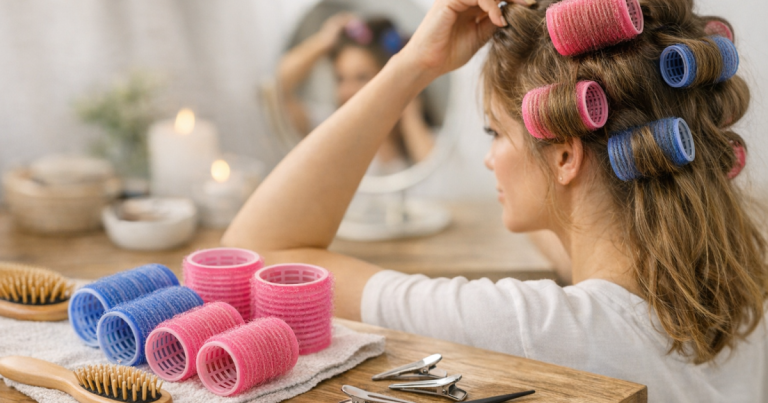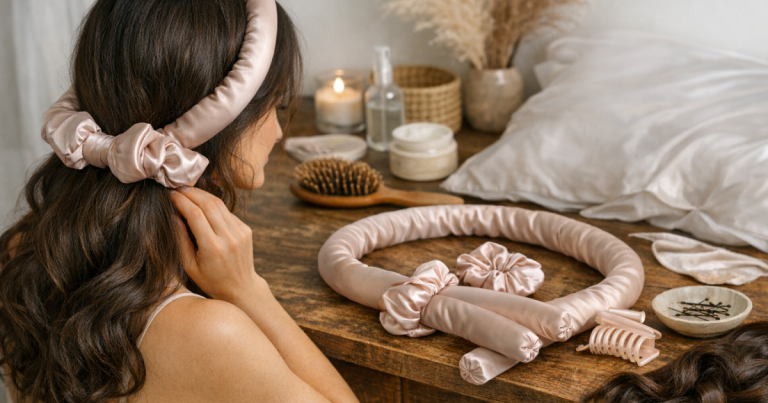
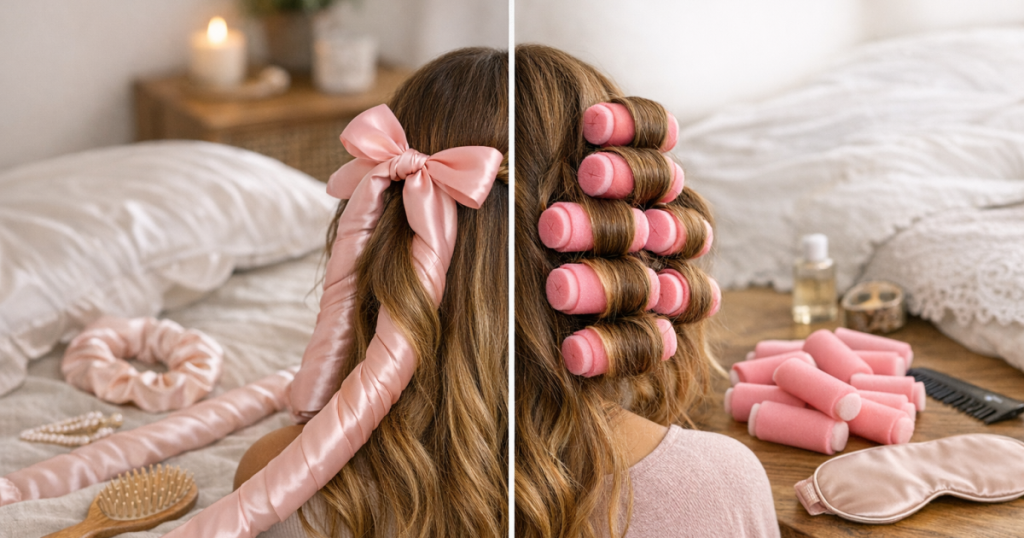
If your curls look lovely at night but flatten by mid-morning, the tool may be the issue rather than your technique. The choice of heatless curling ribbon vs foam rollers comes down to curl shape, comfort, hold and how your hair behaves while you sleep. A ribbon is usually smoother and better for soft, continuous waves; foam rollers give more control over curl placement and root lift, but can feel bulkier. The right choice is less about which method is trendier and more about matching the tool to your haircut, density and patience.
The short version
- Choose a curling ribbon if you want relaxed waves, less frizz, fewer dents and a more comfortable overnight set.
- Choose foam rollers if you want more defined curls, targeted volume, shorter-hair control or the ability to vary curl size around the head.
- Fine hair often needs smaller sections, very light product and a completely dry finish before unwrapping, whichever method you use.
- Layered or shorter hair is usually easier to control with rollers, though a ribbon can still work if you wrap the shorter pieces deliberately.
- Thick hair may need more sectioning than a single ribbon can offer, while rollers let you split the hair into manageable areas.
How a curling ribbon sets the hair
A heatless curling ribbon is usually a long, soft rod covered in satin, silk or a smooth fabric. You place it over the head and wrap sections of hair around each side, then secure the ends while the hair sets. The result is typically a loose, flowing wave pattern rather than a tight curl, because the hair follows one continuous curve.
This makes a ribbon particularly good for medium to long hair, soft blow-dry-style movement and low-tension styling. It also reduces the number of contact points in the hair, which can help avoid the little dents that clips, bands and roller edges sometimes leave. If you sleep on your side, you may still notice the ribbon, but it is generally less lumpy than a head full of rollers.
The limitation is control. A ribbon asks the hair to behave in one main direction. If your layers are very short, your fringe slips out, or your hair is dense at the back, the wrap can become uneven unless you section carefully. For step-by-step placement help, especially around shorter pieces, see our guide to using a silk curling ribbon on layered hair.
How foam rollers behave differently
Foam rollers work by rolling individual sections around separate soft cylinders. That sounds more old-school, but it gives you a lot of control: you can use smaller sections around the face, larger ones through the lengths, and different rolling directions depending on whether you want bounce, lift or a more uniform curl.
They are often better when the goal is definition rather than a soft bend. They also suit shorter hair because each piece only needs to reach around its own roller, not travel around a long central ribbon. If you struggle to get root movement, foam rollers can be placed close to the scalp in a way a ribbon usually cannot.
The trade-off is comfort and finish. Foam rollers can feel bulky overnight, and if the hair is too damp or rolled too tightly, you may get dents, squashed roots or a curl that looks more set than soft. They can also disturb frizz-prone hair if the foam surface catches, so the smoothness of the covering and how neatly you wrap the ends matter.
Match the method to your hair type
Fine or low-density hair
Fine hair can look fuller with either method, but it also drops quickly if the set is too loose, too damp or weighed down by product. A ribbon gives a polished, airy wave, but it may not create enough grip if your hair is very silky. Foam rollers can create better hold because each section is wound more tightly, though you need to avoid overloading the head with too many small curls unless that is the look you want.
Use dry or barely misted hair, keep sections small enough to set properly, and avoid heavy oils before styling. If your main problem is collapse after brushing out, the troubleshooting steps in our guide to stopping heatless curls dropping on fine hair are a better next step than simply switching tools.
Thick, dense or coarse hair
Thicker hair often needs more structure. A single ribbon may create a lovely surface wave but leave the underneath less shaped, especially if the sections are too wide. Foam rollers let you divide the hair more evenly, which can make the result more consistent from roots to ends.
That said, thick hair can become big very quickly with small rollers. If you want a soft, modern finish, use larger sections and avoid rolling everything in the same direction. A ribbon may still be the nicer option if your hair already holds shape well and you mainly want a smoother, heat-free bend through the lengths.
Layered hair, face-framing pieces and fringes
Layers are where the decision becomes more personal. Long layers can work beautifully with a ribbon because the shorter pieces blend into the wave. Short layers, curtain fringes and face-framing pieces often need extra attention because they can spring loose before the hair sets.
Foam rollers make it easier to isolate awkward pieces. You can roll a fringe separately, set face-framing sections away from the face, and leave longer back sections softer. If your layers are only slightly shorter, a ribbon may still be neater and more comfortable.
Shoulder-length or shorter hair
Foam rollers usually have the advantage on shorter hair. The hair does not need to wrap around a long ribbon, and you can place rollers exactly where you need movement. A ribbon can work on shoulder-length hair if the hair is long enough to cross around the rod securely, but it may produce uneven bends if the ends keep escaping.
Wavy, curly or frizz-prone hair
For naturally wavy or curly hair, the smoother option is often kinder. A satin or silk-covered ribbon can help stretch and organise the wave pattern without creating too many separate contact points. Foam rollers can be useful for reshaping specific pieces, but rougher foam or untidy rolling may encourage frizz.
Whichever method you choose, detangle first, wrap the ends neatly and avoid taking the hair down before it is fully set. Disturbing half-damp hair is one of the quickest routes to puffiness.
Comfort, timing and the kind of curl you actually want
When weighing heatless curling ribbon vs foam rollers, think about when you prefer to style. A ribbon is usually the easier overnight method because there is less bulk across the scalp. It suits people who want to wrap quickly, sleep, then release soft waves in the morning.
Foam rollers are often better for a daytime set: apply them for a few hours while the hair dries or settles, then remove them before going out. Some people do sleep in them, but side sleepers may find them irritating. They are also more visible and less convenient if you are moving around the house or getting ready.
Curl shape matters too. A ribbon tends to create elongated waves, often with a smooth bend away from the face. Foam rollers can create rounder, bouncier curls, more lift at the crown and more variation across the head. If you usually brush your curls out into soft waves, rollers can still work, but start larger and looser rather than creating tight ringlets you then have to soften.
Practical checks before you set your hair
- Start with the right moisture level: hair should be dry or only slightly damp. If it is wet inside the wrap, it may still be unset in the morning.
- Use lighter product than you think: a small amount of mousse, setting spray or curl cream can help, but too much product makes fine hair limp and thick hair sticky.
- Keep the ends smooth: ragged ends wrapped carelessly will dry into hooks or flicks. Tuck the ends flat before securing.
- Choose section size deliberately: larger sections create softer bends; smaller sections create more definition and longer-lasting shape.
- Let the set cool and settle: after removing the tool, use your fingers first. Brushing immediately can make fresh heatless curls fall faster.
- Protect the result overnight: if you are styling for the next day, a smooth hair wrap or loose scrunchie can help reduce friction while you sleep.
Where self-grip rollers fit in
Foam rollers are not the only roller option. Self-grip or Velcro-style rollers are often used for lift, fringe shaping and blow-dry bounce rather than a true overnight curl set. They can be useful if your main goal is volume at the crown, but they are not always gentle on fragile or tangle-prone hair. For a realistic look at what they do well and where they fall short, read our Conair Self-Grip Rollers review.
Main points
A curling ribbon is the smoother, more sleep-friendly choice for soft waves on medium to long hair. Foam rollers are the more adjustable choice for curl definition, shorter layers and targeted volume. Fine hair needs light product and a dry set; thick hair needs careful sectioning; layered hair needs extra control around the face. The best method is the one that matches your real routine, not just the curl pattern you like in a photo.
FAQ
Can I use a curling ribbon on wet hair?
It is better to use dry or barely damp hair. Wet hair wrapped tightly may still be damp in the morning, which makes curls drop or turn fluffy once released.
Are foam rollers better for long-lasting curls?
Often, yes. Foam rollers can create more defined sections and stronger shape, but they can also look too curly if you use very small rollers or tight tension.
Which method is more comfortable to sleep in?
A curling ribbon is usually more comfortable because it creates less bulk around the head. Foam rollers can work overnight, but side sleepers may find them awkward.
What should I choose for fine, straight hair?
Use a ribbon for soft, natural waves and foam rollers for stronger hold. Keep product light, avoid wet hair and do not brush the finished curls too soon.
Can I combine both methods?
Yes. You can use a ribbon through the longer lengths and one or two rollers for a fringe, crown lift or short face-framing layers that need extra control.
Quick Buying Links
Heatless Curling Ribbon
The choice of heatless curling ribbon vs foam rollers comes down to curl shape, comfort, hold and how your hair behaves while you sleep.
Foam Rollers: How to Choose
Worth considering if its strengths better match your needs.