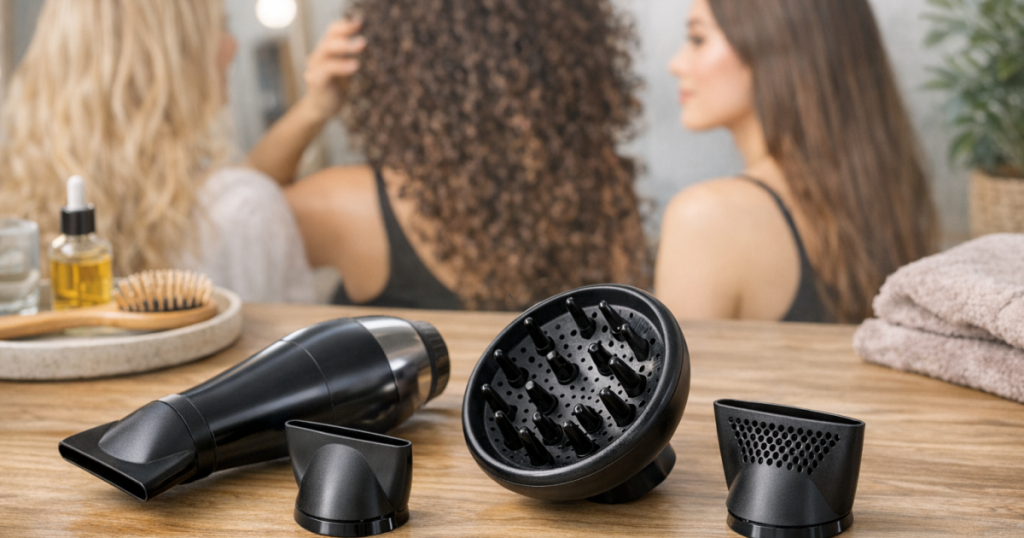
The right hair dryer nozzle changes how air hits your hair: narrow and focused for smoothing, wide and gentle for softer drying, diffused for curls, and comb-style for stretching textured hair. The mistake many people make is using the attachment that came on the dryer by default, rather than matching it to their hair type, finish and styling method.
A nozzle is not just an add-on. It controls direction, pressure and heat concentration, which affects frizz, root lift, curl pattern and how polished your blow-dry looks. If your ends feel rough, your fringe kicks the wrong way, or your curls puff instead of forming, the attachment choice is one of the first things to check.
The short version
- Fine or flat hair: use a wider concentrator or dry mostly without an attachment first, then finish with a medium concentrator for shape.
- Thick, coarse or frizz-prone hair: use a narrow concentrator with controlled sections and downward airflow.
- Wavy, curly or coily hair: use a diffuser when you want definition and less disruption to the curl pattern.
- Textured hair that needs stretching: use a compatible comb or pik attachment, with tension and moderate heat.
- Layered hair and fringes: use a slim concentrator for precision, but keep it moving so it does not overheat one area.
How dryer attachments actually change the result
A bare dryer blasts air over a broad area. That is useful when hair is very wet and you want to remove moisture quickly, but it can rough up the cuticle and disturb curls. A concentrator narrows that airflow, so you can aim it along a brush, around a fringe, or down the hair shaft for a smoother finish.
A diffuser does the opposite. It spreads the air so curls and waves are disturbed less. Instead of pushing hair around, it lets sections dry with more of their natural pattern intact. A comb attachment adds controlled tension, which can help stretch curls or coils before further styling.
Compatibility matters. Some dryers use push-fit attachments, some use magnetic fittings, and some have brand-specific shapes. For example, the Dyson Supersonic Hair Dryer, ghd Helios Hair Dryer and Shark SpeedStyle Hair Dryer all use their own attachment systems, so replacement nozzles are not automatically interchangeable. Always check the exact dryer model before assuming a diffuser or comb will fit.
Step 1: Decide whether you need control, volume or curl protection
Start with the finish you want rather than the attachment you already own. For a sleek blow-dry, you need direction and tension, so a concentrator makes sense. For root lift, you need airflow that does not flatten the hair too soon, so a wider nozzle or rough-dry stage works better. For curl definition, you need less air disturbance, so a diffuser is usually the better starting point.
Before styling, remove excess water with a towel or microfibre towel and detangle gently. Hair is more vulnerable when wet, so rushing a brush through knots can undo the benefit of a careful blow-dry. If tangles are a regular issue, the Wet Brush Original Detangler review explains where a flexible detangling brush helps and where it still has limits.
Step 2: Match the nozzle to your hair type
Fine hair: choose softer airflow and avoid over-concentrating heat
Fine hair often needs volume more than intense smoothing. A very narrow concentrator can make fine hair look polished, but it can also collapse roots if you aim it down too early or hold it too close. Start by rough-drying the roots on a lower or medium setting, lifting sections with your fingers. Once the hair is around 70 to 80 per cent dry, use a medium or wider concentrator to shape the lengths.
For a bouncy blow-dry, direct the nozzle across the roots first, then use a round brush through the mid-lengths and ends. Keep the dryer moving and avoid repeatedly heating the same fine front pieces. If your hair drops quickly after heat styling, use less product at the roots and focus hold through the lengths instead.
Thick or coarse hair: use a narrow concentrator in sections
Thicker hair usually needs more control. A narrow concentrator helps push air along each section, which can reduce frizz and make the surface look smoother. The key is sectioning. Trying to smooth a large mass of hair with a focused nozzle often leads to hot outer layers and damp inner layers.
Work from underneath, using clips to keep upper sections out of the way. Aim the airflow from root to tip while your brush provides tension. Keep a little distance between the attachment and the hair rather than pressing the nozzle directly onto the brush, as this can concentrate heat too aggressively on the same area.
Curly and wavy hair: reach for the diffuser
For waves and curls, a diffuser is usually the most curl-friendly attachment. It reduces the force of the air, helping the pattern dry with less puffiness. For loose waves, hover the diffuser around the hair first, then gently cup the ends if you want more shape. For stronger curls, bring sections into the diffuser bowl and lift towards the scalp without scrubbing or twisting.
Use low or medium airflow. High airflow can blow curls apart even through a diffuser. If your roots take longer to dry, tilt your head and focus the diffuser near the root area before touching the ends. Let the hair cool before you separate curls; breaking them up while warm can invite frizz.
Coily or textured hair: consider a comb attachment for stretch
A comb or pik attachment can be useful when you want to stretch coily or tightly curled hair before braiding, wrapping, roller-setting or smoothing. The attachment helps combine airflow with gentle tension, but the technique matters. Work in small sections, detangle first, and move from ends towards roots rather than forcing the comb through from the scalp.
Use a heat protectant and moderate settings where possible. The goal is controlled stretching, not making the hair bone-dry and rigid. If the comb attachment snags, stop and detangle the section again rather than pulling through resistance.
Damaged, bleached or fragile hair: go wider and gentler
Fragile hair does not respond well to repeated intense heat in one spot. A wider concentrator, lower heat and more movement are usually kinder than a narrow nozzle on a hot setting. Dry the roots and mid-lengths first, then finish only the outer layer with more precise airflow if you want polish.
Heat protection becomes more important when hair is porous, highlighted or already prone to snapping. For fine hair in particular, the ghd Bodyguard Heat Protect Spray review for fine hair is useful if you want lightweight protection without making the style feel coated.
Step 3: Use the attachment in the right direction
Even the correct attachment can disappoint if the airflow is aimed the wrong way. For smoothing, point the concentrator down the hair shaft, following the brush from root to tip. Blowing upwards roughens the surface and can make frizz more visible, especially around the crown and hairline.
For volume, direction changes. Lift the roots first and dry them against the way they naturally fall. Once the root area has cooled, then smooth the lengths into place. For fringes and face-framing layers, move the nozzle side to side at the root before shaping the ends, as this prevents a harsh bend or flat curtain effect.
For diffusing, avoid rubbing the attachment into the hair. Bring the diffuser to the curl, pause, then move to the next section. The less you disturb the pattern, the cleaner the result usually looks.
Step 4: Check the finish before adding more heat
If your blow-dry is not working, do not immediately turn the dryer hotter. Check these points first:
- Is the section too large? Large sections make concentrators less effective and leave damp patches underneath.
- Is the nozzle too narrow for your hair condition? Fine, fragile or bleached hair may need a softer, wider airflow.
- Is airflow pointing in the right direction? Downward for smoothness, lifted at the root for volume, diffused for curl pattern.
- Is the hair still too wet for finishing? Precision nozzles work better once the hair is partly dried.
- Are you touching the hair too much as it cools? Letting the shape set before brushing or separating helps the finish last.
Common nozzle mistakes that cause frizz or flatness
Using no attachment for the entire blow-dry is the classic frizz trigger. It dries hair, but it does not give enough direction for a polished finish. On the other hand, using a narrow nozzle from soaking wet to fully dry can overwork fine hair and make roots fall flat.
Another common mistake is treating a diffuser like a speed tool. A diffuser is about preserving shape, not blasting hair dry as fast as possible. If you use high heat and high airflow while constantly moving the diffuser, waves can become fluffy and curls can lose clumps.
Do not forget the cool stage. A short cool shot helps set the shape, particularly around the fringe, crown and ends. Once your blow-dry is finished, protecting the style overnight can matter as much as the drying method. The LilySilk Silk Hair Wrap review covers how a silk wrap can help reduce friction on heat-styled hair while you sleep.
Questions people ask
Should I dry my hair with or without the nozzle first?
For straight, fine or thick hair, rough-dry without a nozzle or with a wider attachment until the hair is partly dry, then switch to a concentrator for shape. For curls, start with a diffuser rather than blasting the pattern apart.
Is a narrow concentrator bad for fine hair?
Not always. It can help smooth the final surface, but it is easy to overdo. Use it briefly, keep it moving, and avoid aiming hot concentrated air at fine roots for too long.
Can a diffuser make straight hair wavy?
A diffuser can encourage existing bend, but it will not create a lasting curl pattern on naturally straight hair by itself. For straight hair, it is usually better for gentle drying than for creating defined waves.
Why does my hair look frizzy after using a concentrator?
The airflow may be pointing upwards, the section may be too large, or the hair may be too wet for smoothing. Aim the nozzle down the hair shaft and work in smaller sections with steady brush tension.
Do universal diffuser attachments fit all dryers?
No. Some universal diffusers fit a range of barrel sizes, but not every dryer shape or attachment system. Check the dryer model, barrel diameter and fitting style before relying on a universal attachment.
Main points
Use a concentrator when you want direction, polish and tension. Choose a narrower version for thick or frizz-prone hair, and a wider or medium one for fine, fragile or volume-focused styling. Use a diffuser when curl pattern matters more than sleekness, and use a comb attachment when textured hair needs controlled stretch.
The best result usually comes from changing attachments during the blow-dry: remove moisture first, then refine the shape, then cool the hair before touching or brushing it out. If your current routine leaves your hair flat, fluffy or unevenly dried, the nozzle is a simple place to adjust before changing your whole styling routine.