Flat roots can make an otherwise polished blow-dry feel unfinished, especially on fine, long or freshly washed hair. The quickest way to get root lift with Velcro rollers is to place them only where you need height, overdirect each section, add gentle warmth, then let the hair cool fully before you remove them.
Velcro rollers are not really curlers at the root; they are setting tools. They hold the hair up while it cools, so the shape you create lasts longer than simply brushing the roots upwards and hoping they stay there.
At a glance
- Work on clean, dry or almost dry hair; damp roots need much longer to hold.
- Use medium rollers at the crown and smaller rollers for stubborn, short or very fine root sections.
- Lift each section up and slightly forward before rolling, rather than pulling it straight back.
- Warm the root area briefly, then leave the rollers in until the hair feels completely cool.
- Remove gently and style with fingers; heavy brushing can flatten the set.
What Velcro rollers actually do at the roots
The lift comes from changing the direction in which the hair cools. When hair is warmed with a dryer, or set after a blow-dry while it is still warm, the bonds in the hair temporarily relax. As the hair cools around the roller, it takes on a lifted shape at the root.
This is why simply placing a roller on top of flat hair rarely works. The section has to be lifted away from the scalp before it is wrapped. Once you understand the set, root lift with Velcro rollers becomes less about the roller itself and more about section size, tension, cooling time and product weight.
Start with the right amount of prep
For most hair types, roots should be dry or around 90% dry before the rollers go in. If the scalp area is too wet, Velcro rollers can leave hair puffy at the ends but limp underneath. If the roots are bone dry and slippery, add a little grip first.
- Fine hair: Use a light root-lift spray or a small amount of mousse through the roots only. Avoid heavy oils or creamy leave-ins near the scalp.
- Medium hair: A volumising mousse or blow-dry spray can help the shape hold without making the hair stiff.
- Thick hair: Dry the roots thoroughly first, then use rollers to set the top layer. Trying to lift heavy, damp sections usually leads to collapse.
- Freshly washed, silky hair: A little dry shampoo or texture spray at the root can give the roller something to grip.
If you use a dryer for the warm-up step, a light protectant is sensible, especially around the hairline and crown. Fine hair can be easily weighed down, so our review of a lightweight heat protect spray for fine hair may help if your roots tend to go flat after product.
Choose roller size by the lift you want
Bigger rollers create a smoother, softer bend; smaller rollers give more lift because they raise the root more sharply. For root volume, the largest roller in the pack is not always the most useful one.
- Fine or short layers: Try small to medium rollers, roughly 25 mm to 38 mm, so the roots have enough curve to stand up.
- Medium-length hair: Medium rollers usually work well at the crown, with smaller rollers around the parting if those areas fall flat.
- Long or heavy hair: Use medium rollers close to the roots and avoid wrapping too much length around them. The aim is lift, not a full curl set.
- Bobs and lobs: Medium rollers on the top section can add height without making the silhouette too rounded.
If your bob goes sleek but loses height at the top, combine this technique with the drying pattern in our guide to blow-drying a bob without flattening it.
The step-by-step set
1. Dry the root area first
Focus your dryer at the roots before you start rolling. Lift the hair with your fingers or a vent brush and dry against the direction it naturally falls. You do not need high heat for ages; you need the root area warm, dry and moveable.
2. Create clean, narrow sections
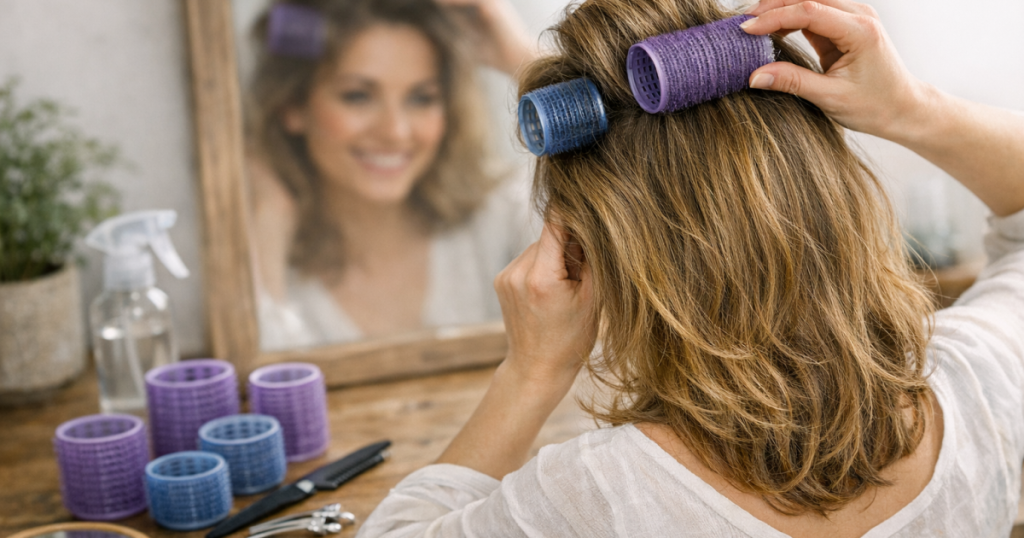
Take a section no wider than the roller and not much deeper than its diameter. Overwide sections are one of the main reasons the lift drops. The roller should sit close to the scalp rather than floating loosely on top of a bulky section.
3. Overdirect the hair
Hold the section up and slightly forward, away from where it will eventually sit. For crown lift, pull the hair upwards and a little towards the face before rolling back. This overdirection builds height into the root once the hair falls back into place.
4. Roll from the ends, but keep the tension at the root
Place the ends neatly around the roller, then wind down towards the scalp. The root should feel lifted, not dragged. If the ends are uneven or layered, smooth them around the roller with your fingers so they do not kink.
5. Clip if the roller feels loose
Velcro grip is useful, but it should not be doing all the work. If a roller wobbles, secure it with a section clip placed at the base. This is particularly helpful on thick, glossy or freshly conditioned hair.
6. Add warmth, then let it cool
Give each roller a short blast of warm air at the roots, then switch to cool air or simply leave the set to cool naturally. The cooling stage is not optional. Removing rollers while the hair is still warm usually gives a few minutes of height, then a gradual drop.
Where to place rollers for natural-looking height
You do not need to cover your whole head. For everyday root lift, targeted placement looks more modern and is quicker to do.
- For a centre parting: Place one roller on each side of the parting, rolled away from the face, plus one or two at the crown.
- For a side parting: Add the most lift on the heavier side, then use a smaller roller near the front to stop the fringe area collapsing.
- For crown flatness: Use two or three rollers in a row from the top of the head towards the back, each overdirected forwards before rolling.
- For curtain fringes: Roll the front sections up and back, then pinch the roots lightly as you remove the rollers.
Airflow matters here. A concentrator nozzle can help direct warmth exactly where the roller sits instead of roughing up the rest of the hair. If your dryer attachments feel confusing, read our guide to choosing the right hair dryer nozzle for your hair type.
Hair-type adjustments that make the lift last
Fine hair
Use fewer rollers and lighter products. Fine hair often loses lift because too much mousse, spray or serum has been layered on before the set. Keep conditioner away from the roots, use small sections, and let each roller cool completely. A very light mist of flexible hairspray at the roots after removing the rollers can help, but spray from a distance so the hair does not become wet.
Thick hair
Work with the top layer rather than trying to lift every strand. Thick hair can be too heavy for Velcro rollers if the sections are large or damp. Dry thoroughly, use clips, and focus on the crown, parting and face-framing areas. For very dense hair, smaller sections usually beat bigger rollers.
Curly or wavy hair
Velcro rollers can disturb natural curl patterns if dragged through the hair. Use them only on smoothed, stretched sections where you want lift, and remove them by unwinding gently rather than pulling. If you want to keep curl definition, limit rollers to the crown instead of the full top layer.
Layered hair
Layers can spring off the roller if the ends are not controlled. Tuck the shortest ends around the roller first, then roll slowly with even tension. Smaller rollers are often easier than large ones because they catch shorter pieces more securely.
Common mistakes that flatten the result
- Using rollers on wet roots: The set takes too long and often dries flat underneath.
- Choosing rollers that are too large: Oversized rollers smooth the hair but may not create enough bend at the root.
- Rolling in the direction the hair already falls: Overdirection is what creates the lift.
- Removing too soon: Warm hair has not finished setting. Wait until the roller and hair feel cool.
- Brushing hard afterwards: Use fingers, a tail comb at the roots, or a very light surface brush instead.
- Using heavy finishing products: Shine oils and rich creams can pull down the exact area you are trying to lift.
How to remove the rollers without losing volume
Do not yank Velcro rollers out sideways. Hold the root gently with one hand and unwind the roller in the opposite direction from how you rolled it. If the hair catches, pause and loosen the section with your fingers rather than pulling through the snag.
Once all rollers are out, let the hair sit for a minute before styling. Then place your fingers at the roots and gently lift or shake. For extra crown height, slide a tail comb into the root area and nudge upwards rather than backcombing aggressively.
Things readers ask
How long should Velcro rollers stay in for root lift?
Leave them in until the hair is completely cool and dry. For a quick refresh, 10 to 15 minutes can work; for longer-lasting height, allow more time after warming the roots.
Should I use Velcro rollers before or after hairspray?
Use most hairspray after removing the rollers. A tiny amount before setting can add grip, but too much makes the hair sticky and harder to unwind cleanly.
Can Velcro rollers give lift without heat?
Yes, if your hair already has some warmth from drying or enough natural texture to set. On very straight, silky or heavy hair, a brief warm blast followed by cooling usually gives a better hold.
Why do my roots drop after half an hour?
The usual causes are damp roots, sections that are too wide, rollers that are too large, heavy product, or removing the rollers before the hair has cooled.
Are Velcro rollers suitable for fragile hair?
They can be, but removal matters. Avoid tugging, use fewer rollers, secure them with clips if needed, and unwind slowly so the Velcro does not rough up delicate strands.
Final thoughts
The most reliable lift comes from a small, controlled set: dry roots, right-sized rollers, overdirected sections, gentle warmth and a proper cooling window. Think of Velcro rollers as a root-setting tool rather than a full styling shortcut. Used selectively at the crown, parting and front hairline, they can make an everyday blow-dry look fuller without needing a complete restyle.