Carry-on packing forces a blunt choice: keep your hair routine reliable, or reclaim space for clothes, skincare and toiletries. For many travellers, foldable hair dryers sound like the neat compromise, but the hinge is only useful if the dryer still suits your hair type, destination and styling habits.
The real question is not whether the handle folds. It is whether the smaller format reduces enough bulk without making your blow-dry slower, frizzier or more awkward once you arrive.
The short answer for hand-luggage trips
A folding travel dryer is worth packing when your hair dries reasonably quickly, your accommodation dryer is uncertain, and you rely on controlled airflow rather than salon-level power. It is less convincing if you have very dense hair, tight curls needing a proper diffuser, or a polished blowout routine that depends on a full-size barrel brush and consistent heat control.
For a weekend city break, gym-bag styling, or a holiday where you only need roots dried and lengths smoothed, a compact dryer can be a genuinely useful space-saver. For two weeks away with thick, porous or colour-treated hair, it can become the tool that technically fits but takes too long to use. If heat exposure is your main concern, it is worth reading whether travel hair dryers damage hair more than full-size models before deciding what belongs in your bag.
Where foldable hair dryers earn their space
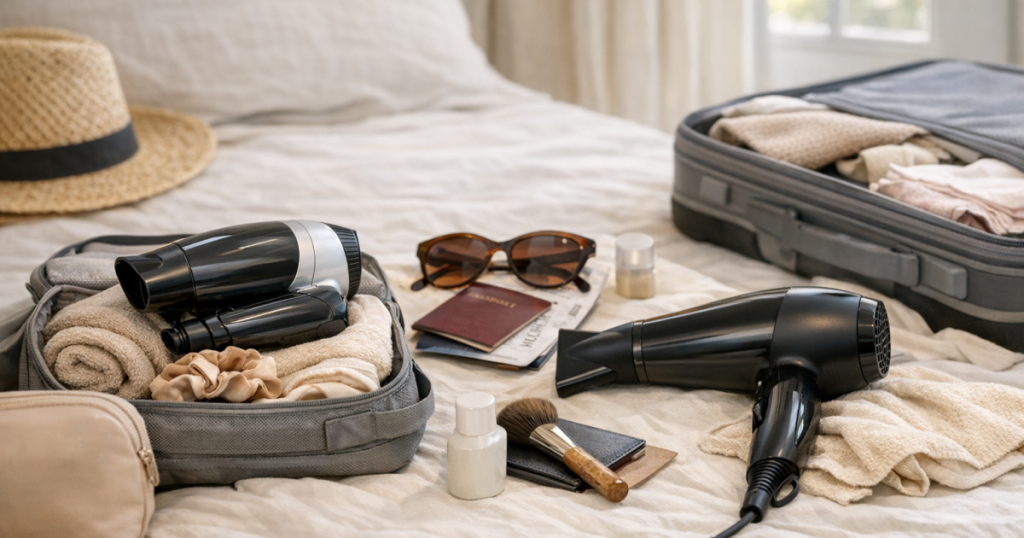
The obvious benefit is shape. A fixed-handle dryer can create awkward dead space in a small case, while a folding handle usually sits more neatly between soft items. That matters most if you travel with a strict cabin bag or a smaller under-seat bag where every corner counts.
The less obvious benefit is routine control. Hotel and rental-property dryers vary widely: some are wall-mounted, some have limited settings, and some are simply inconveniently placed. Bringing your own dryer gives you a familiar grip, familiar airflow, and fewer surprises on the first morning of a trip.
They are also useful if you do not need to dry your whole head from soaking wet. If your usual travel routine is rough-drying the roots, refreshing a fringe, smoothing face-framing layers or drying a heat protectant before styling, a smaller dryer can be enough. It becomes far more questionable when you expect it to replace a full-size dryer for a complete, high-tension blow-dry every day.
When a folding dryer may not be the cleverer choice
Compact does not always mean efficient. Some small dryers feel convenient in the bag but frustrating in use because the handle is shorter, the nozzle feels less stable, or the airflow is too concentrated for your hair texture. The key is not to assume that travel-sized automatically means travel-friendly for your routine.
- Very thick or long hair: a smaller dryer may extend drying time, especially if you start with very wet hair. Towel-blot thoroughly first and consider whether you will realistically use it after a long day out.
- Curly and coily hair: the issue is often attachment compatibility. If you rely on a diffuser, check whether the travel dryer has one available, whether it attaches securely, and whether the bowl shape suits your curl pattern.
- Fine hair: compact dryers can be useful, but too much concentrated airflow may collapse volume or rough up the cuticle. Lower airflow control matters more than maximum force.
- Bleached or heat-styled hair: consistent heat settings and a good pre-dry routine matter. If the dryer runs too hot for your comfort, the space saving is not worth the compromise.
- Short hair, fringes and bobs: this is where a compact dryer often makes the most sense. You need precision and quick drying rather than a powerful full-head blow-dry.
A quick hair-type reality check
Before packing one, think about what your hair actually needs when travelling, not what your at-home routine looks like on a perfect wash day.
Fine or flat-prone hair
A folding dryer can work well if you use it to lift the roots while the hair is damp rather than fully wet. Pack a light brush or comb, dry against the direction of your parting for a little lift, then let the lengths cool before brushing into place. Avoid blasting fine hair upside down for too long if it tends to become fluffy rather than full.
Thick, coarse or high-density hair
Be realistic. A compact dryer may be helpful for drying the hairline and scalp, but it may not be satisfying for a full blow-dry. If you are packing for a trip with limited time, pre-plan styles that do not require drying every section from scratch. A loose plait, low bun, claw clip or overnight heatless set can reduce the amount of hot-air styling you need.
Wavy, curly and coily hair
Attachment fit is the deal-breaker. A travel dryer without a secure diffuser can disturb curl clumps and create frizz, especially if you try to dry quickly. If curl definition matters more than packing space, compare the travel option with your full-size set-up. For diffuser-specific guidance, the Dyson Supersonic diffuser attachment review for curly hair is useful for understanding what makes a diffuser feel controlled, even if you are not packing that exact dryer.
Step-by-step: decide before it goes in your carry-on
Use this simple packing test before giving a dryer valuable space in your cabin bag.
1. Check your accommodation first
Look at the room details, message the host, or check recent reviews. A listed dryer is not always the same as a good dryer, but if you only need a basic rough-dry, the provided option may be enough. If you are staying in several places, pack based on the least certain one.
2. Confirm voltage and plug suitability
For travel outside the UK, check the appliance label and manufacturer guidance for voltage compatibility, plug type and adaptor needs. Do this before you travel, not at the hotel mirror. Never assume a dryer is suitable for every destination simply because it is marketed for travel.
3. Fold it and pack it as you would for the trip
Do a real packing run. Place the dryer in the bag with your brush, styling product, underwear, clothes and wash bag. If the folding handle saves space but the nozzle, cable and brush still make the kit bulky, the advantage may be smaller than expected.
4. Time your actual drying routine
Test it after your normal wash. Time how long it takes to get your hair to the point where you would leave the house or go to dinner. If it adds ten or fifteen minutes and leaves the finish less smooth, you have your answer before the trip.
5. Test the finish without your full home kit
Travel styling often fails because the dryer is packed but the supporting tools are not. Try using only what you plan to take: travel brush, comb, clips, heat protectant and any curl cream or smoothing product. If the result depends on three extra tools, you may not be saving much space overall.
Real examples you may come across
Rather than looking for the smallest dryer on the shelf, use recognisable models as reference points for the sort of checks to make. Availability, included attachments and product details can change, so verify the current specification with the retailer or manufacturer before travelling.
- ghd Flight+ Travel Hair Dryer: a familiar travel-dryer example to assess if you want a compact option from a salon-led styling brand. Check the current attachments, voltage information and storage case details.
- BaByliss Travel Dry 2000 Hair Dryer: a high-street travel option often considered for holidays and gym bags. Check the handle design, settings and whether the airflow suits your hair density.
- Remington On The Go D1500 Hair Dryer: another compact travel model to compare by packed size, nozzle fit and ease of use rather than headline claims alone.
The point is not that one named model is automatically right for every traveller. It is to compare the things that matter in real use: how it sits in the hand, whether it fits your bag, whether the controls are easy to use, and whether your hair still looks like your hair afterwards.
What to pack with it, and what to leave out
A travel dryer is only as useful as the mini routine around it. A small microfibre towel or soft cotton T-shirt can remove excess water before you switch on the dryer, reducing time under heat. Sectioning clips help thick hair dry more evenly. A compact brush is often more useful than packing both a round brush and a paddle brush.
For heat-styled hair, a leave-in spray or heat protectant can help your routine feel more controlled, but avoid overpacking full-size products. Decant only where the product packaging allows and where it will not leak. If your hair is prone to frizz, a small amount of lightweight oil or cream on the ends may be more useful than a second hot tool.
Do not forget the low-tech alternatives. A silk or satin wrap can protect a blow-dry overnight, while a satin heatless curling rod or soft rollers can create shape with no plug socket needed. If you are trying to preserve waves or curls after styling, sleeping in heatless curls without flattening them may save more luggage space than packing another electrical tool.
Carry-on packing scenarios
One-night work trip
Worth considering if your hair needs a quick fringe refresh or root lift before a meeting. If your accommodation confirms a dryer and your style is low-maintenance, leave your own at home.
Weekend city break
Usually a good fit if you are sharing a room, want predictable morning styling, or dislike wall-mounted dryers. Keep the rest of the kit minimal: one brush, one styling product and one protective accessory.
Beach or pool holiday
Less straightforward. Salt water, humidity and repeated washing can make a small dryer feel underpowered for long or dense hair. Consider wearing natural texture, braids, buns or heatless waves for most days, then using the dryer only for evenings.
Wedding or event travel
Pack it only if you have tested the exact routine in advance. Event hair is not the moment to discover that a compact dryer leaves your roots damp or your curls frizzy. If the style matters, plan a backup such as rollers, a smoothing brush routine or a protective overnight wrap.
Questions people ask
Can a folding travel dryer go in hand luggage?
In general, hair dryers are commonly packed in cabin baggage, but airline and airport rules can change. Check your airline’s hand-luggage guidance before you fly, particularly if you are carrying multiple styling tools or travelling through more than one airport.
Is a hotel hair dryer enough?
Sometimes. If your hair is short, fine or easy to air-dry, the hotel dryer may be perfectly adequate. If your hair is thick, curly, extension-wearing, frizz-prone or needs a diffuser, relying on an unknown dryer is a bigger gamble.
Should I pack a dryer or a heatless styling tool?
If you mainly want shape, waves or next-day polish, heatless tools can be more space-efficient. If you need to dry your scalp, fringe or roots quickly, a dryer is more practical. Many travellers do best with one compact drying option and one soft overnight styling method, not a full duplicate of their home set-up.
Main points
Foldable hair dryers are worth it for carry-on packing when they solve a specific problem: uncertain accommodation dryers, quick root drying, fringe control, or a compact routine for short to medium hair. They are less worthwhile when they slow down thick hair, lack a usable diffuser, or require so many extra accessories that the space saving disappears.
The best decision is made before the suitcase comes out. Test the dryer with your real travel routine, check destination compatibility, and be honest about your hair type. If it gives you reliable results with fewer tools, it earns its place. If it only looks compact in the box, your cabin bag may be better served by heatless styling, protective accessories and a simpler holiday hair plan.