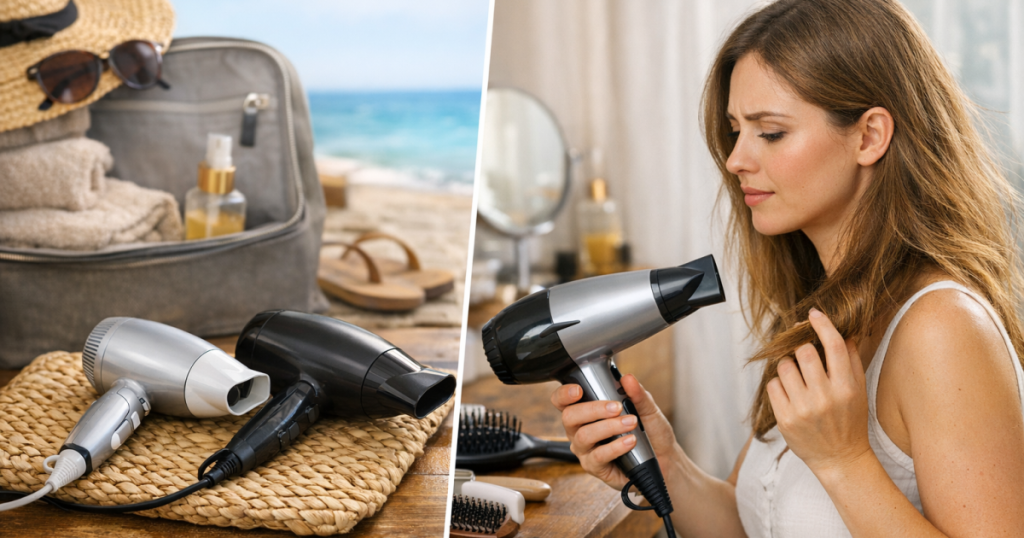
The short answer: travel hair dryers do not automatically damage hair more than full-size models. Damage usually comes from too much heat, too little airflow, over-drying, rough handling and using the wrong attachment. A compact dryer can be perfectly fine for occasional use, but it can become harsher if it takes much longer to dry your hair or forces you to hold concentrated heat close to the same section.
The real question is not simply small versus large. It is whether the dryer can move enough air for your hair type, whether you can control the heat, and whether your routine protects the cuticle while you style.
The short version
- Compact dryers are not inherently more damaging; technique and heat exposure matter more than size.
- A weaker dryer can cause more wear if it makes you dry for much longer or repeatedly go over the same sections.
- Full-size models often suit thick, long or coarse hair better because they may dry faster and work more effectively with attachments.
- Fine, short or lightly layered hair can usually cope well with a compact dryer, provided you use moderate heat and keep the dryer moving.
- Bleached, highlighted, relaxed or frequently heat-styled hair needs the gentlest routine, whichever dryer you pack.
Why compact dryers can feel harsher
A travel dryer is designed to save space. That usually means a smaller body, a shorter barrel and a more basic attachment set. None of that guarantees damage, but it can affect how the heat reaches your hair.
The biggest issue is drying time. If the dryer has lower airflow, you may compensate by turning up the heat, holding it closer or drying each section for longer. Hair does not only respond to peak temperature; it also responds to how long it is exposed. Ten rushed minutes with aggressive heat can be less kind than a slightly cooler, better-directed routine that gets the hair dry efficiently.
Another factor is heat distribution. Some small dryers feel very hot at close range because the airflow is more concentrated. If there is no concentrator nozzle, or if the nozzle is too short to direct air cleanly down the hair shaft, the cuticle can be roughed up rather than smoothed. That is when hair looks puffy, dull or frizzy even if it is technically dry.
Full-size dryers are not automatically gentle either. A powerful dryer used on maximum heat, held too close and aimed against the cuticle can still leave ends feeling dry. The advantage of a better full-size model is usually control: more usable settings, stronger airflow, and attachments that make it easier to dry quickly without relying only on heat.
Step 1: Match the dryer to your hair type
Fine or low-density hair
Fine hair is often the easiest match for a compact dryer because it dries quickly. The risk is not usually lack of power; it is over-drying. Use the lowest heat that still gets the job done, focus airflow at the roots first, and stop before the lengths feel papery or static.
If your fine hair is highlighted or prone to breakage, treat the compact dryer as a finishing tool rather than a start-to-finish blast. Blot well, let hair air-dry for a few minutes if practical, then use controlled heat to shape the roots and smooth the mid-lengths.
Thick, coarse or high-density hair
Thick hair can expose the limits of a compact dryer. If airflow is too weak, the outside layer dries while the inner sections stay damp, so you keep returning to the same areas. That extended drying time can make the surface rough and the ends feel tired.
Sectioning matters here. Work in smaller sections, remove excess water before starting, and use airflow to push moisture out rather than pressing hot air into one clump of hair. If you regularly travel with thick hair and expect a polished blow-dry, it is worth reading whether travel hot brushes are powerful enough for thick hair, because the same airflow-versus-density issue often applies.
Curly, wavy or textured hair
For curls and waves, damage is only part of the story. Shape disruption and frizz are just as important. Many compact dryers either lack a diffuser or come with a small diffuser that does not cup curls comfortably. That can encourage you to touch the hair too much, blast curls apart or dry unevenly.
Use a low or medium heat setting, keep the airflow gentle where possible, and dry in stages. If your curl pattern collapses easily, prioritise root drying and leave the ends slightly damp rather than trying to force a completely dry result in a hotel room mirror.
Bleached, colour-treated or heat-styled hair
Compromised hair needs the most conservative approach. If the hair already feels porous, stretchy when wet, brittle at the ends or rough after washing, a hot compact dryer can highlight that weakness quickly. Use a heat protectant, detangle gently before drying, and avoid repeatedly heating the same front pieces or face-framing layers.
For this hair type, the safest-looking result often comes from combining partial air-drying with a short, controlled blow-dry. You do not need to avoid the dryer completely; you need to reduce unnecessary passes.
Step 2: Use airflow before heat
A good drying routine starts before the dryer is switched on. Hair is most vulnerable when wet, so the way you remove water matters. Squeeze with a soft towel or microfibre wrap rather than rubbing. Detangle from the ends upwards with a brush or comb that does not snag. Add your leave-in or heat protectant evenly, not just to the top layer.
Once you start drying, aim for the highest airflow and lowest comfortable heat that works for your hair. Airflow moves water away; heat helps evaporate it. If the dryer feels very hot but barely moves the hair, you are relying too much on temperature and not enough on air movement.
Keep the dryer moving and avoid pressing the outlet right against the hair. As a general habit, hold it roughly 15-20 cm away for rough drying, moving closer only briefly when using a nozzle to smooth a section with a brush. If the scalp feels too hot, the hair is getting too much heat as well.
Step 3: Do not skip the attachment question
Attachments are not just styling extras. A concentrator nozzle helps direct air down the hair shaft, which can reduce frizz and improve shine. A diffuser spreads airflow for curls and waves, helping them dry with less disturbance. Without the right attachment, you may end up using more heat and more brushing to correct the finish.
If your compact dryer comes with a nozzle, use it for smoothing the lengths and ends. Keep the airflow pointing from root to tip rather than blowing upwards into the cuticle. If the nozzle keeps falling off, feels flimsy or becomes awkward to angle, it may not be helping as much as you think.
For a clearer breakdown of nozzles, diffusers and styling direction, see which hair dryer nozzle to use for your hair type. This is especially useful if your travel dryer feels fine for rough drying but leaves your finished style looking fluffy.
Step 4: Change your routine when you are travelling
Holiday hair often behaves differently because the whole environment changes. Humidity, hard water, sea salt, chlorine, hotel shampoo and less precise mirrors can all affect how polished your blow-dry looks. It is easy to blame the dryer when the routine around it has changed too.
Before you decide the compact dryer is damaging your hair, check these practical details:
- Water removal: Are you starting with soaking wet hair? More water means longer heat exposure.
- Product amount: Too much leave-in or oil can make fine hair limp and encourage extra drying; too little protection can leave porous ends exposed.
- Section size: Large sections dry unevenly, especially on thick hair.
- Direction: Blowing hair in every direction creates frizz, even on healthy hair.
- Finish point: Drying until the hair feels hot and bone-dry can make the ends feel rougher.
- Voltage and plug suitability: Check the appliance instructions and destination requirements before travelling, particularly outside the UK. A dryer should only be used with the voltage and adaptor arrangement it is designed for.
A useful travel compromise is to dry the roots properly, smooth the most visible top layer, then leave the lower lengths to finish naturally if your style allows. You will use less heat and still avoid the flat, damp-root feeling that makes hair collapse.
When a full-size dryer is the kinder choice
If you blow-dry several times a week, have dense hair, wear a smooth bob, or need a polished finish quickly, a full-size dryer may be less stressful for your hair overall. Not because it is bigger, but because it may dry efficiently with better control. Shorter drying time at a moderate heat can be kinder than a long session with a small dryer struggling through thick sections.
A full-size option also makes more sense if you rely on a concentrator nozzle, round brush tension or a diffuser every time you wash your hair. If you are assessing whether your main dryer is still doing enough at home, our Remington Proluxe Hair Dryer review gives a useful example of what a mid-range full-size dryer can offer in terms of everyday styling practicality.
That does not mean you need to pack a full-size dryer for every trip. For a weekend away, a compact model may be completely adequate. For a two-week holiday where you plan to wash and style frequently, the trade-off becomes more noticeable.
Signs your drying routine is causing stress
Damage is not always obvious after one use. Watch for small changes that appear after repeated drying sessions:
- Ends feel rough or catch on each other after drying.
- Hair looks shiny when wet but dull once blow-dried.
- Frizz appears mainly on the top layer or around the face.
- Your usual brush snags more than normal.
- Colour-treated sections feel drier than untreated hair.
- Curls lose definition and look expanded rather than formed.
If these signs show up only when you travel, the dryer might be part of the issue, but so might water quality, sun exposure, swimming or product changes. Adjust one thing at a time: lower the heat, use smaller sections, add a nozzle, pre-dry more gently, or reduce how often you blow-dry fully.
A safer compact-drying routine
Use this simple sequence when you want a decent finish without overworking your hair:
- Blot first: Squeeze out water with a soft towel until hair is damp rather than dripping.
- Protect evenly: Apply heat protectant through the mid-lengths and ends, then lightly over the top layer if needed.
- Start at the roots: Lift sections with your fingers and dry the root area before focusing on the ends.
- Use medium heat where possible: Save the hottest setting for brief moments, not the whole blow-dry.
- Direct the air: Use a concentrator for smooth styles and point airflow down the hair shaft.
- Pause before the hair overheats: If a section feels hot to touch, move on and let it cool.
- Finish gently: Use a cooler setting if available, then stop. Do not keep drying just to chase every last hint of moisture from the ends.
Helpful questions
Is a hotel hair dryer worse than taking my own?
Not always, but hotel dryers are unpredictable. Some are efficient; others have weak airflow, limited settings or no useful nozzle. If your hair is thick, curly, bleached or easily frizzed, taking a compact dryer you already understand can give you more control.
Can I use a travel dryer every week?
Yes, if it dries your hair efficiently and you use sensible heat. If weekly use means long drying sessions, high heat and repeated passes over the same sections, a full-size dryer may be a better match for your main routine.
Does a small dryer make frizz worse?
It can if the airflow is poorly directed or too hot at close range. Frizz often comes from rough drying, missing attachments, humidity and over-brushing as much as from the dryer itself.
What to remember
A compact dryer is not automatically the damaging option. The gentlest choice is the one that dries your hair efficiently, gives you enough control, and fits your hair type. Fine and short hair can often do well with a smaller dryer. Thick, coarse, curly or chemically treated hair needs more care, and may benefit from a stronger full-size model for regular styling.
When travelling, focus on reducing total heat exposure: blot properly, use a suitable attachment, keep the dryer moving, choose moderate heat and stop before the hair feels parched. That approach matters far more than the size of the dryer in your suitcase.