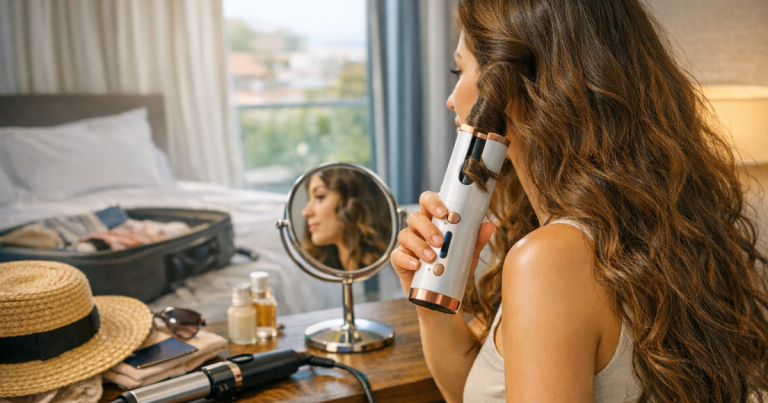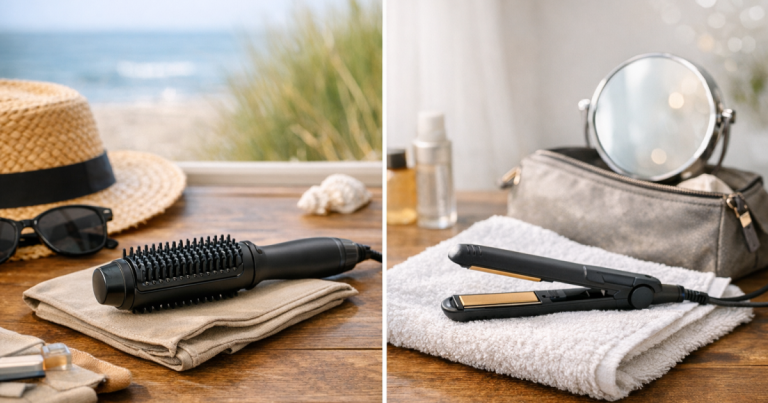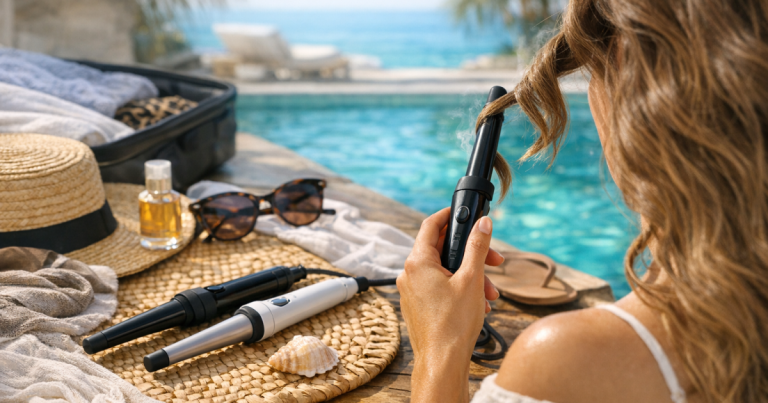
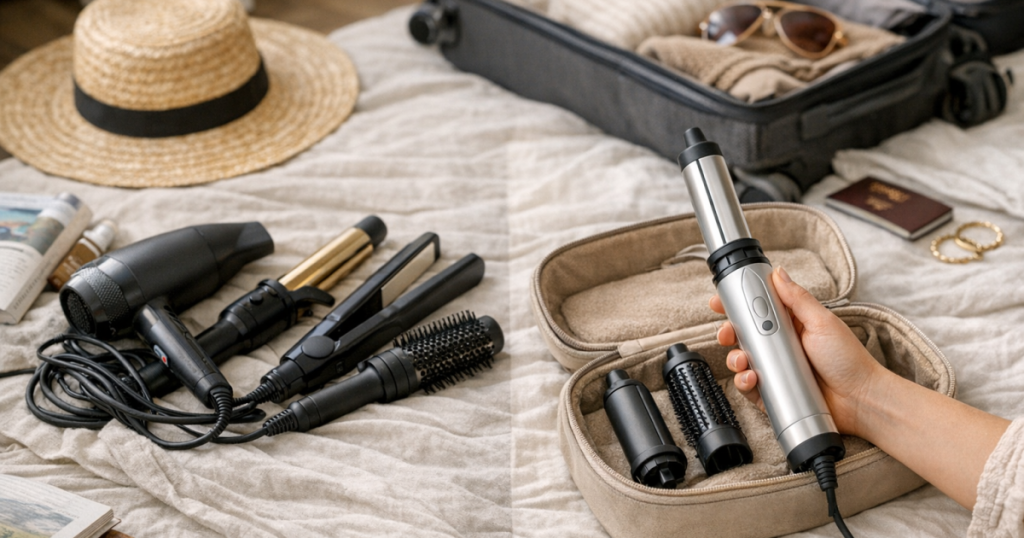
A compact multi-styler can be a brilliant space-saver if you usually pack a dryer, brush, tong and straightener for trips. The catch is that one handle with several attachments rarely performs every job exactly like the separate tool you already trust. The right answer depends on your hair type, your styling routine and how polished you need your hair to look away from home.
For a weekend away, an all-in-one tool may be more than enough. For thick, textured, very long or frizz-prone hair, it can still be useful, but it may work better as a reduced kit rather than a complete replacement.
At a glance
- Yes, it can replace separate tools if you mainly rough-dry, add volume, smooth the front sections or create soft bends.
- It may not fully replace them if you need pin-straight results, tight curls, strong root lift or very fast drying on dense hair.
- Hair type matters more than suitcase size. Fine hair often benefits most from a lighter kit, while thick hair needs airflow, tension and enough time.
- Attachments are only useful if you genuinely use them. A smaller set of well-chosen heads beats a bulky case full of extras.
- For heatless routines, it is often a support tool rather than the main styler, helping with drying, smoothing or fringe control before overnight shaping.
Step 1: Work out what you actually do on a trip
Start with your real holiday or work-trip hair routine, not your ideal routine at home. Many people pack for every possible hairstyle, then wear their hair in the same two looks all week. Write down the jobs your travel tools need to cover:
- Drying from wet or damp hair.
- Smoothing frizz around the hairline and ends.
- Adding volume at the roots or through the crown.
- Creating waves, curls or flicked-out ends.
- Refreshing second-day hair without washing.
- Prepping hair before heatless curls, rollers or a silk wrap.
If your list is mostly drying, soft smoothing and volume, one travel-friendly multi-tool has a good chance of covering it. If your list includes sleek straightening and long-lasting defined curls, you may still want one dedicated tool alongside it.
Before any styling tool touches your hair, the prep step matters. Detangling carefully helps attachments glide instead of snagging, particularly if your hair tangles at the nape or has dry ends. For a more detailed routine, see how to detangle hair before heatless styling without frizz.
Step 2: Match the tool to your hair type
Fine or flat hair
Fine hair is often the easiest match for a compact multi-styler because it usually dries faster and responds well to air styling, round-brush attachments and soft curling barrels. The main risk is over-styling. Use the lowest effective heat and airflow setting, and prioritise lift at the roots rather than repeatedly passing over the same lengths.
If your hair collapses quickly, choose a routine that sets shape while the hair cools. A multi-tool can create volume, but clips, rollers or a cool-shot finish often make the result last longer.
Thick or dense hair
Thick hair needs more realism. A single compact multi-styler may reduce your kit, but it will not always dry dense hair as quickly as a full-size dryer. If you have heavy lengths, consider rough-drying most of the moisture first, then using the styling attachment for shape. On trips where wash days are unavoidable, this can still save space, but it may take patience.
If thick hair struggles to hold shape, styling from almost-dry rather than wet hair usually works better. You can also pair your travel tool with heatless shaping overnight; this is especially helpful if you want soft curls without spending ages with a hot attachment. Our guide to getting heatless curls to hold in thick hair is a useful next step.
Curly, coily or textured hair
For textured hair, the question is not simply whether the tool is compact; it is whether it gives enough control. Look at the attachments carefully. A diffuser, smoothing brush or concentrator-style attachment can be more relevant than curling barrels if you wear your natural pattern most of the time. If you rely on tension to stretch the roots or smooth the canopy, check whether the brush attachment feels secure and gentle enough for your hair density.
A multi-tool may be ideal for refreshing the front pieces, drying roots or softening frizz, but it may not replace your preferred diffuser or paddle brush if those are essential to your usual finish.
Short hair, bobs and fringes
Shorter cuts often travel well with one tool, because smaller sections are easier to control. A round-brush or smoothing head can shape a bob, lift a fringe and tame the crown without needing multiple appliances. The limitation is precision: if you depend on a mini straightener for a blunt fringe or sharp flicks, keep that in mind before leaving it behind.
Step 3: Compare what one tool can and cannot replace
Well-known examples such as the Dyson Airwrap Multi-styler and Shark FlexStyle Air Styling & Drying System show why this category is appealing: one base can be paired with different styling attachments. The important point is not the brand name, but whether the attachment mix matches your real routine.
- Hair dryer: A multi-styler can often handle drying, but very thick or long hair may still prefer a dedicated travel dryer for speed. If drying is your main priority, read whether a foldable hair dryer is worth packing before switching completely.
- Round brush: This is one of the easiest tools to replace if you like bounce, curved ends and smooth volume.
- Curling tong: Soft curls and bends are realistic, but tight, uniform curls may be harder to achieve unless the attachment is designed for that look and your hair holds shape well.
- Straightener: This is the hardest tool to replace. Smoothing brushes can reduce frizz and soften bends, but they do not always create the same sleek, compressed finish as straighteners.
- Waver: A multi-tool can create loose movement, but it will not usually mimic the pattern of a three-barrel waver exactly.
Step 4: Do a home trial before you travel
The best test is not reading the attachment list; it is styling your hair exactly as you would in a hotel room. Try this before a trip:
- Wash and towel-dry as normal. Use your usual leave-in or heat protection so the test is fair.
- Time the drying stage. If it takes too long at home, it will feel even more annoying when you are getting ready to go out.
- Style only with the travel tool. Do not rescue the look with your full-size dryer, straighteners or favourite brush.
- Check the result after two hours. The fresh finish matters less than how the style behaves once you have walked outside, worn a coat or dealt with humidity.
- Pack the attachments you used. If one head never left the case during the trial, it probably does not deserve suitcase space.
This test also reveals whether you need a supporting accessory. A silk hair wrap, soft scrunchies, velcro rollers or a detangling brush can sometimes make a smaller styling kit work better than adding another heated tool.
Step 5: Decide what to leave behind
Once you know what the all-in-one tool does well, build your travel kit around the gaps. For many people, the neatest setup is not one tool only, but one main styler plus one lightweight support item.
- If you wear smooth blow-dries: Take the multi-styler and a gentle brush. Leave the separate round brush behind if the attachment gives enough tension.
- If you wear waves: Use the multi-tool for drying and front-piece shaping, then rely on a satin heatless curling rod or overnight method for softer lengths.
- If you need sleek hair every day: Keep a compact straightener in the kit and use the multi-tool mainly for drying and volume.
- If you refresh rather than restyle: A multi-tool plus a silk wrap may be enough, especially for short trips.
- If your hair frizzes easily: Prioritise prep, sectioning and a small amount of finishing product over packing more appliances.
Key questions answered
Can one travel multi-styler replace a hair dryer?
Sometimes, yes. It depends on how wet your hair is when you start and how dense your hair is. Fine and medium hair may manage well, while very thick hair may find a dedicated dryer faster and less tiring.
Is it better than packing straighteners?
Only if you do not need a very sleek finish. A smoothing attachment can make hair look neater, but straighteners give more compression and precision. If straight hair is your non-negotiable look, do not assume a compact multi-styler will fully replace them.
Will it work with heatless curls?
Yes, and this is one of the most useful ways to use it. Dry hair to the right dampness level, smooth the roots or fringe, then set the lengths with your preferred heatless method. This reduces styling time while keeping the main curl formation gentler.
What should UK travellers check before packing one abroad?
Check the product label and instructions for voltage compatibility, plug requirements and the storage case size. Do not assume every tool is suitable for every destination, and remember that bulky attachment cases can take up more room than expected in carry-on luggage.
Main lessons
A compact multi-styler is most likely to replace separate travel tools when your routine is flexible: soft blow-dried shape, light smoothing, volume, bends and quick refreshes. It is less likely to be a complete replacement if your hair is very thick, needs high tension, or depends on a specific finish from straighteners, a diffuser or a waver.
The smartest approach is to test your full travel routine at home, then pack only the attachments and accessories that earn their space. For many hair types, that means a smaller, more intentional kit rather than a single miracle tool — and that is often the most practical travel upgrade of all.