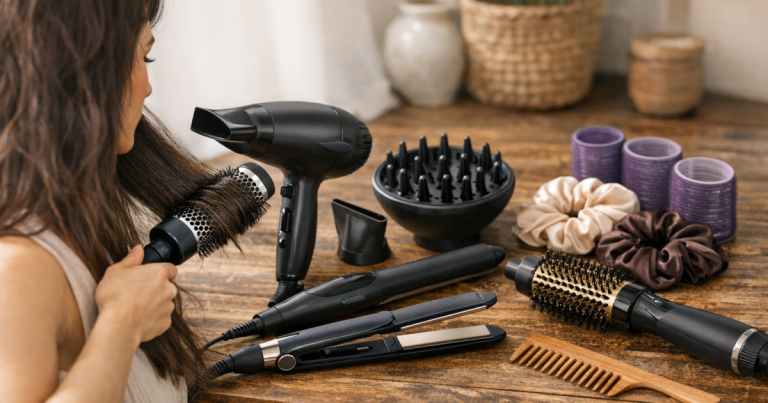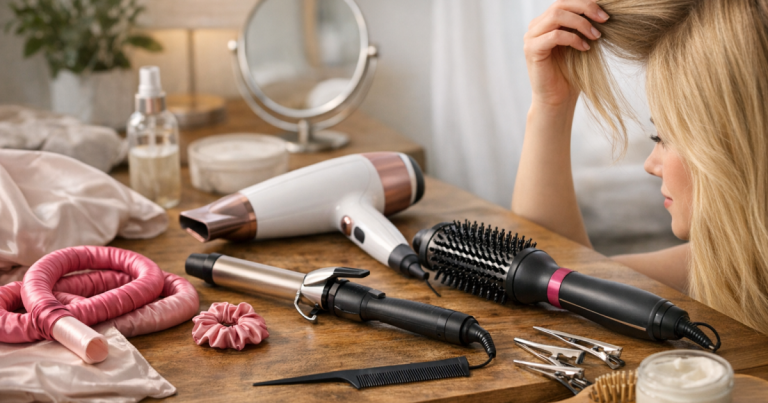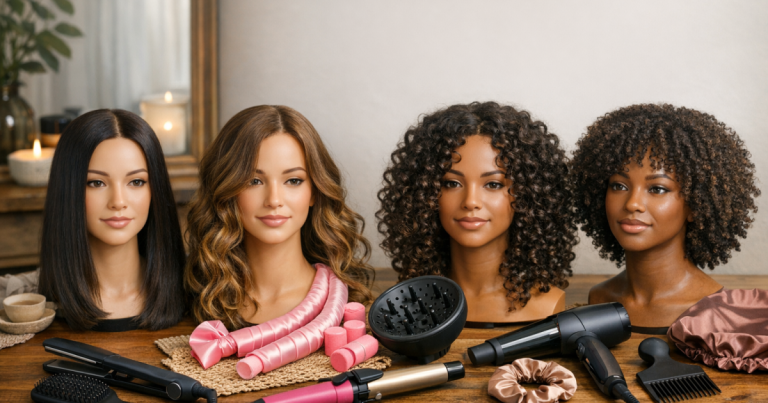
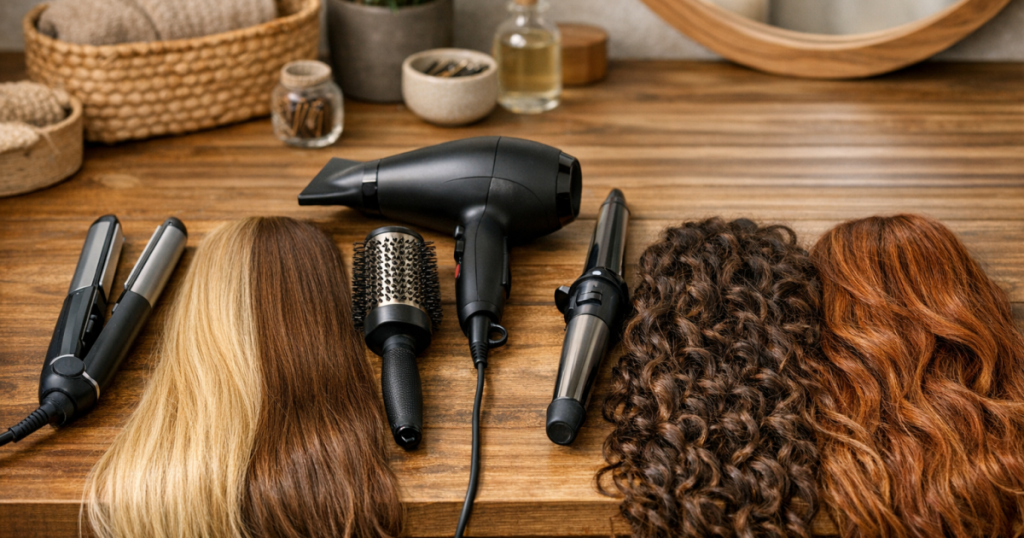
The right amount of heat by hair type is usually lower than most people expect, and it depends as much on condition, density and styling goal as on whether hair is fine, thick, straight or curly. Too little heat can leave hair fluffy or half-set; too much can make ends feel rough, faded or limp. The useful question is not “how hot can my tool go?” but “what is the lowest setting that gives me the shape I want?”
The short version
Most at-home styling works best when you start low, use clean sections, and increase heat only if the hair is not responding. A rough starting point is 120–150°C for fine, fragile or colour-treated hair, 150–180°C for medium or resilient hair, and 170–200°C for very thick or coarse hair that needs smoothing. These are not fixed rules: bleached thick hair may need less heat than natural fine hair, and curly hair may need more preparation rather than more temperature.
Heat is only one part of the result. Tension, section size, hair dryness, product build-up, humidity and the quality of the tool all change how much temperature you actually need. Before reaching for a hotter setting, it is often more effective to plan the style before choosing the tool, because a root lift, loose bend, sleek finish and stretched blow-dry all need different handling.
Why hair type changes heat needs
Hair does not heat evenly. Fine strands warm quickly because there is less fibre for the tool to work through. Dense or coarse hair can resist styling because each section contains more hair, not necessarily because the strand itself needs extreme heat. Curly and coily hair add another layer: the bend in the strand can make moisture, natural oils and tension distribute unevenly, so preparation matters as much as the temperature dial.
Condition is the biggest modifier. Heat-styled, bleached, relaxed, permed, highlighted or sun-exposed hair should be treated as more fragile, even if it looks thick. Older ends usually need less heat than newer roots. If the ends straighten instantly but the roots stay puffy, the answer is not always a hotter tool; it may be smaller sections, better tension, more drying time, or a different styling method.
Useful starting temperatures by hair type
Fine or low-density hair
Fine hair usually needs the least heat because the strand is smaller and more responsive. Start around 120–140°C for straighteners, curling wands or heated brushes, then increase slightly only if the shape drops immediately. If the hair is fine but healthy, slippery and resistant, 150°C may be enough for a longer-lasting bend.
The main risk is not that fine hair will refuse to style; it is that it can be overworked before you notice. One slow pass is usually kinder than repeated quick passes. For volume, velcro rollers, foam rollers or a cool-set blow-dry can give lift without flattening the cuticle repeatedly.
Medium, straight or wavy hair
Medium strands often sit in the 150–175°C range for heated styling. This hair type usually responds well when it is fully dry, sectioned neatly and styled with moderate tension. If waves collapse in damp British weather, avoid jumping straight to the maximum setting. A light hold product, smaller sections and allowing the hair to cool in shape can do more for longevity than extra heat.
For a soft wave, use the lowest setting that creates a bend in one pass. For a smoother finish, focus on even tension from roots to ends. If you need several passes on the same section, the section is probably too thick or the hair is not dry enough.
Thick or high-density hair
Thick hair is often misunderstood. High density means there is a lot of hair on the head; it does not automatically mean each strand can tolerate very high heat. Many thick-haired people get better results by taking narrower sections and working at 170–190°C rather than clamping large sections at the highest setting.
If your hair is thick but soft, porous or highlighted, stay closer to medium-hair temperatures. If it is thick, natural and resistant, you may need to move towards 190–200°C for sleek straightening, but the goal is still one controlled pass rather than repeated passes. A good blow-dry foundation can reduce the amount of direct iron heat needed afterwards.
Coarse hair
Coarse hair has a larger strand diameter and can need more heat to reshape, particularly when you want a polished finish. A realistic starting range is 175–200°C for straighteners or hot brushes, provided the hair is healthy, fully dry and protected with a suitable heat styling product. Coarse hair often benefits from tension and patience more than maximum temperature.
Puffiness after heat styling usually comes from uneven drying, too-large sections, or brushing the hair after it has set. If the aim is smoothness rather than pin-straight hair, a blow-dry brush or straightening brush may be enough, but technique matters: start with dry or nearly dry hair, work in layers, and let the section cool before touching it again.
Curly and coily hair
Curly and coily hair varies hugely, so curl pattern alone is not a safe temperature guide. Fine curls may need very low heat, while coarse coils may need more warmth for stretching. If you want to preserve curl definition, use low or medium dryer heat with a diffuser and avoid blasting the cuticle open. If you want stretch, tension-based methods can reduce reliance on irons.
For many curl types, the lowest-risk route is to stretch first and refine later. For example, banding can stretch curls without heat, making it easier to smooth, braid, wrap or lightly finish the hair afterwards. This is especially useful when you want length and manageability without repeatedly straightening the same areas.
Colour-treated, bleached or chemically processed hair
Processed hair should be treated as delicate, regardless of whether it is fine, thick, straight or curly. Start around 120–150°C and only increase if the hair remains healthy, elastic and responsive. Bleached ends can be far more fragile than natural roots, so split your approach: a little more control near the root area, less heat and less contact time through the ends.
Look for warning signs while styling: a rough feel, faded tone, sudden frizz, excessive snagging, or ends that will not hold shape. Those signs usually mean the hair needs conditioning, trimming, a break from heat, or a gentler styling plan rather than a hotter tool.
Heat level is not just the temperature setting
A tool set to 180°C can behave differently depending on plate material, airflow, clamp pressure, section size and how slowly you move. That is why two people can use the same number and get very different results. Treat the setting as a starting point, not a guarantee.
- Section size: Smaller sections need less heat because the tool can reach the hair evenly.
- Hair dryness: Direct heat tools should be used on dry hair unless the tool is specifically designed for damp styling. Steam and sizzling are signs to stop.
- Contact time: Holding heat on the hair for longer can be as damaging as using a higher setting.
- Build-up: Heavy oils, dry shampoo or old styling product can make hair feel resistant and uneven under heat.
- Cooling time: Hair sets as it cools, so pinning, rolling or leaving curls untouched can improve hold without extra temperature.
When heatless methods make more sense
Not every style needs a hot tool. If your goal is bend, volume, root lift, stretching or overnight shape, heatless methods can be more forgiving, especially for fragile ends or hair that is already dry from colouring. Heatless styling is not automatically effortless, but it shifts the work from temperature to timing, tension and set.
Satin rods, silk wraps, foam rollers, velcro rollers, plopping, braiding and banding all work by holding the hair in a new shape while it dries or cools. The trade-off is time: heat gives speed, while heatless styling often needs a longer setting window. If curls drop quickly from a wand, an overnight set may last better because the hair has cooled and dried in its final shape.
Fabric also matters. If your hair marks easily, frizzes or tangles overnight, it is worth understanding how silk and satin heatless curlers behave differently before choosing a method. The smoother the setup, the less likely you are to undo the result with friction.
How to lower heat without losing the style
If you are trying to reduce heat damage, do not simply turn the tool down and style as normal. Lower heat usually needs better preparation. Wash or refresh the hair so it is not coated in old product, dry it thoroughly, detangle gently, and decide whether you need lift, smoothness, curl or stretch before you begin.
- For volume: Dry the roots first, then set the top layers with rollers while they cool.
- For sleekness: Blow-dry in sections before using a straightener, rather than asking the straightener to do all the work.
- For waves: Curl at a lower temperature, then clip or cup the curl until it cools.
- For coarse hair: Use steady tension and smaller sections instead of rushing with higher heat.
- For curls: Stretch or define first, then use heat only where it adds something the non-heat method cannot.
A simple test helps: style one hidden section at your usual setting, then another at 10–20°C lower with better sectioning and cooling. If the lower setting gives the same result, keep the lower setting. If it fails, adjust technique before increasing the temperature again.
Common mistakes that make hair seem more heat-resistant
Hair often looks as though it needs more heat when the real issue is preparation. Damp roots, oily lengths, product build-up, rushed sectioning and brushing out a hot curl too soon can all make a style collapse. In wet or windy UK weather, humidity can also swell the hair after styling, so a heat-only approach may not last without hold, smoothing product or a protective finish.
Another common mistake is treating the whole head the same. Hairline pieces, bleached face-framing sections and older ends usually need the lowest heat. Crown areas may need more tension. Nape sections may be denser and require smaller partings. Customising by area is often more effective than using one high setting everywhere.
Questions people ask
Is 230°C too hot for home styling?
For most hair, 230°C is more than is needed for regular at-home styling. It may give a fast result on very resistant hair, but repeated use at that level can leave ends dry, faded or brittle. Start lower and increase only when the hair genuinely will not respond.
Does thick hair always need more heat than fine hair?
No. Thick hair may need smaller sections and more tension, not necessarily a much higher temperature. A thick head of highlighted or porous hair can be more fragile than fine natural hair.
What heat should I use on damaged hair?
Use the lowest setting that works, often around 120–150°C, and avoid repeated passes. If the hair feels rough, stretchy, brittle or tangly, take a break from direct heat and use conditioning and heatless styling until it feels stronger.
Is blow-drying less damaging than straightening?
Usually, blow-drying with controlled airflow and moderate heat is gentler than clamping hair between hot plates, but technique matters. Holding a dryer too close, overdrying the ends or using high heat for too long can still cause dryness.
Can heatless styling replace all hot tools?
Not always. Heatless methods are excellent for waves, curls, stretch and volume, but a very sleek glassy finish may still need controlled heat. The best routine often uses heatless setting most days and hot tools only for targeted finishing.
What to remember
Your ideal setting is the lowest temperature that changes the hair in one controlled attempt and lets the style last. Fine, processed and fragile hair should stay low; medium hair usually sits in the middle; thick, coarse or resistant hair may need more warmth, but only with good sectioning and tension. If you keep needing more heat every time you style, your hair may not need a hotter tool. It may need a better plan, cleaner sections, more cooling time, or a heatless method that does some of the work before heat ever touches the hair.