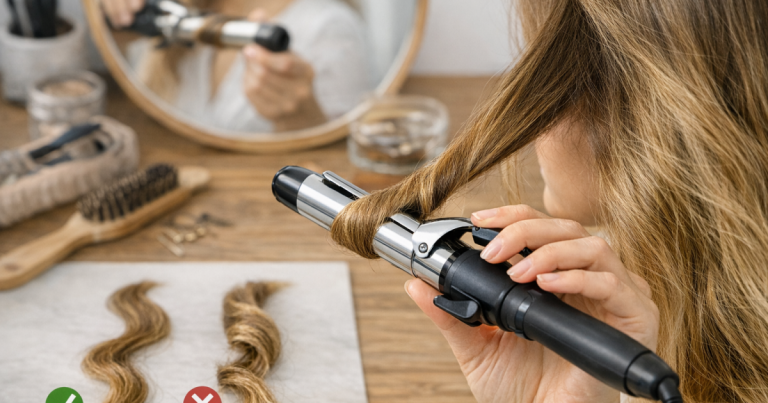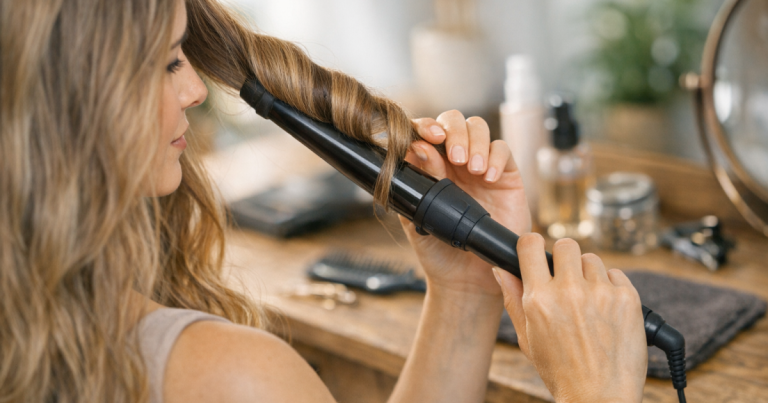
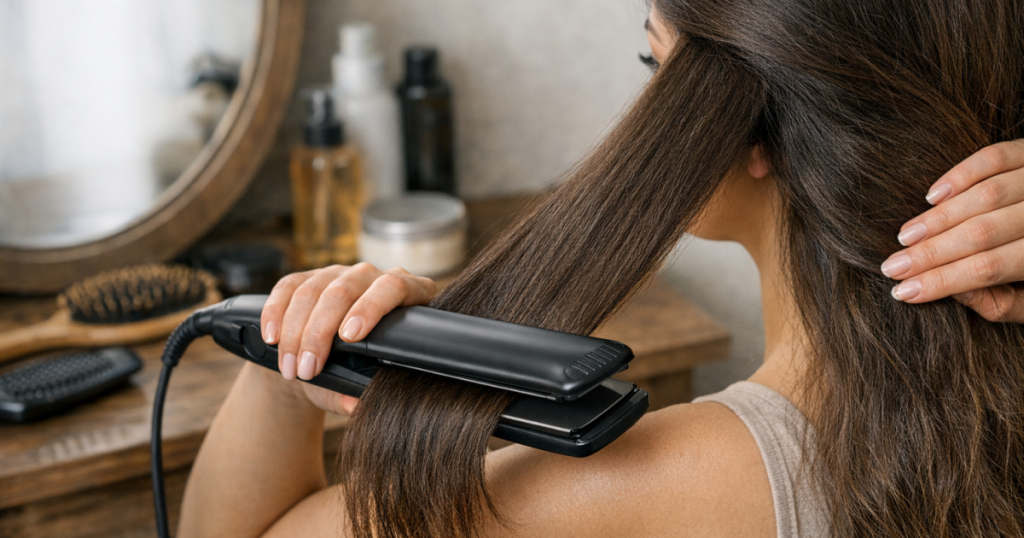
Thick hair usually needs tension, clean sectioning and the right pace rather than endless heat passes. Using a wide-plate straightener on thick hair should feel controlled: the aim is to smooth each section once or twice, not clamp down repeatedly until the hair gives in.
Wide plates can be brilliant for dense, coarse, long or high-volume hair, but they are less forgiving around roots, fringes and short layers. The technique below keeps the speed advantage while reducing the risk of bulky roots, flattened ends or that slightly puffy finish that appears half an hour later.
At a glance
- Start with fully dry, detangled hair; damp patches can steam and roughen the finish.
- Work in narrower sections than the plate width suggests, usually around 3–5 cm wide and not too thick.
- Use firm, even tension with a brush or comb ahead of the plates.
- Move slowly enough for one smooth pass, but do not pause on one spot.
- Leave the ends slightly bevelled or curved so thick hair does not look blocky.
- Use heat protection and choose the lowest effective heat setting for your hair’s condition and texture.
Why wide plates behave differently on thick hair
A wider straightener covers more surface area, which is why it can feel faster on long, dense hair. The trade-off is manoeuvrability. Wide plates do not get as close to tight root areas as narrow plates, and they can make shorter face-framing pieces feel awkward if you try to style them the same way as the back sections.
Thick hair also hides uneven work. A top layer can look sleek while the underneath still holds bend, bulk or humidity-triggered puffiness. That is why sectioning matters more than simply choosing a hotter setting. If your hair is coarse, wavy, curly or naturally expansive, think in layers: underneath first, then mid-sections, then the visible canopy.
Hair pattern matters too. Type 1 thick hair may need smoothing mainly for bulk and polish, while Type 2 or Type 3 hair often needs more tension to stretch bends evenly. If you are not sure how your curl pattern affects tool choice, the Type 1 to 4 hair styling tool guide is a useful next read.
Step 1: prep the hair so the plates glide
Start with clean, fully dry hair or hair that has been blow-dried smooth enough to section easily. A wide plate should glide in a steady movement; if it snags, your prep is not finished. Detangle from ends to roots with a brush or wide-tooth comb, then part the hair where you actually want it to sit.
Apply a heat protectant before straightening, focusing on mid-lengths and ends rather than soaking the roots. Give sprays time to dry down before using the tool. Straightening over wet-feeling product can make the hair drag, steam or turn slightly stiff. For a deeper look at this prep step, see the GHD Bodyguard Heat Protect Spray review, which explains what to check before using protection under straighteners.
If your hair expands easily, avoid loading it with heavy oil before straightening. A small amount after styling can soften the finish, but too much before heat can leave thick hair separated at the ends and greasy near the scalp.
Step 2: section smaller than you think
The biggest mistake with wide plates is taking sections that are wide and deep. The plates can cover the outside, but heat and tension may not reach the middle evenly. For thick hair, use sections that are roughly 3–5 cm wide and thin enough that you can see light through them when lifted. Very dense hair may need even slimmer horizontal slices around the nape and crown.
Clip the top layers away and begin underneath. Work from the nape upward, then move to the sides, then finish the top layer. Gentle sectioning clips are useful here because they keep bulk controlled without crushing newly smoothed pieces. If your hair is breakage-prone, avoid tight metal clips that pinch the same spot repeatedly.
For very thick hair, divide the head into four working zones: back left, back right, front left and front right. This keeps the process calmer and prevents the common problem of re-straightening sections because you have lost track of what has already been done.
Step 3: choose a sensible heat setting
Wide plates can feel more powerful because they contact more hair at once, but higher heat is not automatically better. Start lower than your maximum setting and increase only if the hair needs multiple passes to smooth. Fine-but-thick hair usually needs less heat than coarse, resistant hair. Bleached, highlighted or fragile ends also need a more cautious approach than healthy virgin hair.
As a practical check, one controlled pass should smooth the section without leaving it limp, rough or smoky-smelling. If you need three or four passes, reduce the section size before turning the temperature up. If your ends feel dry straight away, lower the heat and use a slower, more even glide.
With tools such as the ghd Max Wide Plate Hair Straightener or Remington Shine Therapy Wide Plate S8500, always check the current product information for available settings and use guidance, as ranges and features can vary by model and retailer listing.
Step 4: use tension, not pressure
Clamp firmly enough that the hair is held flat, but do not squeeze so hard that the plates drag. The smoothest finish comes from tension before the hair reaches the straightener. Place a brush or comb just below the roots, draw it through the section, and follow behind it with the plates.
Keep the section taut and angle it slightly away from the scalp. This gives you smoother roots without forcing the wide plates into an awkward position. Around the hairline, take smaller sections and use the edge of the plate carefully rather than trying to flatten a large chunk at once.
Move at a steady pace from roots to ends. For coarse or wavy thick hair, a slower single pass often looks better than several quick passes. Do not stop halfway down the section, as pausing can create dents or overheat one area.
Step 5: avoid flat, heavy ends
Thick hair can look blunt or triangular when wide plates are pulled straight down through the ends. To stop this, rotate your wrist slightly under for a soft bevel, or angle the plates away from the face for a looser, salon-style finish. The movement should be subtle; you are not curling the hair, just preventing a hard edge.
On long layers, over-straightened ends can make the shape look thinner even when the hair is dense. Keep the plates moving and reduce pressure over the final few centimetres. If the ends are dry, use a tiny amount of lightweight oil or serum after the hair cools, applied first to your palms and then skimmed over the surface.
Step 6: let the hair cool before judging the result
Thick hair often looks finished while it is still warm, then expands as it cools. After each larger zone, let the hair sit loose for a minute rather than brushing it immediately. Once cool, check the roots, underneath layers and crown in natural light if possible.
If you spot puffiness, do not redo the whole head. Isolate the area, take a thinner section and make one controlled pass with tension. Reworking already-smooth lengths is what often leads to dryness and a stiff finish.
Common problems and quick fixes
The roots still look bulky
Your sections are probably too deep, or the plates are not getting close enough with proper tension. Lift the section away from the scalp, comb through first, then follow with the straightener. For very dense roots, work in smaller horizontal slices.
The top looks smooth but the underneath is puffy
You may be straightening only the visible layer. Start at the nape and smooth every underneath section before releasing more hair. Thick hair needs structure, not random passes over the surface.
The finish goes frizzy after leaving the house
Humidity, product choice and hair condition can all play a part. If frizz appears quickly, think about whether your priority is smoothing, definition or volume before adding more heat. This breakdown on choosing what your hair needs first can help you adjust your routine.
The ends look too straight
Use less pressure over the last few centimetres and curve the plates slightly inwards or away from the face. Thick hair often needs a softened edge to look polished rather than pressed.
When a wide plate is not the easiest choice
A wide straightener is not always the most precise tool. If you have a short bob, a fringe, very short layers or lots of face-framing pieces, a narrower straightener may handle detail work better. You can still use the wide tool through the longer back sections, then switch to a smaller plate for the front if you own both.
Wide plates are also less suitable if your main aim is flicks, waves or root shaping. They can create a gentle bend, but they are not as nimble as a slim straightener or curling wand. For thick hair that is long and mostly worn sleek, though, the time saving can be significant when the technique is right.
Common questions
Should thick hair be straightened in bigger sections with a wide plate?
No. The plate can be wider, but the section still needs to be thin enough for even tension and heat contact. Wide, deep chunks usually leave hidden puffiness.
Is a wide-plate straightener on thick hair better than a standard straightener?
It can be better for long, dense hair because it covers more area, but a standard plate is usually easier for fringes, short layers and detailed root work.
How many passes should I use?
Aim for one slow, controlled pass or two at most on each section. If you need more, make the section thinner before increasing heat.
Can I use oil before straightening thick hair?
Use caution. Heavy oil before heat can make thick hair look separated or coated. A tiny amount after styling, once the hair has cooled, is usually safer for shine.
Why does my hair look smooth indoors but puff up outside?
The underneath may not be fully smoothed, or your hair may need better humidity control. Let each zone cool, check hidden layers and avoid brushing warm hair too soon.
What stands out
The best way to use a wide straightener on thick hair is to treat it as a smoothing tool, not a shortcut for huge sections. Prep thoroughly, section with discipline, use tension ahead of the plates and soften the ends so the result still has movement.
If your finish is not lasting, change one variable at a time: smaller sections, steadier pace, lighter product or better cooling time. Thick hair responds well to consistency, and the right method should leave it sleek without making it feel scorched, flat or overworked.