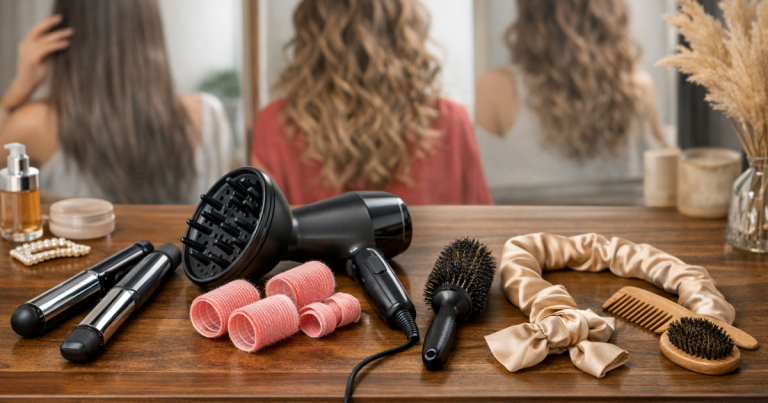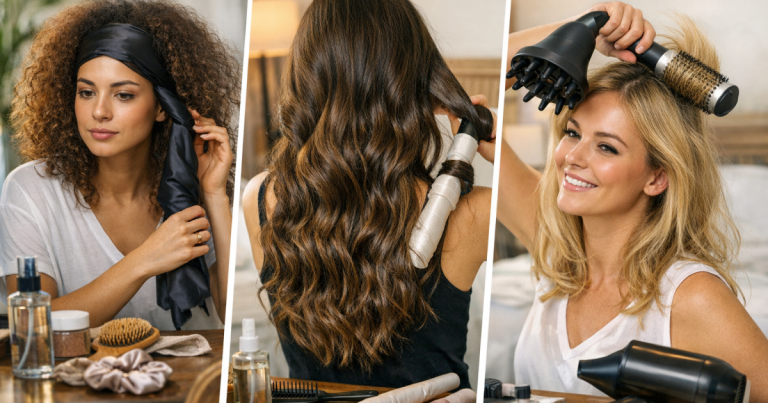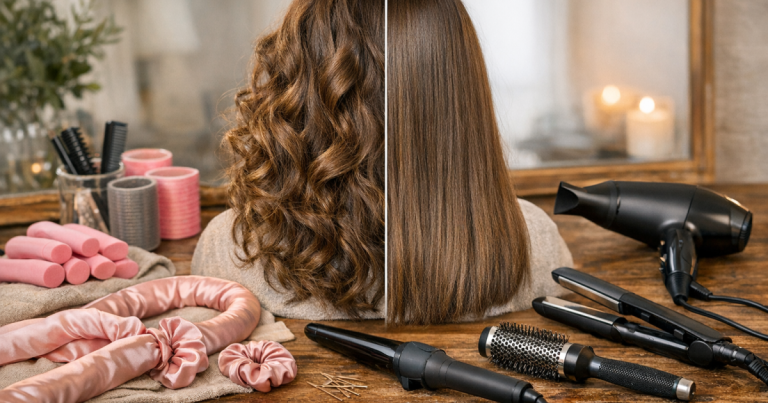
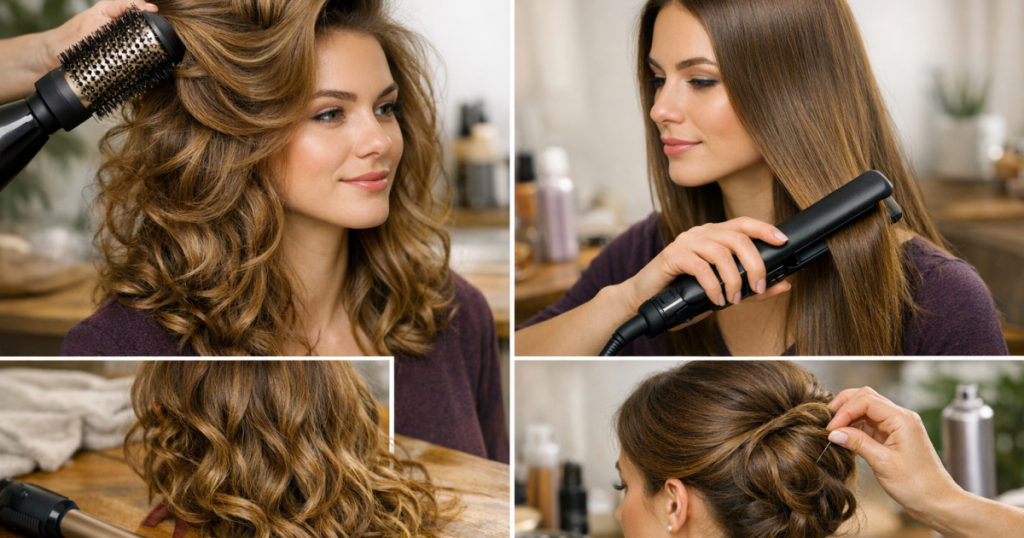
A tool can make hair look fuller, sleeker, bendier or longer-lasting, but those outcomes come from different mechanics. Understanding hair tool results helps you stop expecting one tool to do everything: a roller lifts, a brush stretches, a diffuser preserves pattern, and a wrap encourages bend without direct heat. Once you separate lift, shape, smoothness and hold, it becomes much easier to match your styling routine to your hair type, your finish, and how much effort you want to put in before leaving the house.
At a glance
- Lift is about root direction, drying position and how much support hair gets while it cools or sets.
- Shape comes from the curve you create through wrapping, rolling, twisting, brushing or scrunching.
- Smoothness depends on tension, cuticle alignment, moisture balance and how much the tool disturbs the hair surface.
- Hold is the result of preparation, setting time, cooling time, hair texture and finishing product, not just the tool itself.
- Hair type matters: fine hair usually needs lighter tension and less product; thick, coarse or curly hair often needs stronger sectioning and more controlled drying.
Why one tool rarely delivers every result equally
Most styling disappointment comes from asking a tool to perform outside its natural strength. A large hot brush can create a smooth, bouncy finish, but it may not give tight, long-lasting waves. A diffuser can encourage curl definition and reduce disruption, but it will not flatten hair in the way a brush with tension can. Heatless rollers can build softness and volume, but they rely heavily on prep, section size and setting time.
Think of every tool as having a main job and a secondary effect. Velcro rollers mainly support lift and soft shape. A paddle-style hot brush mainly smooths and stretches. Foam rollers create a rounded set, while a satin heatless curling rod gives a looser bend pattern. A diffuser helps curls keep their natural structure by drying without blasting the pattern apart.
The finish also changes depending on whether the hair is fine, dense, bleached, naturally coarse, wavy, curly or prone to humidity frizz. The same tool that gives airy lift on fine hair may produce puffiness on thick hair if the sections are too large or the root area is not controlled.
Lift: what creates volume at the root
Lift is not just “big hair”. It is the angle at which the root dries or sets. Hair that dries flat against the scalp will usually stay flat, even if the mid-lengths are curled. Hair that cools or sets with the root elevated has a better chance of holding volume.
The most reliable lift usually comes from three things: root direction, section size and cooling time. Lifting the section upwards or slightly overdirecting it away from where it naturally falls gives the root more height. Smaller sections are easier to control, especially on dense hair. Letting the hair cool in its lifted position helps the shape last longer.
For fine hair, lift works best when the tool is light and the product is not too heavy. Large Velcro rollers at the crown can give visible volume without compressing the hair. If you are working with this hair type, the step-by-step advice in using Velcro rollers for volume on fine hair is a useful next read because the technique is more important than simply adding more rollers.
For thick or coarse hair, root lift often needs more deliberate sectioning. Big sections may look efficient, but they can collapse because the tool cannot support the weight evenly. Focus on the crown, front hairline and any flat areas rather than trying to lift every section equally.
Shape: waves, bends, curls and flicks are not the same
Shape describes the visible curve in the hair. A wave has a looser S-pattern, a curl has more rotation, a bend is softer and less uniform, and a flick is usually created at the ends or around the face. Different tools create different kinds of shape because they hold the hair at different angles.
- Rollers create rounded shape because the hair wraps around a barrel and sets in that curve.
- Heatless curling rods create a spiral or ribbon-like bend depending on how tightly the hair is wrapped.
- Hot brushes create bevelled ends, soft bounce and gentle curve rather than defined curls.
- Diffusers enhance the hair’s existing wave or curl pattern instead of imposing a new one.
- Straighteners used with a turn can create waves, but the result depends heavily on wrist angle and tension.
Fine hair tends to show shape quickly but lose it just as quickly if the section is too silky, overconditioned or not allowed to cool. Thick hair may take longer to form a bend, but once it is properly set, the shape can be more substantial. Curly hair often needs less imposed shape and more pattern protection, so scrunching, diffusing and avoiding rough brushing can matter more than wrapping every section into a new form.
Smoothness: the difference between sleek, soft and puffy
Smoothness is about how aligned the hair surface looks. It does not always mean poker-straight. Smooth waves, polished curls and soft blow-dry bounce can all look smooth if the cuticle is lying neatly and the hair has not been roughed up during styling.
Tension is the key difference. A brush that holds the hair firmly while warm air passes through can stretch texture and reduce visible frizz. A roller smooths by wrapping the hair neatly and allowing it to set. A diffuser does the opposite: it avoids too much tension so curls are not pulled out or made fluffy.
Frizz-prone hair needs controlled handling. Brushing dry waves can create a halo, while overworking damp curls can disturb clumps before they set. Coarse hair may need slower styling in smaller sections, while fine hair may become limp if too much oil or smoothing cream is added before using a tool.
If your smooth blow-dry attempts keep turning into width rather than polish, the technique in using a hot brush without making hair puffy explains why direction, section tension and finish choice can make such a noticeable difference.
Hold: why the style drops even when the tool worked
Hold is often blamed on the tool, but it is usually a combination of hair condition, prep, cooling or setting time, and the environment. A curl can look perfect for ten minutes and still drop if it was brushed out too soon, set in a section that was too large, or overloaded with a softening product.
Hair holds shape best when it has a little grip. Very freshly conditioned hair can feel beautiful but may be too slippery for rollers or heatless wraps. On the other hand, dry, porous or heat-damaged hair can grab shape unevenly, giving frizz at the ends and collapse at the root. The balance is to create enough control without making the hair stiff.
Cooling matters with heated tools because hair is more flexible when warm. Removing a roller, brush or curl before the section has cooled can soften the result immediately. Heatless styling follows a similar principle, but the “set” comes from time, mild dampness, product memory and the hair drying or settling into a new position.
Humidity also changes hold in the UK, particularly for porous, coloured, bleached, wavy and curly hair. A style that lasts indoors may swell outside on a damp day. That does not mean the tool failed; it means the finish needs realistic support from prep, drying and a suitable finishing layer.
Hair-type notes: matching the result to your texture
Fine or flat hair
Fine hair usually benefits from lightweight tools and minimal product. Prioritise lift at the root before shaping the ends. Large rollers, gentle root direction and a light finishing mist tend to work better than heavy creams or repeated brushing. Avoid making sections too big, as fine hair can slip out of shape when unsupported.
Thick or coarse hair
Thick and coarse hair often needs patience more than force. Smaller sections, steady tension and enough time for the hair to dry, cool or set will usually give a better result than rushing through large panels. The aim is control, not flattening every bit of natural body. For tool suitability by density, styling tools that cope with thick and coarse hair goes deeper into what tends to work in real routines.
Wavy and curly hair
Wavy and curly hair needs a clearer decision: are you enhancing the natural pattern or reshaping it? Diffusing, scrunching and gentle drying preserve texture. Rollers and heatless rods redirect it. Brushes and smoothing tools stretch it. Trying to do all three at once often creates frizz, uneven shape or a finish that feels neither curly nor polished.
Frizz-prone or damaged hair
Frizz-prone hair usually needs less disturbance. Smooth the surface while the hair is damp, avoid rough towel drying, and choose tools that do not require repeated passes. Damaged ends may not hold a clean shape because the surface is uneven, so a trim, conditioning routine and gentler styling method can make tools perform better.
Common result mix-ups
- “I want volume” but the real goal is lift. Backcombing and texture can add size, but root lift gives cleaner height.
- “I want curls” but the reference photo shows waves. Use larger sections, looser wrapping and less rotation for a softer bend.
- “I want smooth hair” but not flat hair. Use tension through the mid-lengths while keeping some root elevation.
- “My style will not hold” but the hair is too soft. Reduce heavy conditioning before styling and allow the set to fully cool or dry.
- “My curls look frizzy” but the tool is breaking the pattern. Switch from brushing to scrunching, diffusing or finger placement where possible.
Choosing the finish before choosing the tool
The most useful question is not “which tool is best?” but “what finish am I trying to create?” A polished finish needs control and alignment. A textured finish needs grip and separation. A natural finish needs support without over-shaping. Those goals can overlap, but one should lead the routine.
For example, a polished bouncy blow-dry needs smooth roots, curved ends and a controlled surface. A relaxed heatless wave needs shape and softness, but not necessarily high shine or strong root lift. A natural curly finish needs definition and hold without stretching the curl pattern too much. If you like switching between these moods, the guide to choosing tools by polished, textured or natural finish can help you organise your routine by outcome rather than by tool type.
FAQ
Why does my hair look good at first and then drop?
The section may not have cooled, dried or set fully before you released it. Heavy conditioner, large sections and damp weather can also soften the result quickly.
Can heatless tools give the same hold as heated tools?
They can give lasting shape, but they rely more on time, prep and section control. Heated tools change shape faster; heatless tools usually need longer setting time.
Why does my hot brush make my hair puffy?
Puffiness usually comes from too-large sections, not enough tension, brushing against the natural fall, or stopping before the hair is fully dry and smooth.
What matters more: the tool or the product?
The tool creates direction and shape; product supports grip, smoothness and longevity. If either one is wrong for your hair type, the result will be less reliable.
Should curly hair be smoothed before shaping?
Only if you want a more polished or stretched result. If you want to keep natural curl definition, shape the curls by scrunching, diffusing or setting without brushing the pattern apart.
Key takeaways
Lift, shape, smoothness and hold are separate results, even though one routine can include all four. Root angle creates lift, wrapping or brushing creates shape, tension and surface control create smoothness, and cooling or setting time supports hold. The more clearly you define the finish first, the easier it is to choose the right styling method and avoid blaming a tool for a result it was never designed to deliver.