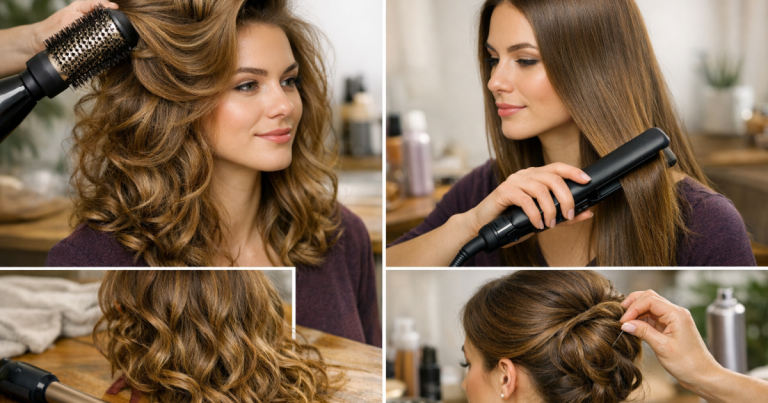
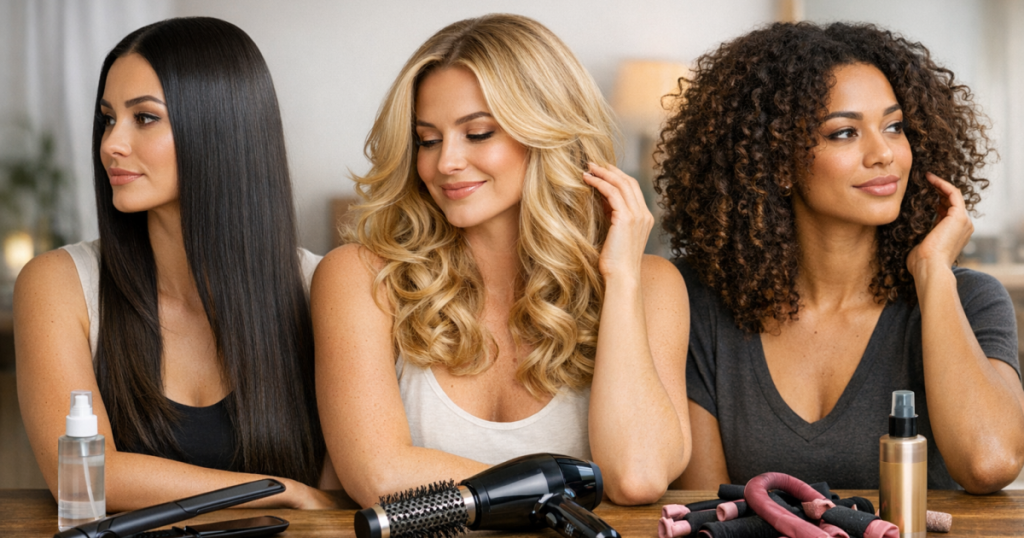
A good hairstyle starts less with the tool and more with the finish you want. For most people, choosing the right styling method comes down to three outcomes: sleek, bouncy or textured. Each needs a different balance of prep, tension, drying time, hold and movement, and the best route changes noticeably between fine, thick, curly, wavy and high-density hair.
The mistake is treating every styling goal as though it needs the same routine with a different attachment. Sleek hair usually needs alignment and frizz control. Bouncy hair needs lift, curve and lightness. Textured hair needs definition without making the shape too neat. Once you know which finish you are aiming for, it becomes much easier to decide whether to air-dry, wrap, roll, diffuse, brush, smooth or use controlled heat.
The short version
- Choose sleek when you want polish, shine, reduced frizz and a more uniform surface.
- Choose bouncy when you want root lift, curved ends, soft movement or a salon-blow-dry effect.
- Choose textured when you want separation, undone waves, curl definition or visible shape rather than smoothness.
- Fine hair usually needs lighter prep, less product and methods that preserve volume.
- Thick or high-density hair needs sectioning, drying control and enough hold to stop the style collapsing.
- Curly and coily hair often benefits from definition-first styling, then selective stretching or shaping if a sleeker finish is wanted.
Start with the finish, not the appliance
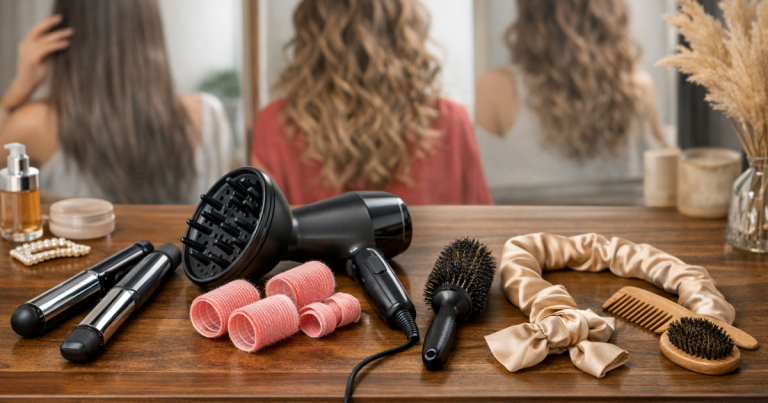
Hair tools are often marketed around speed, shine or volume, but your hair does not respond to marketing categories. It responds to water, tension, product, temperature, airflow and time. A round brush, rollers, a silk wrap and a diffuser can all be useful, but only if they support the finish you actually want.
Sleek styling relies on the cuticle lying flatter. That can come from tension while drying, wrapping hair while it cools, a smoothing brush, a silk hair wrap overnight, or a controlled heated pass if the hair can tolerate it. Bouncy styling relies on shape memory: hair is lifted, curved and allowed to cool or dry in that shape. Textured styling relies on separation and pattern, so scrunching, twisting, plopping, diffusing or heatless wave-setting often makes more sense than brushing everything smooth.
Your natural texture and density matter as much as the desired finish. If you are unsure why a method works beautifully for someone else but falls flat on you, it is worth reading about how hair texture and density affect brushes, dryers and rollers. The same tool can behave completely differently on fine, low-density hair than it does on coarse, high-density hair.
When a sleek finish makes the most sense
Sleek hair is not the same as flat hair. A good sleek style looks controlled, glossy and intentional, with the surface aligned and flyaways reduced. It is a strong choice when your outfit or occasion calls for polish, when humidity has made the hair look fuzzy, or when your cut has sharp lines that look best with a clean finish.
For straight or slightly wavy hair, sleekness often starts with drying direction. Aim the airflow down the hair shaft, use a brush that gives enough tension without snagging, and work in manageable sections. A lightweight smoothing cream or serum can help, but too much product can make fine hair look oily before the style has even settled.
For curly hair, a sleek finish usually needs more preparation. That might mean stretching the hair first, smoothing in smaller sections, or choosing a low-tension style such as a wrapped bun, polished ponytail or silk-scarf set rather than forcing the hair completely straight. The aim is not to fight the hair at all costs; it is to decide how much natural texture you want to soften.
Sleek methods are best for frizz control and shine, but they can reduce visible volume. If your hair is fine or sparse around the hairline, keep lift at the crown and avoid heavy oils near the roots. If your hair is thick, do not rush the drying stage: hair that feels smooth outside but is still damp inside can swell later and lose the finish.
When bounce is the better goal
Bouncy styling sits between sleek and textured. It needs smoothness, but not so much control that the hair becomes stiff. The easiest way to recognise a bouncy finish is movement: the roots lift, the mid-lengths curve and the ends sit with shape rather than hanging straight down.
For fine hair, bounce usually comes from lightweight volume. Velcro-style rollers, a round brush, root clips or a heatless curling rod can work well if the hair is allowed to cool or dry fully before being released. The biggest risk is overloading the hair with product. A small amount of mousse at the roots or a light styling spray through the lengths is often more effective than rich creams.
For thick hair, bounce needs more structure. Large sections may look quick, but they often leave the underneath damp or shapeless. Smaller sections, longer setting time and a clip to hold each curve while it cools can make the difference between a style that drops after an hour and one that keeps its movement.
For wavy hair, bounce can be encouraged rather than manufactured. Scrunching in a light foam, diffusing the roots, then setting the face-framing pieces in rollers can give lift without brushing away the natural wave pattern. For curly hair, bouncy styling may mean enhancing spring and shape rather than creating a blow-dry effect. Curl clumps, root lift and controlled drying matter more than making every section identical.
When textured hair looks more modern
Textured styling is about visible movement. It can be soft and beachy, defined and curly, piecey and undone, or full and fluffy. The common thread is that the hair is not polished into one smooth sheet. Texture works especially well with layered cuts, natural waves, curls, shags, fringes and styles where volume is part of the look.
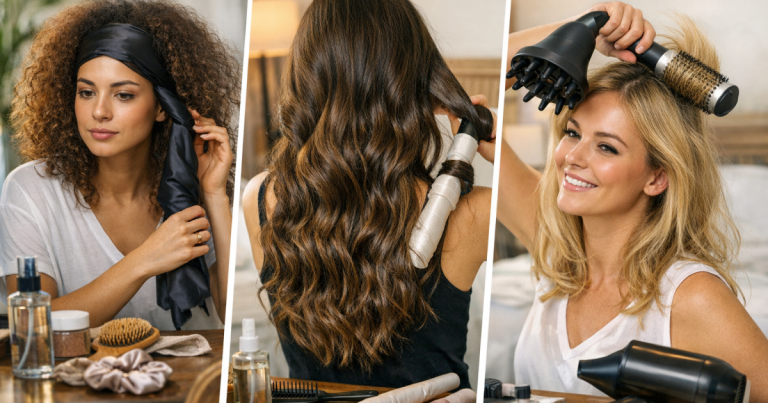
Heatless texture often starts while the hair is damp. Braids, twists, a satin heatless curling rod, finger-coiling, plopping or scrunching can all create shape without relying on high temperatures. The right method depends on how uniform you want the result. Braids tend to create a more crimped pattern, twists give softer bends, and curling rods create a more rounded wave.
If you already have waves or curls, avoid brushing through once the pattern has formed unless your goal is fluffy volume. A detangling brush is most useful before styling or in the shower with conditioner; after drying, fingers or a wide-tooth comb usually preserve the texture better. A tiny amount of oil or serum through the ends can break up stiffness, but too much can collapse the shape.
Textured styles are forgiving, but they are not product-proof. Heavy creams can weigh down fine waves, while very light sprays may not give coarse or high-density curls enough control. Think in terms of support: fine hair needs grip and light hold, thick hair needs definition and drying time, and curly hair needs enough moisture to prevent frizz without losing spring.
Heatless, heated or a mixture?
The most realistic answer is often a mixture. Heatless methods are excellent when you want to reduce heat exposure, style overnight, preserve hair condition or create soft shape without a full blow-dry. Heated methods are useful when you need speed, stronger smoothing, longer-lasting shape on resistant hair, or a more controlled finish for a specific occasion.
A heatless routine can be enough for loose waves, soft curls, root lift, overnight smoothing and gentle volume. It works best when the hair starts slightly damp rather than wet, because fully wet hair may not dry completely in a wrapped or rolled shape. If your hair is dense, give it more drying time before setting, or focus the heatless method on the top layers and face-framing sections.
Heated styling becomes more useful when the hair is very frizz-prone, coarse, resistant to shape or needed quickly. The key is not using heat by default. Use the lowest effective temperature, avoid repeated passes on the same section and let the hair cool in the shape you want. Heat creates the change; cooling helps lock it in.
If you are building a routine around hair type rather than one-off results, the site’s guide to heatless routines for fine, thick and curly hair gives more specific examples of how to adapt the same styling goal to different textures and densities.
Match the method to your hair type
Fine or low-density hair
Fine hair often looks best when the method protects lift. For sleek styles, keep the roots airy and smooth mainly through the mid-lengths and ends. For bounce, use larger rollers or soft bends rather than tight curls that can look sparse when brushed out. For texture, choose lightweight foam, mist or salt-free texturising products if your hair dries out easily. Avoid heavy oils near the scalp.
Thick or high-density hair
Thick hair needs patience and sectioning. Sleek styles require proper drying through the inner layers, not just surface smoothing. Bouncy styles need enough time in rollers, clips or a brush-set shape to make the result last. Textured styles work well when the hair is divided into sections before product is applied, so the underneath is not left undefined.
Wavy hair
Wavy hair can go in almost any direction, which is useful but also confusing. If you brush it smooth, it may behave like straight hair with frizz. If you scrunch it, it may reveal more pattern. For sleekness, dry with tension and finish with a smoothing step. For bounce, lift the roots and set the ends. For texture, apply product to damp hair and avoid disturbing the wave until it is dry.
Curly and coily hair
Curly and coily hair usually responds best when moisture, definition and shrinkage are considered before the finish. A sleek look may mean a stretched style, a smooth updo or a wrap rather than full straightening. A bouncy look may mean defined, springy curls with volume at the roots. A textured look may mean twist-outs, braid-outs, wash-and-go definition or picked-out volume. The right choice is the one that respects the curl pattern while giving the finish you want.
Why the same style drops, frizzes or stiffens
If a sleek look turns puffy, the hair was probably not dry enough, the product was too light for the humidity, or the method did not create enough alignment. If a bouncy look drops, the sections may have been too large, the hair may not have cooled properly, or the products may have been too heavy. If textured hair becomes crunchy, the hold product may need breaking up once dry, or you may need a softer layering of leave-in and gel.
Timing matters too. Hair styled from soaking wet can take too long to set, especially in rollers or wraps. Hair styled when bone dry may not reshape well without heat or a light misting. The most workable point for many heatless styles is slightly damp: enough moisture to reset the shape, not so much that the hair is still wet hours later.
For a broader view of when heatless or heated styling makes more sense by goal, the comparison of heatless and heated styling for curls, waves and volume is a useful next step.
What to remember
Sleek, bouncy and textured are not just aesthetic labels; they are different styling strategies. Sleek needs alignment and control. Bouncy needs lift, curve and cooling time. Textured needs pattern, separation and the right level of hold. Your hair type decides how much tension, product, drying time and heat each strategy needs.
If your current routine is unreliable, do not replace every tool at once. Change one variable: use smaller sections, reduce product, add drying time, switch from brushing to scrunching, or let the hair cool before touching it. Small adjustments often make a bigger difference than buying a more complicated tool.
The best at-home method is the one that gives the finish you want without making your routine harder than it needs to be. Start with the result, respect your texture and density, then choose the gentlest method that can realistically hold the shape.