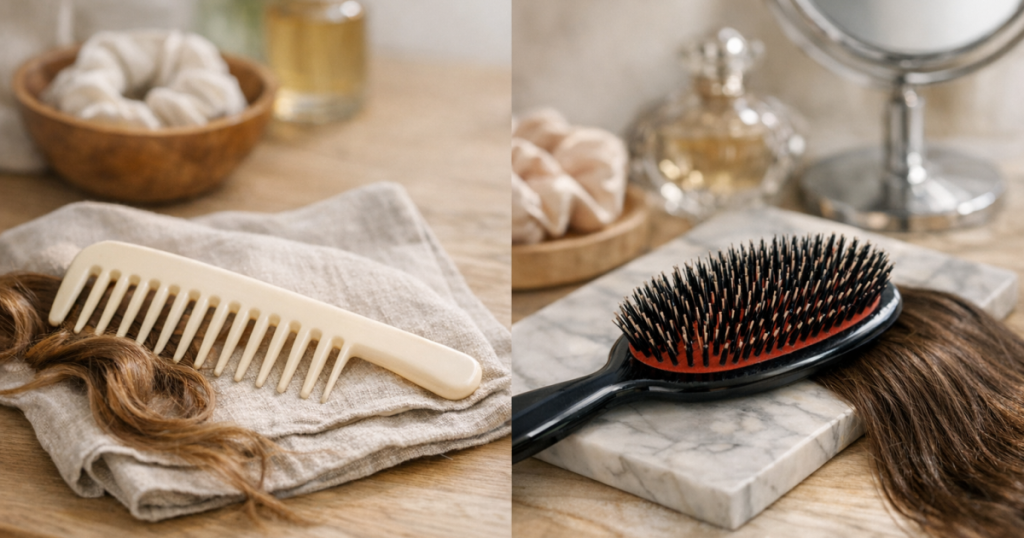
The awkward part of choosing between these two tools is that they solve almost opposite problems. Cricket vs Mason Pearson is really a choice between low-tension detangling and high-polish finishing, so the better buy depends less on prestige and more on your hair texture, porosity, density and preferred finish.
For clarity, this comparison treats the Cricket Ultra Smooth Wide Tooth Comb as a wide-tooth detangling comb and a Mason Pearson Handy Bristle Hair Brush as the representative boar-bristle finishing brush. Mason Pearson offers different sizes and bristle mixes, so always check the exact model before buying, particularly if you need pure bristle rather than a bristle-and-nylon mix.
Main points
- Choose the Cricket comb if your priority is gentle detangling, conditioner distribution, curl clumping, wash-day control or a low-cost everyday tool.
- Choose a Mason Pearson boar bristle brush if your hair is already detangled and you want dry styling polish, smoother roots, natural shine and a more refined finish.
- For curly, coily, fragile or heavily textured hair, the wide-tooth comb is usually the safer first purchase because it works with the hair pattern rather than brushing it out.
- For fine to medium straight or softly wavy hair, the Mason Pearson can feel like a luxury finishing upgrade, provided you do not expect it to replace a detangler.
- Most routines do not need both immediately. Buy the tool that fixes your biggest daily problem first: knots and snagging, or dullness and flyaways.
What each tool is actually for
The Cricket Ultra Smooth Wide Tooth Comb is a simple tool, but that is the point. Wide-spaced teeth move through hair with less compression than a dense brush, which makes it useful for detangling damp hair, spreading conditioner, loosening knots from ends to roots and preserving wave or curl groupings. It is not trying to create a glassy blow-dry finish on its own. Its strength is control with minimal disruption.
A Mason Pearson boar bristle hair brush sits in a different part of the routine. It is a finishing and polishing tool rather than a first-pass detangler. Boar bristles can help smooth the outer surface of the hair, distribute natural oils from the scalp through the lengths and soften the look of flyaways on dry hair. That can be lovely on hair that tolerates brushing, but frustrating on hair that loses definition as soon as a brush goes through it.
If you are not sure whether your hair behaves more like fine straight hair, loose waves, springy curls or dense coils, start by checking how to identify your hair type before buying styling tools. The wrong brush is not always a bad product; often, it is just being asked to do the wrong job.
Side-by-side comparison
- Main purpose: the Cricket comb is best for detangling, sectioning and product distribution. The Mason Pearson is best for dry smoothing, shine and a polished finish.
- Best stage of routine: the comb makes most sense on damp hair, wet-conditioned hair or carefully sectioned dry hair. The boar bristle brush is usually better on dry, already-detangled hair.
- Tension level: a wide-tooth comb can be used with low tension when you work from the ends upwards. A dense bristle brush can create more surface friction if forced through knots.
- Effect on texture: the comb tends to preserve waves, curls and coils better. The Mason Pearson can soften, stretch or brush out natural pattern, which may be helpful for a sleek finish but unhelpful for definition.
- Shine potential: the Mason Pearson has the advantage for dry-hair polish. The Cricket comb can help distribute conditioner or treatment, but it does not buff the hair in the same way.
- Scalp feel: a cushioned bristle brush may feel luxurious if your scalp enjoys brushing. A wide-tooth comb is usually easier to keep light and targeted, especially around tender areas.
- Travel and wash-day practicality: the comb is low-fuss, easy to rinse and simple to throw into a gym bag or wash-day kit. A premium bristle brush needs more careful cleaning and storage.
- Cost decision: the Cricket comb is the more accessible buy. A Mason Pearson is a premium purchase, so check the current £ price from UK retailers and make sure the specific model suits your hair before committing.
Where the Cricket Ultra Smooth Wide Tooth Comb wins
The Cricket comb is the more forgiving tool for anyone whose hair knots easily, tangles after washing or needs products worked through without collapsing the pattern. It gives you space between the teeth, which matters because hair does not get squeezed into a dense bristle bed before the knots have been released.
For wavy hair, it can separate tangles after conditioner while still leaving enough grouping for a natural wave pattern. For curly hair, it can help distribute leave-in conditioner or styling cream through sections without turning the shape into a cloud of frizz. For coily hair, it can be useful when paired with water, conditioner and patient sectioning, though very tight textures may still prefer fingers first before introducing any tool.
It also makes sense for low-porosity hair when product tends to sit on the surface. A wide-tooth comb can help spread a lightweight conditioner or leave-in evenly without overloading the roots. For high-porosity or fragile hair, the benefit is different: you can control tension more carefully, work in smaller sections and stop as soon as a snag appears.
The trade-off is finish. A wide-tooth comb will not give the same glossy, groomed look as a bristle brush on dry hair. It may leave fine straight hair looking separated rather than polished, especially if you use it after styling. If your main complaint is lack of shine rather than tangling, the comb may feel too basic on its own.
For a deeper look at this exact tool, the Cricket Ultra Smooth Wide Tooth Comb review is a useful next read before deciding whether it earns a place in your wash-day routine.
Where the Mason Pearson boar bristle brush stands out
The Mason Pearson appeal is all about the finish. On suitable hair, a boar bristle brush can make dry hair look more groomed with very little styling effort. It is the kind of tool people reach for when their hair is technically styled but needs softening, smoothing or a more expensive-looking surface.
Fine to medium straight hair is often the easiest match. Once tangles are removed, brushing from roots through lengths can help distribute natural oils and reduce the look of piecey flyaways. Soft waves can also benefit if the goal is a brushed-out, romantic finish rather than separated wave definition.
It can be helpful for second-day hair too. If roots look slightly flat but lengths look dry, a boar bristle brush may rebalance the finish better than adding more product. That said, the result depends on your scalp, your hair’s oil level and the styling products already in your hair. If your roots get oily quickly, too much brushing can make hair look heavier rather than fresher.
The weakness is detangling. A Mason Pearson bristle brush should not be your first move on wet knots, dense curls or matted ends. If the hair is not already smooth enough for the bristles to glide, you can create pulling, frizz and breakage. It is also less intuitive for people who style for curl definition, because brushing after drying usually separates the curl pattern.
Hair-type guidance: which one is likely to suit you?
Straight hair
Straight hair can benefit from both tools, but for different reasons. If it is fine, slippery and tangles at the nape, start with the Cricket comb for gentle detangling after washing. If it is already easy to detangle but looks dull or fluffy, the Mason Pearson is the more tempting upgrade. Very fine hair may need a light hand with bristle brushing to avoid flattening the roots.
Wavy hair
For waves, think about whether you prefer definition or softness. The Cricket comb is better when you want to keep waves grouped, distribute leave-in conditioner or prep for heatless styling. The Mason Pearson is better when you deliberately want a brushed-out, smooth, vintage-inspired or softly undone finish. It may reduce definition, so it is not the tool to use right before expecting crisp waves.
Curly hair
Curly hair usually gets more everyday value from the wide-tooth comb. It allows detangling with conditioner, sectioning and product distribution while keeping some curl structure intact. A boar bristle brush can still have a role for slicked-back styles, smoothing the top layer or polishing stretched hair, but it is rarely the best daily detangler for curls.
Coily hair
Coily hair needs the most caution with dense brushing. The Cricket comb is the more compatible option when used slowly, in sections and with slip. Many coily routines still start with finger detangling, then use a wide-tooth comb only once the largest knots are released. A Mason Pearson may be useful for smoothing edges or finishing stretched styles, but it is not the first tool most coily-haired readers should buy for detangling.
Fragile, colour-treated or bleached hair
Fragile hair needs low tension above all. The Cricket comb gives you more control because you can stop at each knot and work gradually. A boar bristle brush may add polish, but only once the hair is dry, detangled and not overloaded with sticky styling product. If your ends feel rough or elastic when wet, prioritise gentle detangling and conditioning before chasing shine.
How they fit into a heatless styling routine
For heatless styling, the Cricket comb is the more versatile prep tool. Before using a satin heatless curling rod, Velcro hair rollers or a silk hair wrap, you generally need smooth sections without ripping through the hair. A wide-tooth comb helps create those sections while preserving enough moisture and product distribution for the style to set more evenly.
The Mason Pearson is more of a finishing tool after the style has formed. For example, if heatless waves look too separated or fluffy, a light pass with a bristle brush can soften the finish. The risk is overbrushing. Too many passes can turn waves into frizz or flatten the shape you worked to create overnight.
If your main styling goal is frizz control, shine or definition, tool choice becomes much easier once you decide which finish you actually want. The guide to matching styling tools to frizz, shine and definition is a helpful companion because it separates finish goals that often get confused.
Common mistakes that make either tool disappointing
- Using the Mason Pearson as a wet detangler: boar bristle brushes are not designed to plough through wet knots. Detangle first with fingers or a wide-tooth comb.
- Starting at the roots with the comb: even a gentle comb can cause pulling if you drag knots down the hair shaft. Start at the ends and move upwards.
- Expecting one tool to do every job: detangling, smoothing, root lift, curl definition and shine are different goals. No single comb or brush does all of them equally well.
- Brushing curly hair after it has dried: this can work for a deliberately fluffy or stretched finish, but it will usually reduce definition.
- Ignoring product build-up: oils, creams and hairspray can collect on both tools. A comb is easy to rinse; a bristle brush needs more careful cleaning so residue does not transfer back onto clean hair.
- Buying the premium brush without checking the model: Mason Pearson brushes vary by size and bristle type. Make sure the version you are considering matches your hair density and styling aim.
Things readers ask
Can a Mason Pearson boar bristle brush replace a wide-tooth comb?
Usually, no. A Mason Pearson is better as a dry finishing brush, while a wide-tooth comb is better for releasing tangles and distributing conditioner. If your hair knots after washing, keep the comb in your routine.
Is the Cricket comb better for curly hair?
For most curly routines, yes. It is easier to use with conditioner, works well in sections and is less likely to destroy curl clumps than dense brushing. Use it gently from ends to roots.
Will a boar bristle brush make hair shinier?
It can make suitable dry hair look shinier by smoothing the surface and spreading natural oils. It works best on hair that is already detangled and not too curly, coated or fragile.
Which tool is better for frizz?
It depends on the cause. If frizz comes from rough detangling or disrupted curls, the Cricket comb is the better fix. If frizz is mainly surface flyaways on straight or softly wavy hair, the Mason Pearson may help polish them down.
Do I need both tools?
You might, but not immediately. Buy the Cricket comb first if knots, wash-day control or curl definition are the problem. Consider the Mason Pearson later if your routine still lacks dry-hair smoothness and shine.
The practical decision
The Cricket Ultra Smooth Wide Tooth Comb is the more sensible first buy for most textured, curly, coily, fragile, long or tangle-prone hair. It is practical, easy to clean, simple to use with conditioner and flexible enough for heatless styling prep. It solves the daily problem that can make the rest of your routine harder: getting hair detangled without unnecessary pulling.
A Mason Pearson boar bristle hair brush makes more sense when your detangling routine is already sorted and your main frustration is the finish. If your hair is straight, fine to medium, softly wavy or worn in smoothed styles, it can be a beautiful upgrade for dry polishing. Treat it as a finishing investment, not as a replacement for a detangling tool.
If you are choosing only one, match it to the moment your routine usually fails. Knots, conditioner distribution and curl-friendly prep point to the Cricket comb. Dullness, flyaways and dry-hair polish point to the Mason Pearson. That single distinction will save you more money and frustration than buying the tool with the most prestige.
Quick Buying Links
Cricket Ultra Smooth Wide Tooth Comb
For clarity, this comparison treats the Cricket Ultra Smooth Wide Tooth Comb as a wide-tooth detangling comb and a Mason Pearson Handy Bristle Hair Brush as the representative boar-bristle finishing brush.
Mason Pearson Boar Bristle Hair Brush
A Mason Pearson boar bristle hair brush sits in a different part of the routine.