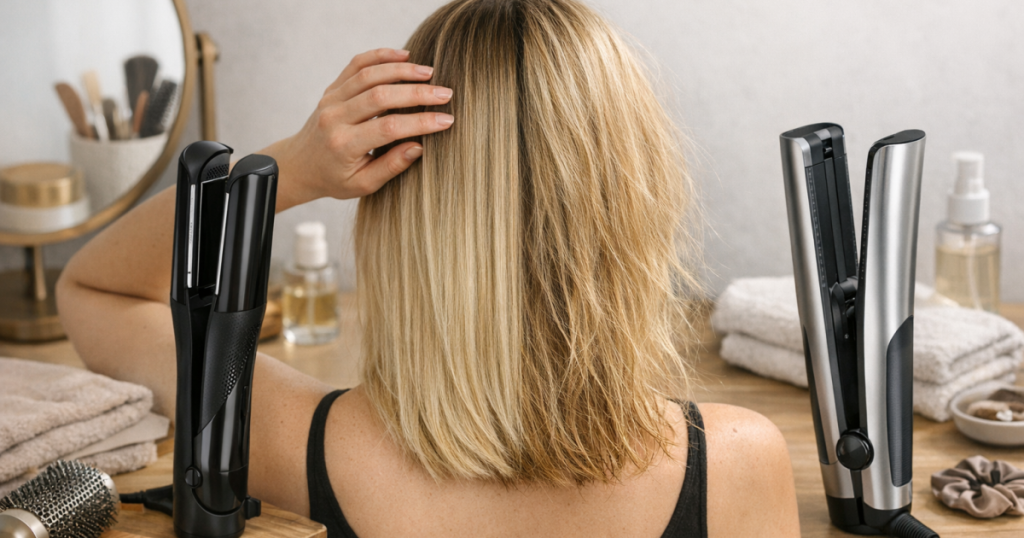
Fine hair can make premium wet-to-dry tools feel risky: the wrong choice leaves roots flat, ends fuzzy or lengths overworked. Duet Style vs Airstrait is really a question of plate-assisted polish versus airflow-led straightening, and the better buy depends on how fine your hair is, how much density you have, and whether you want a sleek finish or softness with a little movement.
Both tools are designed to take hair from damp to styled, but they do not treat fine hair in the same way. One leans closer to the feel of a traditional styler with drying built in; the other uses directed airflow to stretch and smooth without hot plates. For fine hair, that difference matters more than the headline promise.
At a glance
- ghd Duet Style is the stronger pick if your fine hair needs a polished, straighter finish and you like the control of a styler-style shape.
- Dyson Airstrait is the better fit if your priority is reducing direct hot-plate contact and keeping fine hair feeling airy rather than pressed.
- Very fine or low-density hair can look flatter with either tool if you pull too tightly from the roots or use too much smoothing product.
- Fine but frizz-prone hair may prefer the GHD for sleekness, while fine colour-treated or fragile hair may prefer the Dyson’s airflow-led approach.
- Neither is a true volume tool. If lift, bend or waves are the main goal, a hot brush, rollers or a heatless option may make more sense.
If you are still deciding between sleekness, volume, curls and lower-heat routines, the broader guide to best hair styling tools by goal and hair type is a useful next step once you know what finish you actually want.
How the two tools approach fine hair
The GHD Duet Style combines airflow with heated styling plates, so it feels more familiar if you already use straighteners. On wet hair, it dries and smooths in one process; on dry hair, its dry-styling mode is intended for additional shine and polish. That makes it appealing if fine hair tends to look fluffy, uneven or slightly kinked after blow-drying.
The Dyson Airstrait takes a different route. It uses targeted airflow through the arms of the tool to dry and straighten hair with tension, rather than pressing the hair between traditional hot plates. The experience is closer to a very controlled blow-dry than a classic straightener pass. On fine hair, that can feel gentler and less compressed, although the final look is usually smooth-straight rather than bouncy.
The key fine-hair distinction is compression. Fine strands do not need much pressure to lie flat. A tool that gives a glassy finish can also remove too much body if you work slowly at the roots. A tool that relies on air can feel lighter, but it may not give the same sealed, reflective finish on frizzy or porous ends.
Side-by-side comparison for fine hair
Finish
The GHD gives the more traditionally polished result. If your fine hair looks good after straighteners but you dislike blow-drying first, it is likely to feel intuitive. It can make fine hair look neater through the mid-lengths and ends, particularly if your hair has a slight wave, humidity frizz or bends from sleeping.
The Dyson gives a smoother blow-dried-straight effect. It is sleek, but usually less “pressed” in appearance. That is a benefit if your hair becomes limp easily, because the finish can look softer and more natural. If you want a sharp, glass-hair look, though, the GHD has the edge.
Root volume
Neither tool is designed primarily for root lift. The GHD can flatten fine roots if you clamp too close to the scalp or move too slowly. The Dyson can also reduce lift because the airflow and tension encourage hair to sit straighter. With either tool, fine hair benefits from rough-drying or lifting the roots first, then smoothing the lengths.
If your main complaint is flatness rather than frizz, this comparison may point you away from both. Fine hair that needs shape often does better with Velcro rollers, a hot brush, a round-brush dryer or a heatless curling rod used on slightly damp lengths.
Frizz and flyaways
The GHD is generally the stronger option for a more controlled surface finish. Fine hair with frizzy ends, irregular waves or a fluffy halo can benefit from that extra smoothing. The trade-off is that too many passes can make the hair look thinner, particularly around the face.
The Dyson is good for smoothing without the same plate-contact feel, but it may leave very porous ends needing a little finishing help. For fine hair, that finishing help should be minimal: a light serum on the ends, a small amount of oil rubbed between the palms, or a flexible hairspray misted from a distance. Heavy creams and thick oils can undo the airy finish quickly.
Speed and routine
Both tools can reduce the number of steps compared with drying and then straightening. The time saving depends on how damp your hair is, how much hair you have, and how neat you want the result. Fine, low-density hair may style quickly with either. Fine but high-density hair can take longer because the tool still needs manageable sections.
The GHD may feel quicker if you are used to slow, deliberate straightener passes and want that polished finish in one routine. The Dyson may suit you if you prefer a blow-dry rhythm and want to avoid following up with plates. In both cases, sectioning matters: large sections can leave fine hair puffy at the roots and overworked at the ends.
Heat exposure and hair feel
Fine hair shows heat fatigue quickly: ends become wispy, colour can look dull, and the hair may stop holding a smooth finish. The Dyson’s no-hot-plate design is the more reassuring choice if direct plate contact is your main concern. It still uses heated air, so you should follow the manufacturer’s guidance, use suitable heat protection and avoid repeated passes over fragile sections.
The GHD’s advantage is control and polish, but the plate-assisted design means you need to be disciplined with technique. Do not treat it like a tool for endless touch-ups on already styled fine hair. If your ends are highlighted, bleached, chemically treated or prone to splitting, use small sections, steady movement and the least repetition needed to get the result.
Which fine-hair type suits each tool?
Fine, low-density hair
Low-density fine hair has fewer strands overall, so preserving visual fullness matters. The Dyson is usually the safer choice if you want a smooth but not overly compressed finish. Keep the tool moving, avoid pulling hard from the roots, and use very light styling products.
The GHD can still work, but it is best for people who actively want a sleek look and do not mind sacrificing some root volume. It is less ideal if your hair already sits close to the scalp or separates easily by the end of the day.
Fine but high-density hair
Fine hair can still be abundant. If you have lots of fine strands, the GHD’s smoothing power can be useful because high-density fine hair often expands, frizzes or forms hidden kinks underneath. The result can look more finished with fewer styling compromises.
The Dyson is also a strong contender for this hair type, especially if you want smoother lengths without the feel of straightener plates. Just expect to section properly. Fine-but-dense hair can trick you into taking large sections, which slows drying and leaves uneven texture.
Fine wavy hair
If you like wearing your waves stretched and smooth, either tool can help. The GHD gives a sleeker result, while the Dyson keeps the finish a little softer. If you actually want to encourage waves, neither is the most logical first choice. A heatless curling rod, satin overnight method or rollers will usually protect more natural movement.
For a fuller decision on whether your styling goal needs heat at all, compare heatless and heated styling methods before investing in a premium wet-to-dry tool.
Fine, colour-treated or fragile hair
For fragile fine hair, the Dyson has the stronger argument because it avoids traditional hot plates. That does not make it a free pass for daily high-heat styling, but the airflow-led approach is attractive if your hair is already vulnerable.
The GHD can be a better choice if your colour-treated hair becomes visibly frizzy and dull unless it is properly smoothed. The important question is how often you will use it. Occasional polished styling is different from daily passes on delicate front pieces.
Where the GHD Duet Style wins
- It gives a sleeker, more straightener-like finish on fine hair that needs visible polish.
- It suits fine hair with frizz, bends, fluffy ends or a slightly uneven natural texture.
- It feels familiar if you already use GHD straighteners and like that controlled styling motion.
- The dry-styling mode adds versatility when used as directed on dry hair.
- It can be easier to get a neat finish around the lengths if you prefer plate-guided styling.
The main caution is flatness. Fine hair can look too narrow if you clamp firmly from root to tip. For a softer result, start a little away from the root, lift sections as you work, and avoid chasing every tiny flyaway with extra passes.
Where the Dyson Airstrait wins
- It avoids the feel of traditional hot plates, which is appealing for delicate fine hair.
- It creates a smooth, light, blow-dried-straight finish rather than a very pressed look.
- It is a good match for fine hair that becomes limp with standard straighteners.
- It can suit people who want one tool for drying and straightening but dislike using a separate hairdryer and iron.
- It is particularly persuasive for fine hair that is fragile, colour-treated or prone to looking over-styled.
The main caution is expectation. If you want mirror-shine straightening or very crisp control at the ends, the Dyson may feel softer than you hoped. It smooths well, but it is not trying to behave exactly like a classic straightener.
Common mistakes that make fine hair look worse
Using too much product before styling
Fine hair rarely needs a full cocktail of leave-in conditioner, smoothing cream, oil and spray before wet-to-dry styling. A lightweight heat protectant is usually the priority. Add finishing product only where needed, usually through the ends, and keep it away from the roots unless it is specifically designed for volume.
Styling hair that is too wet or unevenly damp
Always follow the tool’s instructions for wet use. In practical terms, fine hair styles more evenly when it is towel-dried and detangled rather than dripping. If the roots are much wetter than the ends, the ends can become overworked while you wait for the root area to dry.
Skipping sectioning because the hair is fine
Fine hair is not always sparse. Even low-density hair benefits from clean sections because the tool can work more evenly and quickly. For face-framing pieces, take smaller sections and move carefully; these strands are often the most fragile and the first to look wispy.
Trying to create volume with a straightening tool
You can preserve some lift, but these tools are not designed to build big volume. If you want bounce, root lift or a curved blowout shape, you may be happier with a different category. For example, if your household also needs a tool for thicker hair and more shape, the Dyson Airwrap vs Shark FlexStyle comparison gives a clearer view of multi-styler options.
Buying considerations before you choose
Check the current UK price gap
Both are premium tools, and pricing can change through UK retailers. Rather than assuming one is always the better-value buy, compare the current price, included accessories, warranty terms, retailer returns policy and whether the tool replaces anything you already own. If it only duplicates your current straighteners, the upgrade case is weaker.
Think about your weekly routine, not the perfect styling day
The right tool is the one you will use well on an ordinary morning. If you usually style in a rush, the Dyson’s softer finish may be more forgiving. If you are willing to section properly for a polished result, the GHD may be more satisfying. Fine hair responds badly to rushed repeated passes, so technique matters as much as the tool.
Consider whether you still need a separate volume method
Many fine-hair routines work best with a split strategy: smooth the lengths with a wet-to-dry tool, then add lift with rollers, a root spray or a heatless shape-setting method. If you expect one tool to dry, straighten, lift and create bounce, both the GHD and Dyson may feel limited.
The practical recommendation
Choose the GHD Duet Style if your fine hair looks best sleek, smooth and deliberately styled. It is the better match for frizz, bends, fluffy ends and anyone who wants a result closer to straighteners without doing a separate full blow-dry first. It rewards careful sectioning and a light hand, but it can make fine hair look too flat if you overwork the roots.
Choose the Dyson Airstrait if your fine hair is delicate, easily flattened by plates or prone to looking overdone. It is the more appealing option for a soft, smooth, air-styled finish and for people who want to minimise direct hot-plate contact. It may not give the same glassy polish as the GHD, but it is often the more fine-hair-friendly choice when softness and hair feel matter most.
If your main goal is volume, waves or bounce, pause before buying either. These are smoothing tools first. For fine hair, the smartest purchase is not always the most advanced wet-to-dry styler; it is the tool that matches your real finish, your patience for sectioning and how much body you want to keep.
Quick Buying Links
GHD Duet Style
At a glance ghd Duet Style is the stronger pick if your fine hair needs a polished, straighter finish and you like the control of a styler-style shape.Dyson Airstrait is the better fit if your priority is reducing direct hot-plate contact and keeping fine hair feeling airy rather than pressed.Very fine or low-density hair can look flatter with either tool if you pull too tightly from the roots or use too much smoothing product.Fine but frizz-prone hair may prefer the GHD for sleekness, while fine colour-treated or fragile hair may prefer the Dyson’s airflow-led approach.Neither is a true volume tool.
Dyson Airstrait for Fine Hair
Worth considering if its strengths better match your needs.