Velcro rollers are useful for lift, fringe shaping and heatless volume, but mousse and hairspray can quickly turn them tacky. The simplest way to clean Velcro rollers is to remove hair first, soften the styling-product residue, wash gently, then let them dry fully before the next set.
The aim is not to scrub them until they look brand new. It is to restore enough grip for clean sectioning without leaving old product on your roots, lengths or ends.
The short version
- Pull out trapped hair before adding water, otherwise it mats into the Velcro teeth.
- Use lukewarm water, not hot water, to help protect plastic cores, foam inserts and adhesive seams.
- Use a tiny amount of gentle shampoo or washing-up liquid to break down mousse and hairspray film.
- Rinse thoroughly so the rollers do not transfer residue back onto clean hair.
- Air-dry completely before storing, especially if the rollers have foam or padded centres.
What mousse and hairspray actually leave behind
Mousse often leaves a slightly slippery or coated feel, especially if it is a volumising formula used at the roots. Hairspray tends to dry harder and can make the roller surface feel gritty, shiny or sticky. When the two build up together, the roller can start grabbing hair unevenly: too much hold in one area, not enough in another.
That matters because Velcro rollers rely on controlled grip. If the surface is clogged, fine hair can collapse faster, thick hair can spring loose, and curly or wavy hair can snag when you unwind the roller. Cleaning is also worth doing before a special blow-dry or heatless set, because stale product can dull the finish even when your hair itself is freshly washed.
Step 1: Remove hair while the rollers are dry
Start with dry rollers. Use your fingers first, then a tail comb, pintail comb or old toothbrush to lift out trapped strands. Work in the direction of the Velcro rather than raking aggressively against it.
For fine or breakage-prone hair, be gentle here. If a roller has wrapped itself in a tight band of shed hair, tease the strands up in small sections rather than pulling in one go. If tangling is a regular issue before styling, it is worth checking whether your detangling tool is helping or roughing up the hair; our Tangle Teezer Original review for wet, breakage-prone hair explains what to consider before setting hair with rollers.
Step 2: Soak briefly, not endlessly
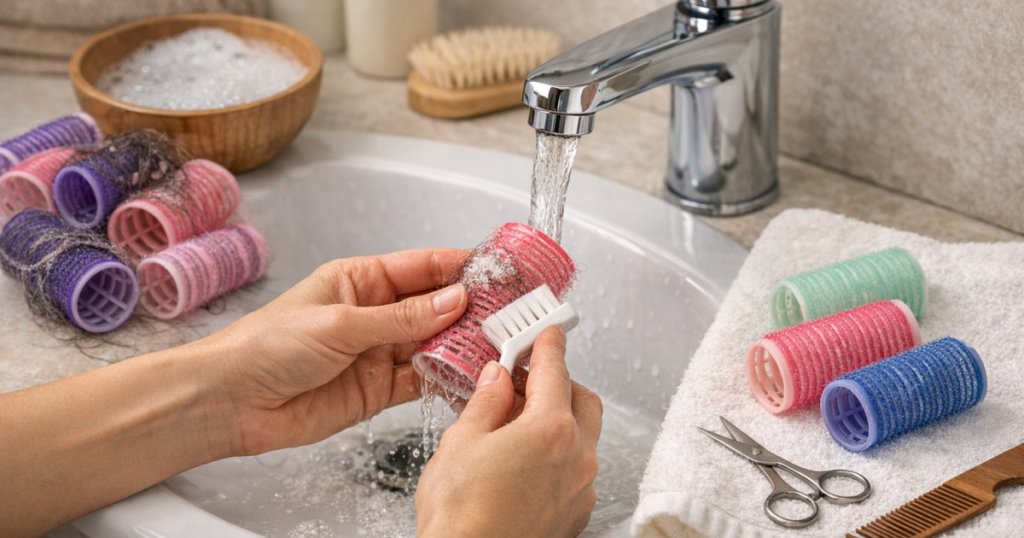
Fill a bowl or basin with lukewarm water and add a small squeeze of gentle shampoo. For very sticky hairspray build-up, a drop of washing-up liquid can help cut through the film, but keep it minimal and rinse well.
Place the rollers in the water for around 5 to 10 minutes. This is usually enough to soften product without over-soaking the inner structure. If your rollers are foam-filled, padded or have a fabric-like covering, avoid leaving them submerged for a long time because they can hold water and take much longer to dry.
Step 3: Brush the surface without flattening the grip
After soaking, use a soft nail brush, clean toothbrush or small cleaning brush to work around the roller surface. Short, light strokes are better than hard scrubbing. You want to loosen residue from the hook-and-loop texture, not crush it flat.
Pay extra attention to the ends of each roller, where mousse tends to collect from handling. If you use rollers near the hairline after applying root mousse, the outer edge may be stickier than the middle. If you set a fringe or crown pieces after hairspray, the tackiest residue is often concentrated on only a few rollers rather than the whole set.
Step 4: Rinse until the water runs clean
Rinsing is the step people rush, but it makes the biggest difference to the next result. Hold each roller under lukewarm running water and rotate it slowly. Squeeze lightly only if the roller has a soft core; do not twist it hard.
If the roller still feels slippery, cloudy or perfumed, it probably has cleanser left in it. If it still feels tacky, it may need a second short wash. Avoid using conditioner on the rollers because it can coat the Velcro and reduce the grip you need for lift.
Step 5: Dry them properly before storage
Shake off excess water, blot the rollers with a clean towel and stand them upright on another dry towel. Leave space between them so air can move around the full surface. A sunny windowsill is not always ideal because strong direct heat can distort cheaper plastic rollers; a well-ventilated room is safer.
Do not put damp rollers straight back into a drawer, pouch or bathroom cabinet. Trapped moisture can make them smell stale, and it can also make leftover residue feel gummy again. If you wash them in the evening, leave them out overnight before using them in the morning.
Hair-type checks before you use them again
Fine or flat hair
Fine hair shows product transfer quickly. After cleaning, run a finger over the roller: it should feel grippy, not coated. If it still feels slick, it can weigh down the roots and make volume drop. Use lighter tension when rolling fine front sections so the Velcro does not tug at fragile strands.
Thick hair
Thick hair often needs more rollers, which means more surfaces collecting mousse and hairspray. Clean the most-used crown and face-framing rollers first if you do not have time to wash the whole set. For more even results, the way you divide the hair matters as much as the rollers themselves; see our guide to sectioning thick hair for even heatless waves.
Curly and wavy hair
Curly and wavy textures are more likely to catch if residue makes the Velcro uneven. If you only use rollers for root lift, keep them especially clean and remove them slowly, supporting the curl pattern underneath. For curl-friendly lift without relying only on rollers, our tutorial on root clipping curly hair while diffusing is a useful next step.
Short hair, fringes and layers
Shorter pieces often need smaller rollers and more precise placement, so any sticky build-up is more noticeable. Clean fringe rollers regularly because they pick up hairspray, skin oils and dry shampoo faster than rollers used through the back of the head.
When a quick wipe is enough
You do not need a full wash after every styling session. If you used only a light mist of hairspray and the rollers still feel clean, remove trapped hair and wipe the surface with a damp cloth. Let them dry fully before storing.
A full wash is more sensible when the rollers feel tacky, look dusty, smell of product, leave flakes on the hair, or start pulling more than usual. If you use mousse at the roots several times a week, a weekly or fortnightly clean is usually more realistic than waiting until the rollers are visibly clogged.
Mistakes that make rollers wear out faster
- Using very hot water: this can soften glue, affect foam centres or warp lightweight plastic.
- Scrubbing with a metal brush: it can flatten or tear the Velcro surface.
- Adding fabric conditioner: it may make the rollers feel smooth, but that is the opposite of what you want for controlled grip.
- Storing them damp: moisture and old styling residue can create a stale smell and a gummy feel.
- Pulling hair out forcefully: this can stretch the roller surface and make future tangling worse.
Questions people ask
How often should I clean Velcro rollers?
Clean them whenever they feel sticky, dusty or less grippy. If you regularly use mousse or hairspray, a light clean every one to two weeks is a sensible routine.
Can I use clarifying shampoo on Velcro rollers?
Yes, a small amount can help with stubborn styling-product residue. Rinse thoroughly so the clarifying formula does not dry onto the roller surface.
Can Velcro rollers go in the dishwasher?
It is better not to. Dishwashers use heat, pressure and detergent that may damage plastic, foam, adhesive or the Velcro texture.
Why do my rollers still feel sticky after washing?
They may still have hairspray film trapped in the Velcro. Repeat a short lukewarm soak, brush gently, then rinse for longer than you think you need.
Should I replace rollers that will not come clean?
If they stay tacky, smell stale, shed pieces, have flattened grip or keep snagging hair after cleaning, replacement is more hair-friendly than forcing another set.
Final thoughts
Clean rollers give better lift, smoother release and a fresher finish, particularly when you use mousse or hairspray for hold. Keep the method gentle: remove hair dry, soak briefly, brush lightly, rinse well and air-dry fully. That small routine protects both the roller grip and the hair you are trying to style.