Short hair can slip, kink or unravel overnight, but it can still curl well without tongs. The trick is to use a heatless curling ribbon with smaller sections, firmer anchoring and a slightly different wrapping angle than you would use on long hair.
For bobs, lobs and layered cuts, success usually depends less on the ribbon itself and more on how damp the hair is, where you position the curler, and how neatly you secure the ends.
The short version
- Start with hair that is dry or only very slightly damp; wet short hair is more likely to dry unevenly and flatten at the roots.
- Place the curler higher than you think, close to the crown, so short layers have enough length to wrap around it.
- Use small, tidy sections rather than trying to wrap the whole side of the head in one pass.
- Wrap away from the face for a softer, more wearable shape around the hairline.
- Secure the ends with a soft scrunchie or claw clip, not a tight elastic that can leave dents.
Before you start: check your cut and curl goal
A soft curler works best on short hair when there is enough length to wrap around the barrel at least once. A chin-length bob, collarbone lob, grown-out pixie or layered bixie can usually work well. A very short crop may still get lift and bend, but it is unlikely to form full spirals without a different method.
Think about the finish you want before wrapping. For a polished bob, aim for soft C-shaped bends through the mid-lengths and ends. For a tousled lob, wrap in smaller sections and alternate the tension slightly. For short layered hair, focus on controlling the front pieces and crown first, because these are the areas that make the style look intentional rather than rumpled.
The main advantage of a heatless curling ribbon on shorter lengths is that it creates shape without exposing fragile ends to repeated heat. The compromise is that the result is usually softer and less uniform than tonged curls, especially if your layers are blunt, thick or freshly cut.
Step 1: prep the hair so it bends, not frizzes
Start with hair that is clean enough to move but not so silky that it slips straight out. Day-one hair can work if you use a light styling mist or mousse, while day-two hair often has enough grip already. Avoid heavy oils before wrapping, as they can make short layers separate and slide.
If your hair tangles easily, brush or comb it through before adding any hold product. Short hair can look frizzy very quickly if sections are forced around the curler while knotted. For a more detailed prep routine, use this guide to detangling hair before heatless styling without frizz before you begin wrapping.
How damp should short hair be?
For most short styles, barely damp is safer than wet. Hair should feel cool to the touch at most, not freshly washed. If it is too damp, the wrapped sections may still be wet in the morning, leaving limp bends instead of curls. Fine hair often needs to be almost fully dry. Thick or coarse hair can handle a little more moisture, but only if the sections are small.
Step 2: position the ribbon higher than on long hair
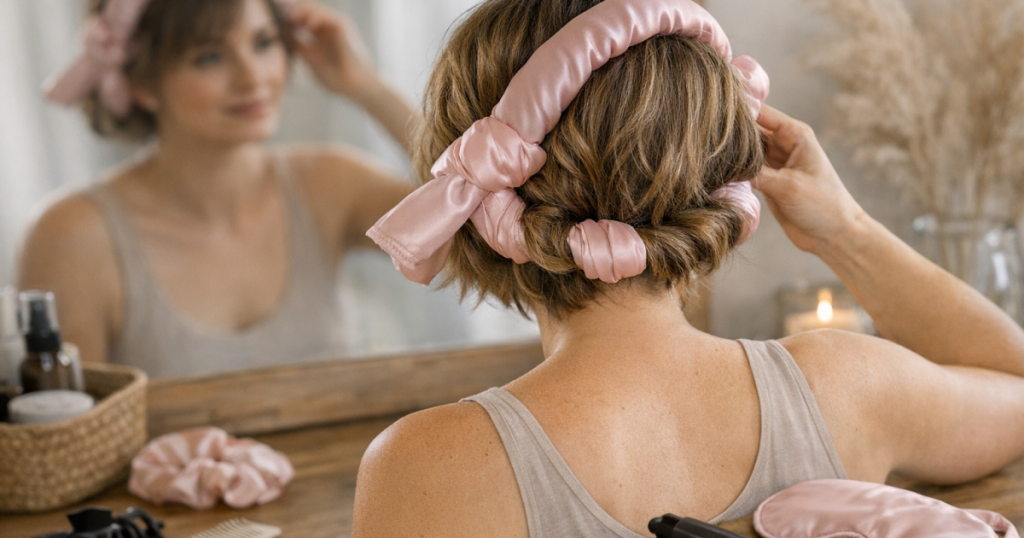
Many people place the curler too low on short hair. If it sits around ear level, the shortest layers may not reach it properly and the curls will start too far down. Place it across the top of the head like an Alice band, with the ends hanging evenly on both sides.
Clip the centre of the ribbon to the crown with a small claw clip while you wrap. This stops the curler slipping backwards and helps keep both sides even. If your hair is very short at the back, do not worry about wrapping every nape piece; those sections can be tucked, clipped, or lightly shaped in the morning.
Step 3: section smaller than you think
Short hair needs smaller sections because there is less length to travel around the curler. Start near the front hairline with a section about 2 cm wide. Wrap it over and around the ribbon, then pick up another small section and add it to the next wrap, almost like a loose French braid around the curler.
Keep the tension even rather than tight. Pulling too firmly can flatten the roots and create dents near the face. Too loose, and the shorter pieces will fall out before they have set. The aim is snug, smooth contact with the curler without stretching the hair.
For a bob
Wrap all sections away from the face for a neat, salon-brushed look. Keep the ribbon close to the side of the head rather than letting it swing forward. When you reach the ends, roll them under the curler and secure with a soft scrunchie.
For a lob
You can wrap slightly larger sections through the back and smaller pieces around the face. If your lob is layered, keep the top layers separate for longer before adding them in, as this helps avoid bulky twists at the cheekbone.
For a grown-out pixie or bixie
Focus on the longer top and front pieces. Wrap the side sections if they reach comfortably, but do not force very short nape hair around the ribbon. A few loose pieces can be smoothed or tucked after the curls are released.
Step 4: secure the ends without dents
The ends are where short heatless curls most often fail. If they are left loose, they flick out. If they are tied too tightly, they dent. Use a satin or soft fabric scrunchie and fasten it around both the ribbon and the wrapped hair. The scrunchie should hold the shape, not squeeze it flat.
If your ends are blunt or slippery, twist the final 2–3 cm around the curler and pin it with a small hair grip before adding the scrunchie. For short layers around the face, a flat duckbill clip can help hold the first wrap in place while you finish the rest of the side.
Step 5: leave it long enough to set
Heatless curls need time for the hair to dry, cool and settle into a new shape. Overnight is easiest, but short fine hair may set in a few hours if it has enough grip. Thick hair usually needs longer, especially if it was even slightly damp at the start.
If your curls drop quickly, the issue is usually moisture level, section size or product choice. Thick hair often needs a little more hold before wrapping and a gentler release afterwards. The same principles used for getting heatless curls to hold in thick hair apply to shorter cuts too: smaller sections, enough drying time, and minimal brushing after release.
Step 6: remove the ribbon carefully
Do not pull the curler straight out. Remove the scrunchies first, then gently unwind each side in the opposite direction to the wrap. If you drag the ribbon down through short hair, it can rough up the cuticle and turn a soft bend into fluff.
Once released, let the curls sit for a minute before touching them. Then use your fingers to separate only where needed. For a bob, rake lightly underneath rather than through the top layer. For a lob, shake the roots with your fingertips and leave the ends more defined. For layered short hair, pinch a little styling cream or lightweight oil over the surface only if the ends look dry.
Common problems and quick fixes
The front pieces keep falling out
Start wrapping closer to the parting and use smaller front sections. A light mist of water or styling spray on just the front pieces can add grip, but do not soak them. Clip the first wrap while you continue down the side.
The curls start too low
Move the ribbon higher towards the crown. On short hair, the position controls where the bend starts. If the curler sits too low, you will get curled ends but flat roots.
The ends look flicked rather than curled
Make sure the last few centimetres are wrapped smoothly around the ribbon before securing. Blunt bobs are most prone to flicked ends, so roll the ends under rather than leaving them pointing outwards.
One side looks better than the other
Check whether you are wrapping both sides in the same direction and using similar section sizes. Many people naturally wrap their dominant side more neatly. Use a mirror for the back half, and clip the centre of the ribbon so it does not drift while you work.
What to use with a curling ribbon on short hair
You do not need a large kit, but a few supporting items make the method easier. A soft scrunchie helps avoid dents, a small claw clip anchors the curler at the crown, and a detangling brush or wide-tooth comb keeps sections smooth before wrapping. If you sleep in the style, a silk or satin pillowcase can reduce friction around short face-framing pieces.
A satin curler is often more comfortable overnight than a firmer foam version, but softer materials can also slip more on very silky hair. If comfort is your priority, a satin style is worth considering; if hold is your struggle, focus on sectioning and grip first. For a closer look at an overnight option, the satin curling set review is a useful next read.
Hair-type adjustments that make the biggest difference
- Fine short hair: use very little product and wrap when hair is almost completely dry. Too much moisture or cream can collapse the curl.
- Thick short hair: divide each side into more sections and give the style longer to set. Large sections may only bend on the outside.
- Wavy hair: work with your natural pattern by wrapping away from the face and separating gently with fingers, not a brush.
- Curly hair: smooth each section before wrapping so the finished shape looks intentional. A light leave-in product can help reduce surface frizz.
- Bleached or breakage-prone hair: avoid tight tension and rough removal. The benefit of going heatless is reduced heat exposure, but friction can still cause damage if the hair is handled harshly.
Main points
Short hair can work beautifully with a heatless curler, but it needs a more controlled technique than long hair. Place the ribbon high, take small sections, secure the ends softly, and release the curls without dragging. The result should be a soft bend or loose curl pattern rather than a rigid ringlet set.
If your first attempt looks uneven, adjust one thing at a time: start drier, use smaller sections, or move the curler higher. Those small changes usually make more difference than changing the tool itself.
Common questions
Can you use a curling ribbon on a chin-length bob?
Yes, a chin-length bob is usually long enough. Keep the sections small and place the curler close to the crown so the hair has enough length to wrap.
Should short hair be wet before using a heatless curler?
No. Short hair should usually be dry or only barely damp. Wet hair can stay damp inside the wrap and leave flat, uneven bends.
How do I stop short layers escaping overnight?
Anchor the ribbon with a claw clip, wrap smaller sections, and secure loose layers with flat clips where needed. A satin pillowcase can also reduce friction.
Will this work on very short pixie hair?
It depends on the length. Longer top pieces can take a bend, but very short sides and nape sections are unlikely to wrap fully around the ribbon.
Can I brush the curls out in the morning?
Use fingers first. A brush can make short heatless curls puff out, especially on fine, layered or wavy hair. If you need smoothing, brush only the underside or the very ends.