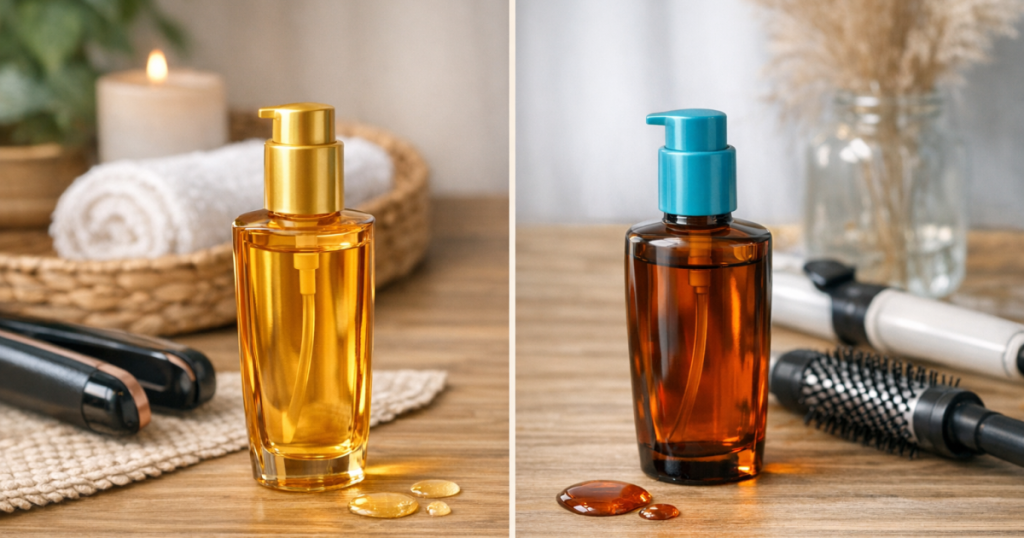
Heat styling changes what you need from a finishing oil: not just shine, but slip, frizz control and a finish that does not turn heavy by day two. For heat-styled hair, L’Oréal Elvive Extraordinary Oil vs Moroccanoil Treatment comes down to texture, budget, styling frequency and how easily your lengths get weighed down.
Neither oil should be treated as your full heat protection step unless the current product label clearly says so. If you are using straighteners, tongs, a hot brush or a high-heat dryer, apply a proper heat protectant first, then use hair oil sparingly to smooth, soften and finish.
The short answer for heat-styled hair
If your hair is fine, easily greasy or you heat style several times a week, the L’Oréal oil is usually the more forgiving everyday option because it can be used in very small amounts without feeling too precious. If your hair is thick, coarse, very dry, coloured or prone to a puffy finish after straightening, Moroccanoil Treatment is the richer, more salon-polished option when applied carefully.
The main difference is not simply “cheap versus premium”. It is how the oil behaves on your hair after heat has already changed the surface feel. Fine hair needs shine without collapse. Bleached hair needs softness without looking stringy. Curly and coily hair often needs more slip through the ends, but not so much weight that the shape goes flat at the roots.
How heat styling changes what a hair oil needs to do
After straightening, curling or blow-drying, the cuticle can feel smoother at first but drier later, especially on porous mid-lengths and ends. A finishing oil helps reduce the rough, fluffy look by adding slip and light coating, but too much can make freshly styled hair separate into clumps.
The trick is placement. Oil belongs mostly on the lower lengths and ends, not on the scalp or freshly lifted roots. If you use it before straightening, the amount has to be tiny and evenly spread; our step-by-step guide to using hair oil before straightening without greasiness goes deeper into that technique.
Also check your whole routine. If your shampoo and conditioner leave your hair squeaky, rough or tangled before styling, an oil has to work much harder afterwards. For dry, heat-styled lengths, a richer conditioner can sometimes make more difference than adding another layer of oil at the finish; this is where our Garnier Ultimate Blends Conditioner review for dry, heat-styled hair is a useful next read.
Where the two oils differ most
Finish and feel
L’Oréal Paris Elvive Extraordinary Oil tends to make sense for hair that wants gloss and smoothness without a very dense finish. It is the easier choice if you like a flexible, everyday result and want to refresh ends between wash days. On fine or medium hair, start with less than you think you need, rub it thoroughly between your palms, then skim the ends rather than pressing oil through the whole head.
Moroccanoil Treatment has a more distinctive, richer styling-treatment feel. It is often chosen by people who want that sleek, polished, blow-dried look rather than just a light shine boost. On thick, coarse, highlighted or frizz-prone hair, it can help the finish look more controlled, but it can overwhelm fine hair if applied too high up or used too generously.
Cost per routine, not just bottle cost
Moroccanoil Treatment is the more premium-feeling product in this pairing, while L’Oréal Elvive Extraordinary Oil is more accessible for regular use. But cost only tells part of the story. A richer oil may last longer if you genuinely need only a tiny amount; a lighter oil may suit you better if you prefer to use it daily on ends, braids, ponytails or slept-on styling.
For heat-styled hair, think in “uses per week”. If you straighten once and then refresh lightly for three days, a lighter oil may fit your rhythm. If you do a full blow-dry and want a glossy finish for a special occasion, the richer option may feel more worthwhile.
Which is better by hair type?
Fine or flat-prone hair
Choose the L’Oréal oil first if your biggest problem is limp roots or oily-looking ends. Use one small drop, warm it between your palms, and touch only the driest tips. Avoid applying it before using Velcro rollers or root-lifting tools, as oil near the top can reduce grip and volume.
Medium, straight or lightly wavy hair
Both can work, but the application decides the result. L’Oréal is better for day-to-day smoothing after straightening. Moroccanoil is better when the ends look dry, fluffy or uneven after a full blow-dry. If your hair sits between fine and thick, try oil only after styling first; pre-styling use is where many routines become greasy.
Thick, coarse or dense hair
Moroccanoil Treatment has the edge if your lengths expand after heat styling or your ends look matte even when they feel smooth. Apply in sections rather than one large amount. Dense hair often needs product distribution more than extra product, so press a little through each side and back section rather than coating the top layer only.
Curly, coily or mixed-texture hair
For curls and coils that are blow-dried, stretched or silk-pressed at home, Moroccanoil may give more softness through the ends, while L’Oréal can be useful for lighter refreshes. Be careful around looser face-framing sections if you have mixed textures: the straighter areas can turn oily faster than the denser sections at the back.
Bleached, highlighted or very porous hair
Porous hair often drinks in product unevenly, then looks heavy in some areas and dry in others. Moroccanoil can help soften rough-looking ends, but use it over a good leave-in or heat protectant rather than expecting oil to repair the hair. L’Oréal is the safer option if your blonde pieces turn stringy quickly.
How to apply either oil without ruining a heat style
Step 1: decide whether it is a prep oil or a finishing oil
Most people get better results using these oils as a finishing step, after the main heat work is done. If you use oil before blow-drying, keep it away from the roots and make sure your hair is not overloaded before adding heat protectant. For straighteners and curling wands, avoid saturating strands with oil before applying high heat.
Step 2: start with the ends, then check the mid-lengths
Apply the smallest amount to the driest ends first. Only move up into the mid-lengths if the hair still looks fluffy. Stop before the roots. On layered hair, pay attention to the shorter pieces around the face, as they show greasiness faster than underneath sections.
Step 3: use your hands before your brush
Rub the oil between your palms until it feels evenly spread, then smooth with open hands. Brush only after the product has been lightly distributed. Brushing a blob of oil straight through hair can create shiny patches and dull patches in the same style.
Step 4: reassess in daylight
Bathroom lighting can hide heaviness. If your hair looks separated outdoors or in natural light, use less next time or switch the oil to ends-only. If it still looks dry and puffy, your issue may be conditioner, heat protectant, tool temperature or sectioning rather than the oil itself.
Common mistakes with oils on heat-styled hair
- Using oil as a heat protectant by default: always check the label and do not skip a dedicated thermal product when using high heat.
- Applying at the roots: this usually reduces volume and makes clean hair look older than it is.
- Adding more to fix dryness: if the hair feels rough, it may need conditioning or a trim rather than extra surface shine.
- Using the same amount on every texture: fine front layers, dense back sections and porous highlighted ends often need different amounts.
- Layering over too many stylers: leave-in cream, serum, heat protectant and oil can quickly become too much, especially on medium or fine hair.
In brief
For most fine to medium heat-styled hair, L’Oréal Elvive Extraordinary Oil is the easier everyday smoothing oil. It gives shine and softness with less risk when used sparingly. For thick, coarse, dry or very frizz-prone heat-styled hair, Moroccanoil Treatment is the stronger choice for a richer, more polished finish.
The better oil is the one that matches your hair density and styling frequency. If your style falls flat, go lighter and use less. If your hair still looks puffy, matte or rough after careful heat styling, the richer option is more likely to suit your lengths.
Questions people ask
Can I use either oil before straightening?
You can use a very small amount before styling if the label and your routine allow it, but do not rely on hair oil alone as heat protection. For straighteners, most people get cleaner results by applying heat protectant first and oil after styling.
Which one is less likely to make fine hair greasy?
L’Oréal Elvive Extraordinary Oil is generally the safer starting point for fine hair because it is easier to use lightly. Apply it only to the last few centimetres of hair and avoid the crown, fringe and face-framing roots.
Is Moroccanoil Treatment better for frizz?
It can be better for thick, coarse or dry frizz because it has a richer styling feel. If your frizz comes from damage, humidity or poor heat-tool technique, oil will help the finish but will not solve the cause on its own.
Can I use hair oil with heatless styling?
Yes, but use less than you would for a sleek blow-dry. Too much oil can reduce grip in heatless curls, rollers and rods, making the shape drop sooner. Apply a tiny amount after taking the style down.
Should I choose the same oil for summer and winter?
Not always. Hair that loves a richer oil in cold, dry weather may feel weighed down in humid conditions. Adjust the amount first before switching products completely.
Quick Buying Links
L’Oréal Elvive Extraordinary Oil
For heat-styled hair, L’Oréal Elvive Extraordinary Oil vs Moroccanoil Treatment comes down to texture, budget, styling frequency and how easily your lengths get weighed down.Neither oil should be treated as your full heat protection step unless the current product label clearly says so.
Moroccanoil Treatment for Heat-Styled Hair
Worth considering if its strengths better match your needs.
Related reading
For a wider routine-based comparison, read our full L’Oréal Elvive Extraordinary Oil and Moroccanoil Treatment Oil comparison, which looks beyond heat styling into everyday use, finish and value.