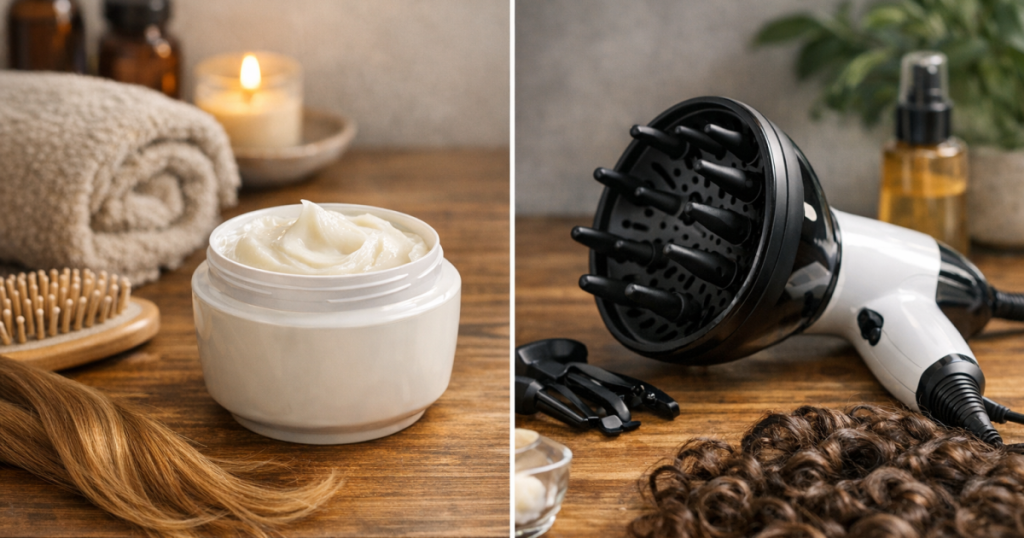
Elvive vs Diffon sounds like an odd match until you ask what your hair is actually missing: softness, strength-feel and slip, or quicker curl drying with more shape. The L’Oréal Paris Elvive Total Repair 5 Hair Mask is a wash-day treatment for hair that feels rough, brittle or overworked. The Bellissima Diffon Supreme is a styling tool for drying waves and curls with a diffuser-style airflow. One works before styling; the other changes how your hair dries.
Main points
- Choose L’Oréal Paris Elvive Total Repair 5 Hair Mask if your main issue is dryness, roughness, tangling, the feel of damage or post-heat dullness.
- Choose Bellissima Diffon Supreme if your main issue is limp curls, slow drying, frizz from rough towel drying, or lack of root lift when air-drying.
- The mask is not a styling tool, so it will not create curl shape, volume or hold on its own.
- The Diffon is not a repair treatment, so it will not make damaged hair healthier by itself.
- Many wavy and curly routines could use both, but if you are buying one first, start with the product that addresses your biggest frustration.
The real difference: condition versus styling control
The easiest way to compare these two is to separate hair condition from hair shape. A mask improves how hair feels after washing. A diffuser-style dryer affects how hair sets as it dries. If your hair feels straw-like before you even pick up a styler, a treatment step is the more logical starting point. If your hair feels healthy enough but dries flat, fluffy or uneven, the drying method is probably the bigger issue.
The L’Oréal mask sits in the care part of the routine. It is designed for damaged-feeling hair and is used after shampooing, then rinsed out. It can help with softness, manageability and slip, which matters if your hair catches easily when detangling. It is also the more relevant option if your hair has been through regular straightening, curling, colouring or brushing friction.
The Bellissima Diffon Supreme sits firmly in the styling-tool category. It is designed for people who want to dry textured hair while supporting curl pattern rather than blasting it around with a standard dryer nozzle. Because it uses warm airflow, it is worth thinking about heat tolerance, drying habits and how often you style. If you are unsure where your hair sits, it helps to work out how much heat your hair type can tolerate before making the diffuser your daily default.
Side-by-side comparison
L’Oréal Paris Elvive Total Repair 5 Hair Mask
- Best for: hair that feels dry, brittle, rough, knotty or over-processed.
- Routine stage: wash day, after shampoo and before styling.
- Main benefit: improves softness and manageability, so styling can feel easier afterwards.
- Limit: it cannot rebuild severely split ends or replace a trim when the ends are visibly breaking.
- Hair-type caution: fine or low-density hair may need a small amount through the mid-lengths and ends rather than a heavy application near the roots.
Bellissima Diffon Supreme
- Best for: wavy, curly and some coily textures that need controlled drying, more definition or better lift.
- Routine stage: after leave-in, curl cream, mousse or gel, once the hair is ready to dry.
- Main benefit: helps dry curls without the same disruption you can get from a narrow dryer nozzle.
- Limit: it will not fix dryness, breakage or product build-up; those need care and cleansing choices.
- Hair-type caution: very fragile, bleached or heat-sensitive hair should use gentler drying habits and avoid over-drying the same sections.
Which one suits your hair type?
Fine straight or slightly wavy hair: the mask is usually the more useful choice if your hair feels dry or tangles at the ends. Use it sparingly and rinse thoroughly so the hair does not collapse. The Diffon Supreme may be less essential unless you are deliberately encouraging waves with mousse or a curl-enhancing routine.
Medium-density wavy hair: this is where the choice becomes more balanced. If your waves form nicely when healthy but drop because the hair is parched, start with the mask. If your waves look good wet but dry into puffiness or uneven bends, the diffuser is likely to make the bigger visual difference.
Curly hair: the Bellissima tool is the more styling-led upgrade because curl pattern is heavily influenced by drying method. That said, curls that feel rough, frizzy and hard to detangle often need a conditioning step too. A mask can make the curl routine easier, while a diffuser helps preserve the shape once products are applied.
Coily or very dense hair: neither option is automatically enough on its own. The mask may support slip and softness, but you may need richer leave-in layering depending on porosity and styling preference. The diffuser can help with drying, but dense roots may take time and should not be overheated for the sake of speed. If your goal is length, stretch or reduced shrinkage rather than curl definition, a non-heat method such as banding curly hair without heat may fit the brief better.
Heat-damaged or colour-treated hair: the L’Oréal mask is the more obvious first purchase if your hair feels compromised. A diffuser can still be useful for curls, but only if you are also managing heat exposure, using sensible drying habits and keeping conditioning consistent.
Where each option can disappoint
The L’Oréal mask can disappoint if you expect it to behave like a bond-building treatment or a haircut in a tub. It can make hair feel smoother and easier to handle, but it will not permanently seal split ends or reverse all visible damage. It can also feel too much on fine hair if used too generously or too often.
The Diffon Supreme can disappoint if your curl routine is not doing enough before drying starts. A diffuser preserves and enhances what is already there; it does not create a strong curl pattern from hair that has no styling product, no moisture balance and no cast. It can also increase frizz if hair is moved around too much while drying, so technique matters.
There is also a cost logic to consider. A hair mask is a consumable product, so you will eventually need to replace it. A diffuser tool is a one-off appliance purchase, but you need to check the current model details, plug suitability for GB use, return terms and whether its drying format suits your hair length and density. For a wider comparison between care and high-end styling investment, you can also read how the Elvive mask compares with a premium hot-air styler.
Common mistakes when choosing between them
- Buying a tool to solve damaged texture: if the hair feels rough when wet, a drying tool is not the first fix.
- Using a mask as a styling product: rinse-out masks are not designed to provide hold, curl memory or root lift.
- Diffusing soaking-wet hair aggressively: this can disturb the curl pattern and encourage frizz before the style has set.
- Over-conditioning fine hair: too much mask can leave roots flat and lengths stringy, even when the ends are genuinely dry.
- Ignoring product build-up: if hair feels coated rather than dry, more mask may make the problem worse.
The more sensible buy
If your biggest complaint is that your hair feels damaged, dry, brittle or hard to detangle, buy the L’Oréal Paris Elvive Total Repair 5 Hair Mask first. It is the more direct answer to a condition problem and can make your usual styling routine behave better, whether you air-dry, blow-dry or use heatless curlers.
If your biggest complaint is that your waves or curls dry flat, undefined, stretched-out or fluffy, the Bellissima Diffon Supreme is the more relevant upgrade. It changes the drying process, which can make a visible difference to curl shape, volume and finish when paired with the right styling products.
For many curly-haired readers, the strongest routine is not either-or. Use a mask when the hair needs softness and slip, then use a diffuser-style tool only when you want faster drying or more controlled definition. If you are choosing just one today, choose care for damaged-feeling hair and choose the Diffon for styling control.
Quick Buying Links
L'Oreal Paris Elvive Total Repair 5 Hair Mask
A strong contender depending on your priorities.
Bellissima Diffon Supreme
The Bellissima Diffon Supreme is a styling tool for drying waves and curls with a diffuser-style airflow.
Questions people ask
Can a hair mask replace a diffuser for curly hair?
No. A mask can make curls feel softer and easier to detangle, but it will not dry the hair, set the curl pattern or create root lift. It supports the routine rather than replacing the styling tool.
Can the Bellissima Diffon Supreme damage hair?
Any heated drying tool can contribute to dryness if used too often, too hot or too close for too long. Use the gentlest effective setting, avoid over-drying, and keep conditioning in the routine.
Is the L’Oréal Elvive mask too heavy for fine hair?
It can be if applied heavily or too close to the roots. Fine hair usually does better with a modest amount through the mid-lengths and ends, followed by a thorough rinse.
Which should I choose for frizz?
If frizz comes from dryness and rough texture, start with the mask. If frizz appears mainly during drying because your curls are being disturbed, the Diffon Supreme is likely to be more useful.
Do I need both products?
You might, if you have textured hair that is both dry and difficult to dry neatly. The mask addresses feel and manageability; the diffuser addresses drying control and curl finish.