Choosing between overnight rollers and a premium airflow styler is really a question of effort, finish and tolerance for heat. Sleep Styler vs Dyson Airwrap is not a straight cheap-versus-expensive decision: one aims to create soft curls while you sleep, while the other is an active styling system for drying, shaping and polishing hair at home.
The better choice depends on when you style, how much frizz control you need, whether your hair holds a set easily, and whether you want one curl-focused tool or a broader drying and styling upgrade.
At a glance
- Sleep Styler Heatless Hair Rollers: best suited to people who want heatless, overnight curls or waves and do not mind sleeping in rollers.
- Dyson Airwrap Co-anda2x Multi-styler and dryer: better for anyone who wants a powered dryer-styler for blowout shape, curling, smoothing and everyday control.
- Choose Sleep Styler if your priority is reducing heat exposure, saving active styling time in the morning and creating a softer, less polished curl.
- Choose the Dyson if your priority is flexibility, a more salon-style finish at home and the ability to adjust your look depending on the day.
- Neither tool is effortless for every hair type. Sleep Styler needs the right dampness and wrapping tension; the Dyson needs sectioning, practice and the right attachment for your goal.
If you are mainly comparing heatless overnight tools rather than powered stylers, the separate Sleep Styler and Kitsch comparison is the more focused next step.
The core difference: passive setting versus active styling
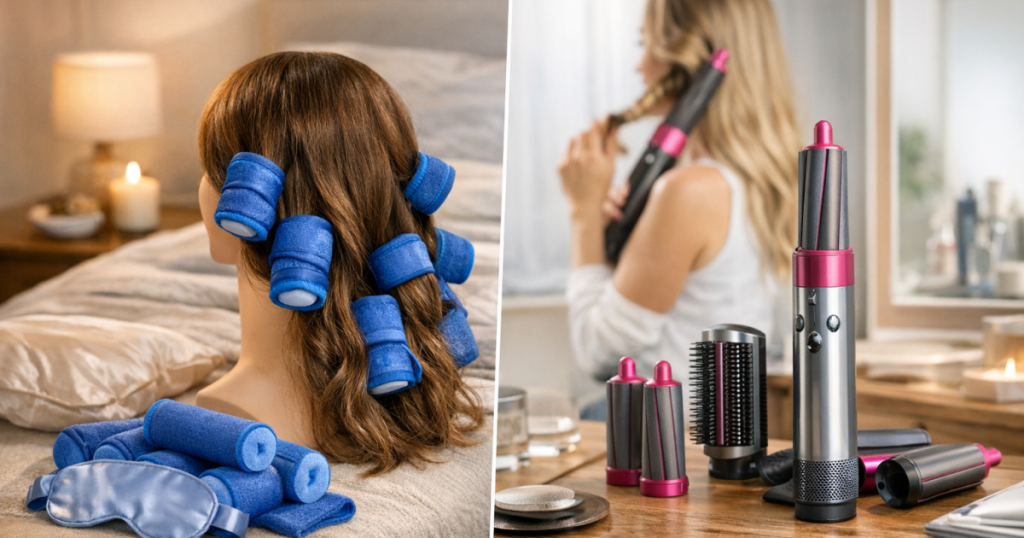
Sleep Styler is a passive styling tool. You wrap damp or nearly dry hair around soft rollers, secure the set, sleep in it, and remove the rollers in the morning. The result depends heavily on hair length, the amount of moisture in the hair, how evenly you section, and how well your hair holds shape without heat.
The Dyson Airwrap Co-anda2x Multi-styler and dryer sits in a different category. It is a powered airflow tool designed to dry and style hair with interchangeable attachments. Depending on the bundle available from UK retailers, it may be used for curling, shaping, smoothing or drying. Because attachment packages can vary, check the exact contents before comparing value.
That means the buying decision is not simply about curls. It is about whether you want to replace a curler-style step with a heatless overnight set, or whether you want a premium tool that can handle more of your full styling routine.
Sleep Styler vs Dyson Airwrap: where each one wins
For curl shape
Sleep Styler usually gives a softer, looser curl or wave pattern. It is more romantic than sculpted, and it tends to suit people who like movement rather than a very controlled curl. The finish can look lovely on medium to long hair, but it may be uneven if some sections dry more than others overnight.
The Dyson is stronger for deliberate styling. With the appropriate curling barrels or styling attachments, it can create a more intentional blowout curl or bend. It is not the same as a traditional clamp curling tong, and results still depend on technique, but it gives more control over direction, volume and how polished the final look feels.
For frizz and smoothing
Sleep Styler does not actively smooth the cuticle in the way a dryer brush, straightener or airflow styler can. If your hair is naturally frizz-prone, porous or affected by damp UK weather, you may need a smoothing leave-in, light oil on the ends, or a silk wrap to preserve the set. The rollers can create shape, but they are not a full frizz-control system.
The Dyson is more capable when smoothing is part of the brief. It can dry, shape and polish in one routine, provided the right attachment is used and the hair is prepped sensibly. For wavy hair that tends to puff at the crown or lose definition at the ends, the tool choice often comes down to whether you want to encourage natural pattern or smooth it into a blow-dried finish. For a broader breakdown by texture, see the guide to wavy hair styling tools.
For time and routine
Sleep Styler is low in active styling time but high in planning. You need to wash or dampen your hair early enough that it is not soaking at bedtime, section it neatly, wrap it securely and sleep comfortably. If your hair is still too wet in the morning, the curl may fall quickly or feel limp.
The Dyson demands more active time while you style, but it does not require sleeping in anything. It is better for people who shower in the morning, refresh hair before work, or change their look depending on the outfit, weather or occasion. The trade-off is that you need to be present and patient while styling; it is not a set-and-forget tool.
For heat exposure
Sleep Styler is the clear choice if avoiding heat is your main reason for buying. It relies on drying and setting rather than hot plates, barrels or powered airflow. That makes it appealing for hair that is already coloured, lightened, dry, fragile or trying to recover from frequent heat styling.
The Dyson is not a heatless tool. Its appeal is that it uses airflow styling rather than the direct hot-plate contact of a straightener or traditional tong. Many readers see it as a gentler alternative to some conventional tools, but it still belongs in the heated styling family and should be used with sensible prep and moderation.
For cost and value
Sleep Styler is the easier purchase to justify if you only want occasional overnight curls. It is a single-purpose, lower-commitment tool, so the risk is mainly whether you like the comfort and whether your hair sets well without heat.
The Dyson Airwrap Co-anda2x Multi-styler and dryer is a premium purchase. Its value depends on how many existing tools it can realistically replace in your routine. If it becomes your dryer, smoothing tool and curling tool, the cost-per-use may make more sense. If you only want curls once a month, it is likely more tool than you need.
Hair-type guidance
Fine hair
Fine hair can respond well to both tools, but the risks are different. With Sleep Styler, too much moisture or product can collapse the result and make roots look flat. Work with lightly damp lengths rather than saturated hair, and use smaller, even sections if your hair slips out easily.
With the Dyson, fine hair often benefits from controlled lift and quick shaping, but it can also lose volume if overloaded with smoothing products. Check which attachments are included and think about whether your priority is root lift, curled ends or a polished blow-dry finish.
Thick hair
Thick hair is where the difference becomes more obvious. Sleep Styler can work, but drying time is the challenge. Dense sections may still be damp in the morning, especially if the hair was wrapped too wet or too tightly. Larger amounts of hair also make comfort more of a factor overnight.
The Dyson is usually the more practical option for thick hair if you want to dry and style in one sitting. It still requires sectioning, and very dense or coarse hair may need more time than product demonstrations suggest. The advantage is that you can see and adjust the result as you go, rather than waiting until morning to find out whether the set has dried.
Curly and coily hair
For naturally curly hair, Sleep Styler is best viewed as a reshaping tool rather than a curl-care essential. It can stretch or redirect curls into softer waves, but it may not give the definition that a diffuser, gel routine or curl-specific method provides.
The Dyson can be useful for smoothing, stretching or creating a blown-out curl effect, depending on the attachments and technique. If maintaining natural curl pattern is your aim, a diffuser-style approach may make more sense than either of these tools.
Short hair and layered cuts
Sleep Styler is less forgiving on short cuts because there may not be enough length to wrap securely around the rollers. Face-framing layers can also spring out or curl in a different direction from the rest of the hair.
The Dyson is typically more adaptable for layered hair because you can work around the cut section by section. Shorter layers may still require practice, and not every attachment will be useful on every length, so check real user images and retailer details for hair lengths similar to yours before buying.
Side-by-side strengths and trade-offs
- Best for heatless styling: Sleep Styler. It is the more suitable option if your non-negotiable is avoiding heated tools.
- Best for a complete styling routine: Dyson Airwrap Co-anda2x. It covers more styling jobs, especially if you regularly dry, smooth and shape your hair.
- Best for comfort-free mornings: Dyson. You do the work while awake, rather than sleeping in rollers.
- Best for low active effort: Sleep Styler. The wrapping takes time, but the styling happens while you sleep.
- Best for polished results: Dyson. It gives more control over finish, direction and smoothness.
- Best for softer, undone curls: Sleep Styler. The finish is usually more relaxed and less blow-dried.
- Best for unpredictable hair: Dyson. If your hair behaves differently depending on humidity, product or wash day, active styling gives you more chance to correct the result.
What to check before buying either tool
For Sleep Styler, check the roller quantity, roller size, fastening method and whether the design suits your hair length. Look closely at reviews from people with hair similar to yours, not just glossy before-and-after photos. The most useful reviews mention whether the rollers stayed in, whether they were comfortable to sleep in, and whether the hair dried fully by morning.
For the Dyson, check the exact UK bundle, included attachments, retailer return policy and warranty terms. Do not assume every Airwrap package includes the same styling heads. If you are buying to replace a dryer, straightener or curling tool, list the jobs you expect it to do before comparing the package against your current routine.
It also helps to map your styling goal before committing. If you are unsure whether you need a roller, curler, dryer or straightener at all, the guide on choosing between straighteners, curlers, rollers and dryers can clarify the wider tool category before you narrow it down to these two products.
Which one should you choose?
Choose Sleep Styler if you want heatless curls, have enough length to wrap comfortably, and prefer to move styling effort into the evening. It is the better fit for someone who likes a soft, casual curl and is willing to experiment with dampness, section size and overnight comfort. It is also the more sensible starting point if you are trying to reduce reliance on hot tools without overhauling your entire routine.
Choose the Dyson Airwrap Co-anda2x Multi-styler and dryer if you want one premium tool to handle more of your styling routine. It is the stronger option for people who need drying power, smoothing control, adjustable shape and a more polished finish. It makes most sense if you style frequently enough to benefit from the versatility and are prepared for a learning curve.
The simple recommendation: go Sleep Styler for low-heat, overnight waves; go Dyson for active, flexible styling with a more controlled finish. If your hair is thick, frizz-prone or highly dependent on weather, the Dyson is likely to be the more reliable day-to-day tool. If your hair is medium to long, reasonably easy to set and you dislike heat, Sleep Styler is the more focused and lower-commitment choice.
Quick Buying Links
Sleep Styler Heatless Hair Rollers
Sleep Styler vs Dyson Airwrap is not a straight cheap-versus-expensive decision: one aims to create soft curls while you sleep, while the other is an active styling system for drying, shaping and polishing hair at home.The better choice depends on when you style, how much frizz control you need, whether your hair holds a set easily, and whether you want one curl-focused tool or a broader drying and styling upgrade.At a glanceSleep Styler Heatless Hair Rollers: best suited to people who want heatless, overnight curls or waves and do not mind sleeping in rollers.Dyson Airwrap Co-anda2x Multi-styler and dryer: better for anyone who wants a powered dryer-styler for blowout shape, curling, smoothing and everyday control.Choose Sleep Styler if your priority is reducing heat exposure, saving active styling time in the morning and creating a softer, less polished curl.Choose the Dyson if your priority is flexibility, a more salon-style finish at home and the ability to adjust your look depending on the day.Neither tool is effortless for every hair type.
Dyson Airwrap Co-anda2x Multi-styler and dryer
Sleep Styler vs Dyson Airwrap is not a straight cheap-versus-expensive decision: one aims to create soft curls while you sleep, while the other is an active styling system for drying, shaping and polishing hair at home.The better choice depends on when you style, how much frizz control you need, whether your hair holds a set easily, and whether you want one curl-focused tool or a broader drying and styling upgrade.At a glanceSleep Styler Heatless Hair Rollers: best suited to people who want heatless, overnight curls or waves and do not mind sleeping in rollers.Dyson Airwrap Co-anda2x Multi-styler and dryer: better for anyone who wants a powered dryer-styler for blowout shape, curling, smoothing and everyday control.Choose Sleep Styler if your priority is reducing heat exposure, saving active styling time in the morning and creating a softer, less polished curl.Choose the Dyson if your priority is flexibility, a more salon-style finish at home and the ability to adjust your look depending on the day.Neither tool is effortless for every hair type.
Common questions
Can Sleep Styler replace a Dyson Airwrap?
Only if your main goal is heatless overnight curls. It will not replace the Dyson’s drying, smoothing or blowout-style versatility.
Is the Dyson Airwrap Co-anda2x better for damaged hair?
It can be a more controlled alternative to some traditional hot tools, but it is still a heated airflow styler. If avoiding heat is the priority, Sleep Styler is the clearer match.
Will Sleep Styler work on thick hair?
It can, but thick hair needs careful sectioning and should not be wrapped too wet. If the hair is still damp in the morning, the curl may drop quickly.
Which tool is better for a quick morning routine?
The Dyson is better if you want to style from damp hair in the morning. Sleep Styler is quicker in the morning only when the hair has fully set overnight.
Do either of these suit very short hair?
Very short hair is usually harder to wrap around Sleep Styler rollers. The Dyson may be more adaptable, but the usefulness depends on the attachments and your exact cut.