Choosing between soft rollers and a satin curling rod is less about which one looks prettier on the dressing table and more about how your hair behaves while you sleep. Sleep Styler vs Kitsch Satin Heatless Curling Set is a genuinely useful comparison because both promise heat-free waves, but they create tension, shape and comfort in different ways. The right choice depends on whether you want distributed rollers, a central wrap, overnight comfort, tighter control at the ends or a looser, softer finish.
In brief
The Sleep Styler Heatless Hair Rollers are better if you like the idea of section-by-section rolling, want more control over placement, or struggle to wrap all your hair around one long rod. The Kitsch Satin Heatless Curling Set is usually the easier pick if you want a simpler routine, softer bend through the lengths and a polished, low-friction satin finish.
- Choose Sleep Styler if you want a roller-based method, root-to-end sectioning and more targeted curl placement.
- Choose Kitsch if you prefer a wrap-around rod, quicker setup and looser, robe-curl-style waves.
- Fine hair usually needs less product and lighter tension with either option, otherwise curls can look flat or stringy.
- Thick hair may need smaller sections, more drying time before bed and careful securing so the shape does not collapse overnight.
- Neither tool is a replacement for a hot curler when you want very defined, same-day curls on fully dry hair.
If you are still unsure how your density, strand thickness or curl pattern affects the decision, start with identifying your hair type before buying styling tools. Heatless curling is far easier to judge once you know whether your hair mainly needs grip, moisture control, volume or frizz reduction.
What each tool is designed to do
Sleep Styler Heatless Hair Rollers
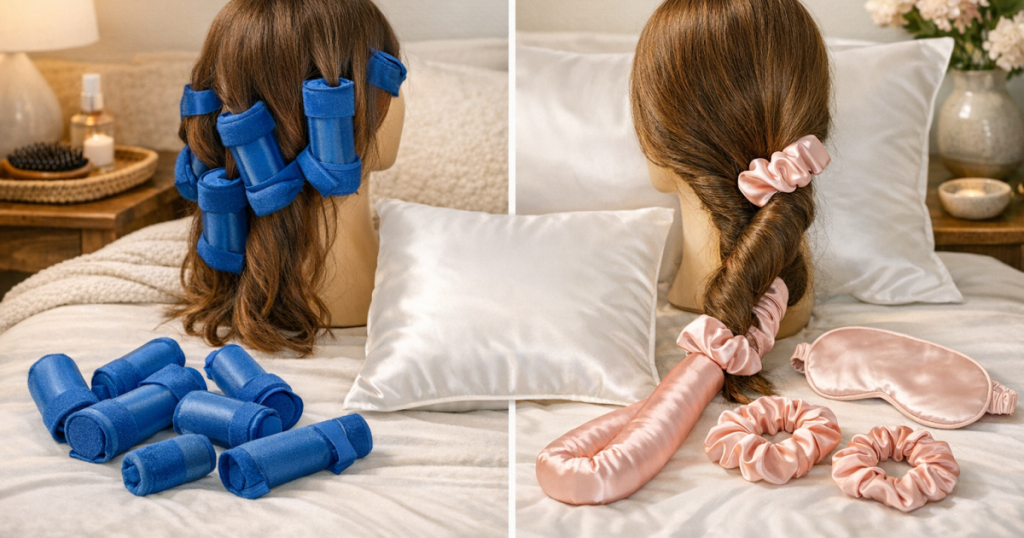
Sleep Styler is a soft roller system designed for damp-to-dry heatless styling. Instead of wrapping the whole head around one central rod, you work in sections, rolling hair around individual padded rollers and securing each one. That makes the method feel closer to traditional rollers, but softer and more sleep-focused.
The main appeal is control. You can decide where you want more bend, which sections need extra lift, and whether the front pieces should roll away from the face. For layered hair, this can be helpful because shorter pieces are not always easy to keep on one continuous curling rod. It also gives you more flexibility if one side of your hair is thicker than the other or if your crown area tends to fall flat.
The trade-off is setup time. Sectioning matters, and the finished result depends heavily on how evenly you roll. If you rush, take sections that are too large, or sleep on half-damp hair that cannot fully dry, you may wake up with soft dents rather than a coherent curl pattern.
Kitsch Satin Heatless Curling Set
The Kitsch option follows the now-familiar satin curling rod method. You place the rod across the top of the head, wrap sections of hair around each side, then secure the ends. It is often quicker to understand than a full head of rollers, and the satin surface is appealing if your hair is prone to friction, fluffy ends or disrupted shine.
The finish tends to be more flowing than roller-set. Think soft bends, loose curls and brushed-out waves rather than lots of individually placed ringlets. It can look particularly good on medium to long hair where the lengths have enough room to spiral around the rod. For readers already weighing up heatless options against premium hot tools, the comparison between the Kitsch Satin Heatless Curling Set and Dyson Supersonic Hair Dryer is a useful next step, because it frames the Kitsch set as a routine change rather than a direct dryer replacement.
The limitation is placement. Because both sides of the head wrap around the same long rod, you have less individual control than you do with separate rollers. If your hair is very short around the face, heavily layered, or much thicker at the back, you may need practice to keep the wrap balanced.
Side-by-side differences that actually affect the result
- Curling method: Sleep Styler uses individual rollers, while Kitsch uses one central satin rod with the hair wrapped around it.
- Best finish: Sleep Styler leans towards more placed curls and bends; Kitsch leans towards soft, continuous waves.
- Control: Sleep Styler gives more control by section. Kitsch is simpler but less precise.
- Comfort: Both are designed for heatless wear, but comfort depends on sleep position. Side sleepers may notice individual rollers; back sleepers may notice the central rod.
- Setup time: Kitsch is usually quicker once you learn the wrap. Sleep Styler takes more sectioning but allows more adjustment.
- Hair length: Kitsch generally suits medium to long hair best. Sleep Styler can be more adaptable for layers, though very short sections may still be difficult to roll securely.
- Frizz control: Kitsch has the advantage of a satin surface. Sleep Styler relies more on neat sectioning, the right level of dampness and product choice.
- Refresh potential: Sleep Styler can target specific pieces. Kitsch is better for refreshing the overall shape through the lengths.
Curl shape, volume and hold
Sleep Styler gives you more opportunities to influence direction. Roll the front sections away from your face for a classic face-framing bend, lift the top sections if you want more movement near the roots, or focus rollers on the mid-lengths if your ends already flick naturally. This makes it stronger for people who want a styled look rather than a very casual wave.
Kitsch produces a more uniform shape because the wrap follows the rod. That can be a benefit if you like symmetrical, soft curls, but it can be less forgiving if you prefer different shapes in different areas. Hair that is very dense underneath and lighter on top may need smaller wrapped sections at the back to avoid a stretched-out result.
Hold depends less on the product name and more on prep. Heatless curls generally need hair to be slightly damp, not wet, before wrapping or rolling. Too wet and the hair may still be damp in the morning; too dry and the shape may not set. A lightweight mousse or styling spray can help some hair types, but heavy creams and oils can weigh down fine hair. For a broader way to match curl definition, smoothness, lift and longevity, use the styling goal matrix for lift, shape, smoothness and hold alongside this comparison.
Hair-type guidance
Fine or low-density hair
Fine hair often looks best when the setup is light and not overworked. The Kitsch rod can be a strong option because it creates a soft bend without needing lots of separate sections. Use minimal product, avoid wrapping too tightly at the root, and release gently so the wave does not collapse into fluff.
Sleep Styler can work on fine hair, particularly if you want more root movement or specific face-framing pieces. The risk is over-sectioning. Too many rollers can create smaller bends than expected, and too much product can make the final result look limp. If your fine hair drops curl quickly, focus on slightly smaller sections through the front and crown rather than trying to force every strand into a tight roller set.
Medium hair with natural movement
This is the easiest hair type for both tools. Sleep Styler gives you a more intentional set, while Kitsch gives you a relaxed, modern wave. If your hair naturally holds a bend after a bun or plait, either tool can work well; your decision should come down to comfort and the finish you prefer.
Thick or high-density hair
Thick hair needs patience with both methods. The common mistake is wrapping too much hair into each section, then expecting it to dry and hold overnight. Sleep Styler can be useful because separate rollers allow you to divide dense hair more evenly. However, more sections also mean more time and more things to secure before bed.
Kitsch can still suit thick hair, but it is worth taking narrower sections and making sure the underneath layers are not bundled loosely around the rod. If the back of your hair usually stays damp for longer, start with hair that is closer to dry than wet and add only a light mist where needed.
Wavy, curly or frizz-prone hair
If your hair already has texture, the Kitsch set may appeal because satin can reduce friction while the rod encourages a smoother wave pattern. It is not a curl-treatment tool, though; it will not replace a full curl routine if you need definition from root to tip.
Sleep Styler can help reshape inconsistent waves, especially around the front, but frizz-prone hair needs careful smoothing before rolling. Detangle first, use a product that suits your texture, and avoid pulling sections so tightly that they dry with stretched roots and puffy ends.
Comfort and sleeping practicality
Overnight comfort is personal. A tool can be soft and still feel annoying if it sits exactly where your head meets the pillow. Sleep Styler spreads the bulk around the head, which some people prefer because there is no single long rod across the crown. The downside is that individual rollers can press into the pillow if you sleep on your side or change position often.
Kitsch keeps the bulk more central and predictable. Some users find that easier because the sides are wrapped neatly and the ends are secured together. Others dislike having a rod near the top of the head. If you are a restless sleeper, the more secure option is the one you can fasten without pulling, slipping or having to redo sections before you fall asleep.
A silk or satin pillowcase can help either method feel smoother, but it will not fix poor wrapping. The most comfortable setup is usually slightly loose at the root, secure at the ends and not overloaded with wet hair.
Common mistakes that lead to disappointing curls
- Starting with hair that is too wet. Heatless tools need time for hair to dry into shape, but soaking sections can stay damp and lose definition.
- Using sections that are too large. This is especially common with thick hair and usually leads to weak bends underneath.
- Skipping detangling. Knots and rough sections create uneven curl patterns, particularly with rollers.
- Adding too much oil before styling. A small amount on dry ends after release may help shine, but heavy oil before setting can reduce hold.
- Pulling too tightly. Tension can create dents, discomfort and flat roots instead of soft volume.
- Brushing out too aggressively. Use fingers or a wide-tooth comb first, then decide whether the curl needs more separation.
Which one should you choose?
Choose Sleep Styler if your priority is control. It suits people who like the logic of rollers, want to style different areas of the head differently, or have layers that do not behave well on one long rod. It is also the better route if you want to refresh selected sections rather than redo the whole head. The compromise is that you need more patience with sectioning and a realistic approach to overnight comfort.
Choose Kitsch if your priority is simplicity. It is the more streamlined option for soft overnight waves, especially on medium to long hair that already holds shape reasonably well. The satin finish is a clear advantage for hair that gets roughed up easily, and the routine is easier to repeat once you find the right dampness level. The compromise is less precision, particularly around shorter layers and very dense back sections.
If you want polished, heatless waves with the least faff, Kitsch is the safer first try. If you want more placement, more root strategy and more control over individual curls, Sleep Styler is the more flexible tool. For anyone building a wider at-home styling routine, it is also worth comparing these heatless options with brushes and dryers in how to choose between straighteners, curlers, rollers and dryers so you do not buy multiple tools that solve the same problem.
Quick Buying Links
Sleep Styler Heatless Hair Rollers
In brief The Sleep Styler Heatless Hair Rollers are better if you like the idea of section-by-section rolling, want more control over placement, or struggle to wrap all your hair around one long rod.
Kitsch Satin Heatless Curling Set
Sleep Styler vs Kitsch Satin Heatless Curling Set is a genuinely useful comparison because both promise heat-free waves, but they create tension, shape and comfort in different ways.
Questions people ask
Can either option work on freshly washed hair?
Yes, but hair should usually be towel-dried and partly air-dried first. If it feels wet rather than slightly damp, it may not dry fully while wrapped or rolled.
Which is better for short hair?
Sleep Styler is usually more adaptable for shorter layers because you can roll smaller sections individually. Very short hair may still need clips or a different styling method.
Which gives tighter curls?
Sleep Styler has more potential for tighter-looking bends because each section is rolled separately. Kitsch tends to create looser, more continuous waves.
Do you need styling product with heatless curlers?
Not always. Fine hair may only need a light mist or mousse, while thicker or resistant hair may benefit from a flexible hold product. Avoid anything too heavy before setting.
Which is easier for beginners?
Kitsch is usually easier to learn because the wrap method is simple and repeatable. Sleep Styler has a slightly steeper learning curve but gives more control once you get the sectioning right.