Your preferred finish should decide the method, not the other way round. For most people, heatless vs heated styling comes down to three things: how polished you want the result, how much time you have before leaving the house, and how your hair behaves when it is stretched, wrapped or dried. Heat can deliver speed and crisp shape; heatless methods are usually kinder to fragile lengths and easier to build into an evening routine.
The most useful approach is not to pick a side permanently. It is to know when heat genuinely improves the finish, when it is doing work a lower-risk method could do, and when a hybrid routine gives you the most believable at-home result.
What to know first
Heated tools change the look quickly because warmth helps reshape the hair fibre while tension, airflow or plates create the finish. That is why a dryer brush can lift roots, a straightener can smooth kinks, and a tong can produce a defined bend in minutes. The trade-off is that frequent heat, high settings, repeated passes and poor prep can leave hair feeling drier or more breakage-prone over time.
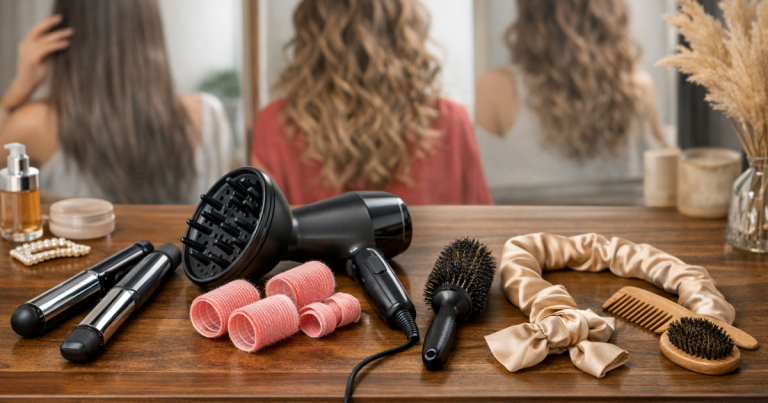
Heatless styling relies on setting hair into a shape as it dries, cools or rests. Think satin rods, foam rollers, pin curls, braids, flexi rods, scrunching, clips and wraps. The finish can be softer and more lived-in, but it needs enough time, the right tension and hair that is not overloaded with product. For a wider view of matching methods to texture, density and styling habits, see this guide to styling tools by hair type.
Match the method to the finish you want
Soft waves
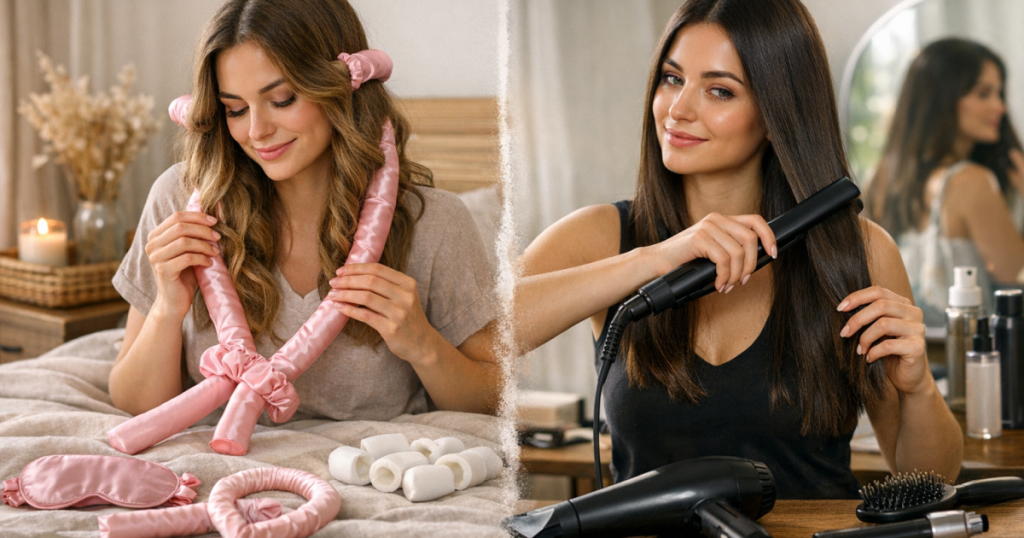
Soft waves are often the easiest finish to achieve without heat, provided your hair has enough length to wrap and enough natural memory to keep a bend. A satin curling rod, robe-belt wrap or loose overnight plaits can create relaxed movement with less day-to-day stress on the lengths. The result is usually more romantic than precise: softer roots, less uniform direction and a finish that looks better when brushed through gently.
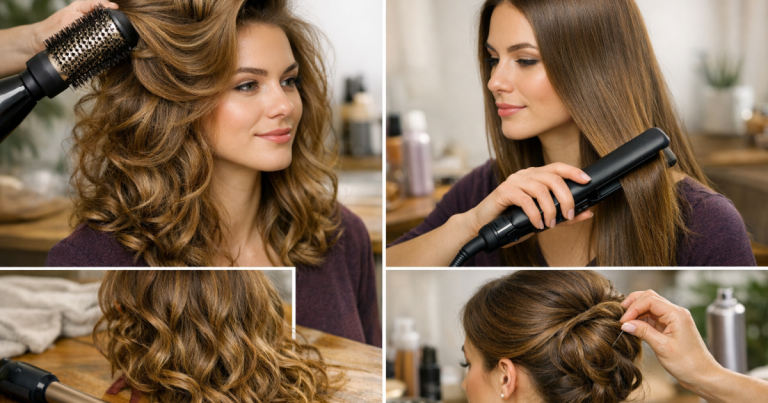
Heated styling is more useful when you want waves that start higher up, frame the face evenly, or last through damp weather. A tong, wand or straightener wave can look more deliberate, especially on hair that dries very straight. The key is to avoid making every section identical unless you want a very styled finish. Alternate directions, leave the ends slightly softer, and let the hair cool before touching it.
If your goal moves between loose bends, sleek lengths and lifted roots, the decision is less about one miracle tool and more about choosing the technique that matches the outcome. The soft waves, glass hair and root lift selection guide breaks those finish-led choices down in more detail.
Glass hair and sleek straight styles
Sleekness is where heated tools usually have the advantage. A blow-dry with a concentrator nozzle, followed by a careful pass with straighteners if needed, can compress the cuticle visually and create that high-shine, polished finish. Heatless methods can make hair smoother, but they rarely create true glass hair on their own unless the hair is already fairly straight, healthy-looking and easy to control.
That does not mean every sleek style needs maximum heat. Wrapping hair flat while it dries, using a microfibre towel to reduce roughness, sleeping in a silk wrap, and brushing with a gentle detangling brush can all reduce the amount of finishing work required. A smoothing blow-dry may then need fewer passes than starting from frizzy, air-dried hair.
For fragile or colour-treated lengths, the smarter compromise is often a low-tension blow-dry, a small amount of smoothing product, and selective straightening only around the hairline or top layer. That gives the visual effect of polish without repeatedly heating every section.
Root lift and volume
Volume is more complicated because different hair types need different kinds of support. Fine hair often needs lift at the root but can collapse under heavy creams or overnight wrapping. Medium-density hair may hold Velcro rollers well. Thick hair may need airflow at the roots before a heatless method can set properly.
Heated options are strongest when you need fast lift: a round-brush blow-dry, hot brush or heated rollers can raise the root area while the hair cools into shape. A recognisable example is BaByliss Thermo-Ceramic Rollers, a traditional heated-roller option readers may come across when looking for volume rather than tight curls. Before choosing any heated roller set, check roller sizes, heat settings, clip comfort and whether the barrel size suits your hair length.
Heatless volume is more subtle but useful for daily wear. Velcro rollers placed at the crown while hair is almost dry can give lift without a full blow-dry. Root clips can help wavy and curly hair dry with more height. The finish tends to be airy rather than salon-bouncy, which can be exactly right for everyday hair.
Curl definition and wave enhancement
If your hair is naturally wavy or curly, the question is not simply heat or no heat. It is whether your texture needs drying support, shaping support or both. Heatless definition can come from finger coiling, brush styling, plopping, scrunching and setting clips. These methods protect the curl pattern from being stretched too much and can reduce the need for hot tools altogether.
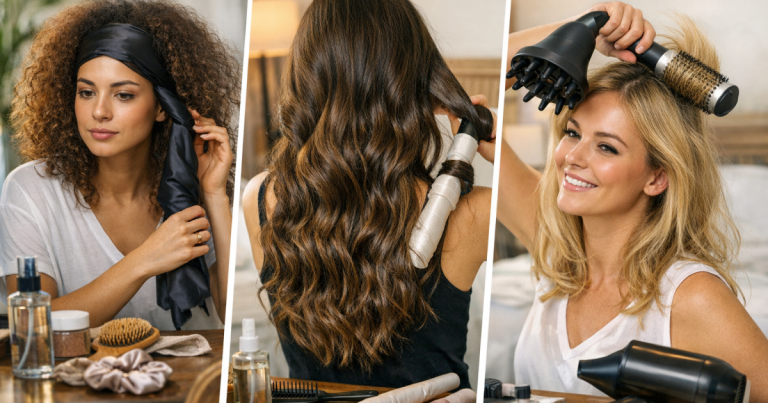
A diffuser is still a heated method, but it is different from clamping hair between plates or wrapping it tightly around a barrel. Used gently, it can dry waves with less disturbance than rough blow-drying. The challenge is technique: too much touching, too much airflow or flipping too aggressively can create frizz. If waves are your main goal, read how to diffuse wavy hair without making it frizzy before blaming the tool.
For heatless curl setting on longer hair, a named option such as the Kitsch Satin Heatless Curling Set is a useful example of the type of overnight tool many people consider. What matters more than the brand name is whether the rod diameter, fabric, fastening method and sleep comfort work for your hair length and routine.
Hair-type guidance that changes the answer
- Fine hair: Heatless methods can be brilliant for soft bends, but avoid heavy oils or thick creams before setting. Heated tools can give better root lift, yet fine hair usually needs lighter tension and fewer passes.
- Thick hair: Heatless styling may need damp hair, sectioning and more drying time. Heat can speed things up, but larger sections often lead to uneven results, so patience still matters.
- Wavy hair: Heatless techniques preserve natural texture well. Diffusing is useful when air-drying leaves roots flat or the pattern drops before it dries.
- Curly and coily hair: Heatless stretching, twists, braids, banding and careful brush styling can reduce reliance on hot tools. Heated smoothing should be occasional and well-prepped if the goal is to protect definition.
- Fragile, bleached or breakage-prone hair: Prioritise heatless setting, silk or satin accessories, low-manipulation styles and gentle detangling. Use heat selectively rather than as the default.
The hybrid routine often looks the most natural
The strongest at-home finishes often combine both approaches. You might air-dry to 80%, use root clips for lift, then diffuse briefly. You might sleep in a satin rod, then refine only the front pieces with a tong. You might wrap hair smooth overnight, then use a straightener on the canopy rather than the whole head.
This is where the heatless vs heated styling decision becomes more nuanced. Heatless methods can do the shape-building while heated tools do the polish, or heat can create the base while heatless accessories preserve it overnight. A silk hair wrap, satin scrunchie or loose claw clip can extend a blow-dry, reducing how often you need to restyle from scratch.
Think in terms of styling workload. If a heated tool is only fixing the same frizzy top layer every morning, your routine may need better drying, overnight protection or product control. If a heatless method always drops within an hour, the issue may be too much moisture at bedtime, sections that are too large, or a finish that your hair type can only hold with some heat-assisted setting.
Where each method can disappoint
Heatless styling can disappoint when expectations are too polished. Overnight curls may be uneven, roots can look flat, and shorter layers can spring out of the wrap. It also requires planning: hair usually needs to be slightly damp or freshly smoothed, and the set needs enough uninterrupted time to form.
Heated styling can disappoint when the finish looks good for 20 minutes and then puffs, drops or feels dry. That usually points to one of four issues: hair was not fully dry before styling, sections were too big, the product mix was wrong, or the style was touched before it cooled. More heat is not always the answer; better preparation often is.
There is also a lifestyle point. If you wash at night, heatless methods may fit naturally. If you wash before work or school, a heated dryer or diffuser may be more realistic. The right method is the one your hair can tolerate and your routine can repeat.
Questions people ask
Can heatless styling give the same result as a curling tong?
It can give a similar wave or curl direction, but usually with a softer, less uniform finish. If you want crisp, identical curls for an event, a tong is normally more predictable.
Is heated styling always damaging?
No. Damage risk depends on frequency, temperature, hair condition, technique and preparation. Occasional careful heat is very different from daily high-heat passes on already fragile hair.
Why do my heatless curls drop so quickly?
Common reasons include hair being too wet, sections being too large, not enough setting time, heavy product, or naturally low hold. Letting the set fully dry before removing it makes a big difference.
What is better for frizz: heatless or heated styling?
For surface polish, controlled heat can smooth frizz faster. For long-term routine gentleness, heatless methods plus better drying and overnight protection may reduce how often frizz needs correcting.
Should I use products with heatless styles?
Usually yes, but lightly. A small amount of mousse, styling cream or anti-frizz product can help hold, while too much oil or heavy cream can make waves drop.
Key takeaways
Choose heatless styling when your priority is gentleness, overnight convenience, soft movement or preserving fragile lengths. Choose heated styling when you need speed, high polish, root lift, strong hold or a more exact finish. For many hair types, the most flattering answer is a hybrid routine: set the shape with lower-stress methods, then use targeted heat only where it improves the final look.
The finish you want matters, but so does the hair you are starting with. Fine hair needs lightness, thick hair needs sectioning, wavy hair needs low-disturbance drying, and fragile hair needs restraint. Once those basics are right, both heatless and heated tools become more predictable.