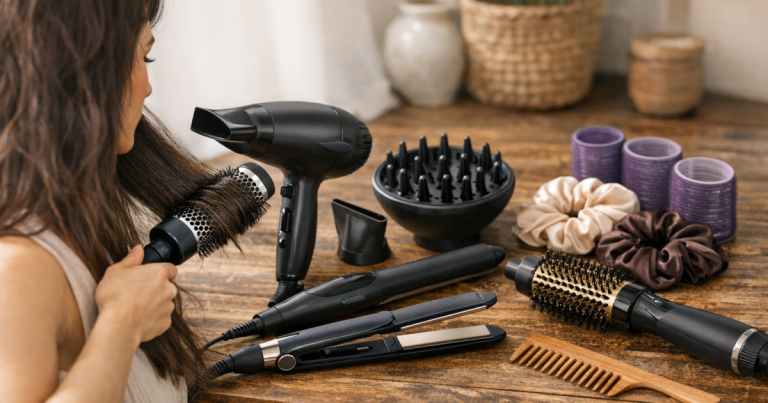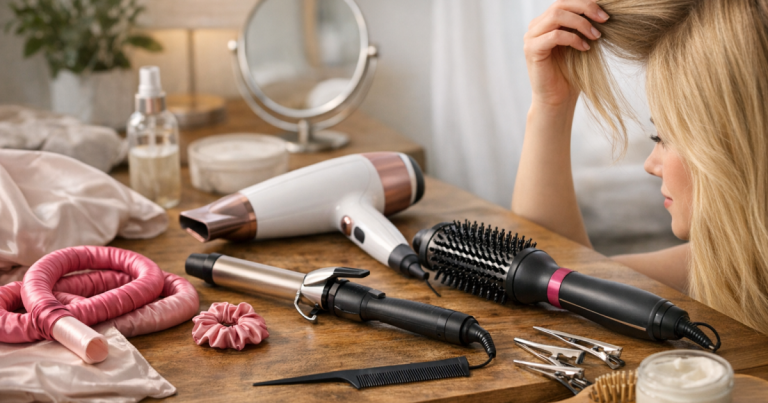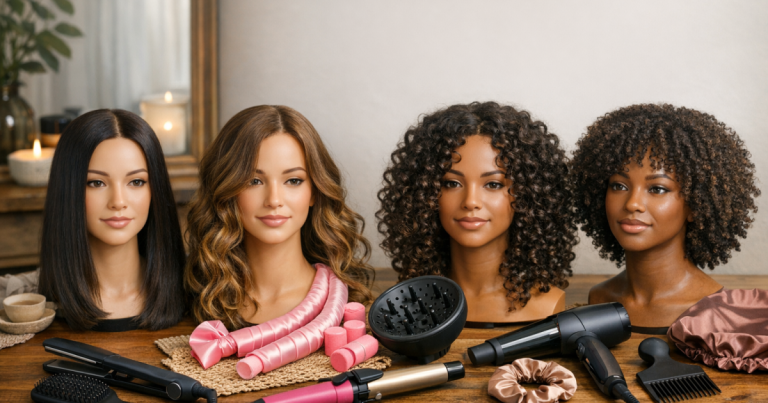
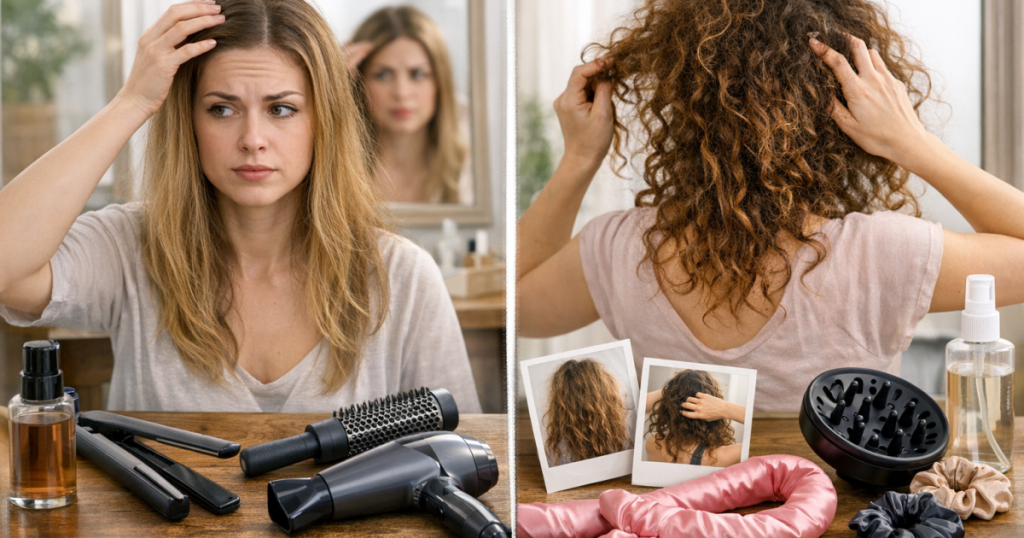
Most styling frustration is not a lack of effort; it is a mismatch between your hair’s behaviour and the tool doing the work. Hair type styling problems usually become easier to solve once you separate texture, density, porosity and cut shape instead of treating all frizz, flatness or puffiness as the same issue.
The aim is not to own every gadget. It is to know which tool changes the finish, which tool only helps the setup, and when a heatless method will give a better result than adding more heat.
In brief
- Fine hair usually needs lift, grip and low-tension shaping rather than heavy smoothing tools.
- Thick hair often needs section control, drying direction and tools that hold enough hair without crushing the shape.
- Curly hair problems are commonly caused by disturbing the curl pattern too soon, not by a lack of styling effort.
- Coily hair benefits from controlled tension, careful airflow and accessories that support stretch without snagging.
- Frizz is not one problem: it can come from dryness, humidity, rough brushing, broken cuticles, overworking or a poor overnight routine.
- Heatless tools can solve shape and set issues, but they do not replace drying power when the root area needs direction.
First, name the real problem
“My hair will not style” is too broad to be useful. A better diagnosis starts with what fails first: roots, mid-lengths, ends, curl pattern, smoothness or hold. The right tool for flat roots is rarely the right tool for fluffy ends, and a brush that makes straight hair glossy can pull waves into a shapeless triangle.
Texture describes the natural pattern of the strand: straight, wavy, curly or coily. Density is how much hair you have on the scalp. Strand thickness is whether individual hairs are fine, medium or coarse. Porosity affects how quickly hair absorbs water and product. A person can have fine strands and high density, or coarse strands and low density, so tool advice only works when those details are separated.
Cut shape matters too. A fringe, heavy one-length ends, grown-out layers or short face-framing pieces can all make the same hair type behave differently. If the front section keeps splitting or puffing, the solution may be a small round brush and nozzle control rather than a new full-head styler. For that specific issue, the step-by-step technique in styling a fringe with a hair dryer is more useful than treating the fringe like the rest of the hair.
Fine hair: flat roots, limp lengths and curls that disappear
Fine hair is easily overwhelmed. Heavy brushes, large smoothing tools and rich finishing products can make it look polished for ten minutes, then flat by lunchtime. The most useful tools are usually those that create lift without dragging the hair down.
What actually helps
- Velcro rollers: useful at the crown, fringe and front layers when the hair is dry or almost dry. They give bend and root lift without the clamp mark that some hot tools can leave.
- Small or medium round brush: better than a very large barrel if the goal is root movement rather than just smoothing the ends.
- Concentrator nozzle: helps direct airflow at the root so the hair cools in a lifted position.
- Heatless curling rod: useful when fine hair drops hot curls quickly, because the hair sets while cooling slowly or overnight.
A detangling brush such as WetBrush Pro Detangler can help before styling, but it will not create volume by itself. For fine hair, detangling should be gentle and brief; repeated brushing after product can remove the grip needed for shape.
Fine hair usually does not need maximum heat or aggressive tension. It needs a clean root area, light product placement, and time for the shape to cool before it is touched. If curls vanish quickly, the issue is often set time, not the curling tool alone.
Thick hair: puffiness, long drying times and shape that will not set
Thick hair can look unfinished even after a long blow-dry because the outer layer dries before the underneath has been controlled. The result is a polished top with swollen mid-lengths, or smooth lengths with damp roots that collapse later.
What actually helps
- Sectioning clips: not glamorous, but essential. Smaller sections let brushes and rollers work on the hair rather than skimming the surface.
- Paddle or vent brush: useful for pre-drying and aligning the hair before detailed shaping.
- Heated rollers: helpful when thick hair needs body and bend without holding a curling tong on every section.
- Wide-barrel heatless wrap: better for soft waves than tight curls, especially if the hair is fully dry before wrapping.
For thick hair, the tool has to match the section size. A roller that is too small may create awkward bends; one that is too large may not grip enough hair to set. If you want a fuller explanation of sectioning, placement and cooling time, the guide to using heated rollers on thick hair breaks down the method in more detail.
Tools such as BaByliss Thermo-Ceramic Rollers are a recognisable example of a heated roller set, but the important checks are roller size mix, grip, how comfortably the clips hold your density, and whether your hair has enough time to cool fully before removal. Thick hair often drops shape when rollers are removed too soon, not because the roller “did not work”.
Wavy hair: frizz at the top, flat underneath and uneven bends
Wavy hair often sits between two routines. Treat it like straight hair and the wave can become fluffy. Treat it like curly hair and it may feel product-heavy or stringy. The best tools encourage pattern without forcing the hair into a shape it cannot hold.
What actually helps
- Diffuser: useful when waves need definition and less disruption from direct airflow.
- Microfibre towel or cotton T-shirt: reduces rough drying before styling, which can make the canopy look frizzy.
- Large heatless curling ribbon: helps create a more uniform wave pattern, especially on layers that bend in different directions.
- Wide-tooth comb: useful in the shower or on wet hair, but often too disruptive once waves have started to dry.
A satin heatless set such as Kitsch Satin Heatless Curling Set can be useful for waves that need a more consistent S-shape, but placement matters. Wrapping too tightly can stretch the root flat while making the ends too curly. For wavy hair, loose tension and larger sections usually look more natural.
Curly hair: definition, shrinkage and root volume
Curly hair tools should preserve clumps, support drying and add volume without breaking the pattern. Many styling failures happen after the right product has already been applied: too much touching, too much airflow, or lifting the roots before the cast has formed.
What actually helps
- Diffuser bowl: supports curls while drying and reduces the blast effect of direct airflow.
- Root clips: lift the crown while curls dry, especially where the top section sits flat.
- Wide-tooth comb or curl-friendly brush on wet hair: helps distribute conditioner or styling product before the pattern is set.
- Silk or satin wrap: protects curl shape overnight so you are not restyling from scratch every morning.
For volume, timing is everything. Root clips work best when placed while the hair is wet enough to be moulded but not so wet that the clip slides or leaves a hard parting. The technique is simple, but placement changes the result; the tutorial on root clipping curly hair while diffusing shows why the crown, parting and front sections need different handling.
Curly hair does not always need a curling tool. If the natural curl is present but inconsistent, the more effective “tool” may be a diffuser, clips and an overnight wrap. Curling individual pieces can help for special styling, but relying on hot tools too often can make the natural pattern harder to maintain.
Coily hair: shrinkage, tension, stretched roots and fragile ends
Coily hair usually needs tools that respect structure and reduce unnecessary manipulation. The problem is rarely that the hair cannot be styled; it is that the wrong tool can create snagging, uneven tension or a finish that reverts quickly.
What actually helps
- Wide-tooth comb: useful for detangling in sections with conditioner or slip, rather than dry combing through tight coils.
- Comb attachment or controlled nozzle: can help stretch the root area during a blow-dry when used with careful sectioning.
- Soft hair pins and sectioning clips: support wrapping, banding or setting without crushing the hair.
- Silk wrap: helps preserve a stretched or smoothed finish overnight and reduces friction around the hairline.
For coily hair, the question is not just “does this smooth?” but “how much tension does it need to smooth?” A brush that requires repeated passes may be less helpful than a tool that lets you work slowly in sections. Ends need particular care because they are older and more exposed to friction, so any smoothing routine should start with detangling and end protection rather than heat alone.
Straight hair: grease at the roots, bends from sleep and flyaways
Straight hair can show every mark: a dent from a clip, a kink from sleeping, or oil at the roots. Because the surface reflects light easily, roughness and flyaways can be obvious even when the hair is healthy.
What actually helps
- Flat brush and nozzle: useful for smoothing from roots to ends without adding too much curve.
- Velcro roller at the crown: adds lift without turning the style into a curl set.
- Mini straighteners: useful for small areas such as the hairline, fringe or face-framing bends, but not a full frizz strategy for dense hair.
- Silk or satin wrap: helps reduce morning creases and friction, especially after a smooth blow-dry.
Straight hair often responds better to prevention than correction. A smooth overnight wrap, dry shampoo used sparingly at the roots, and avoiding heavy oil near the crown can do more than repeatedly straightening the same sections each morning.
Frizz: which tool fixes which kind?
Frizz is where tool advice gets misleading. A straightener may flatten surface frizz for the day, but it will not solve frizz caused by dryness, rough towel drying, humidity, broken ends or brushing curls when dry. Match the tool to the trigger.
- Humidity frizz: use smoother drying, protective finishing product and an overnight wrap; tiny hot-tool touch-ups only help selected areas.
- Dryness frizz: improve conditioning and reduce rough handling before expecting a styling tool to fix the finish.
- Canopy frizz on waves or curls: avoid brushing once dry; use a diffuser, gentle scrunching and a smooth drying surface.
- Heat-damage frizz: reduce heat frequency, use lower-tension styling and protect ends with conditioning support.
- Root frizz: control airflow direction and drying position; do not only smooth the lengths.
The key is to avoid using the most aggressive tool for every frizz type. A mini straightener can refine a fringe or hairline, but if the whole outer layer is fuzzy, the more useful change is usually drying method, product balance and overnight protection.
Heatless tools: when they genuinely solve the problem
Heatless styling tools are not just a gentler version of hot tools. They work best when the problem is shape-setting, overnight preservation or reducing morning restyling. They are less effective when the root area is damp, the hair has not been detangled properly, or the cut needs more support than the tool can provide.
A satin curling rod can create consistent waves on fine, medium or wavy hair, but it may not give enough root lift on very heavy hair unless the crown is handled separately. Velcro rollers are excellent for lift and bend, but they need clean sections and should be removed carefully to avoid tangling. A silk hair wrap is most useful when the style is already smooth and you want to keep it that way overnight.
Heatless methods also suit people who are trying to reduce hot-tool reliance without giving up a styled finish. The trade-off is time: most heatless tools need several hours or overnight wear, and the result depends heavily on how dry the hair is before setting.
What to remember
The most reliable way to solve hair type styling problems is to match the tool to the exact failure point: roots, ends, curl pattern, density, frizz trigger or overnight collapse. Fine hair needs lift without weight. Thick hair needs section control and cooling time. Wavy and curly hair need pattern support rather than constant brushing. Coily hair needs careful tension, protection and tools that work in sections.
If a tool only makes the style look good for a few minutes, it is probably correcting the surface rather than fixing the cause. Start with the smallest useful change: a nozzle, better sectioning, rollers at the crown, a diffuser, root clips or a smoother overnight wrap. That is usually more effective than buying a stronger hot tool and repeating the same routine harder.
FAQ
Can one styling tool work for every hair type?
Not usually. A hair dryer with the right attachment is versatile, but fine, thick, curly and coily hair need different handling, section sizes and drying direction. Attachments often matter as much as the dryer itself.
Are heatless tools better for frizz?
They can be, especially when frizz is caused by repeated heat or overnight friction. They will not fully solve frizz caused by dryness, damaged ends or brushing curls after they have dried.
Why does my hair look good after styling but collapse quickly?
The shape probably has not cooled or set properly, or the tool is too heavy for your strand type. Fine hair often needs lighter product and more cooling time, while thick hair needs smaller sections.
Should curly hair be brushed before using styling tools?
Brush or comb curly hair when wet and conditioned, then avoid disturbing the pattern once it starts to dry. Dry brushing usually creates volume, but it can also cause frizz and break up definition.
What is the easiest upgrade if my routine is not working?
Change the attachment or accessory before replacing the main tool. A concentrator nozzle, diffuser, sectioning clips, Velcro rollers or silk wrap can make a bigger difference than using more heat.