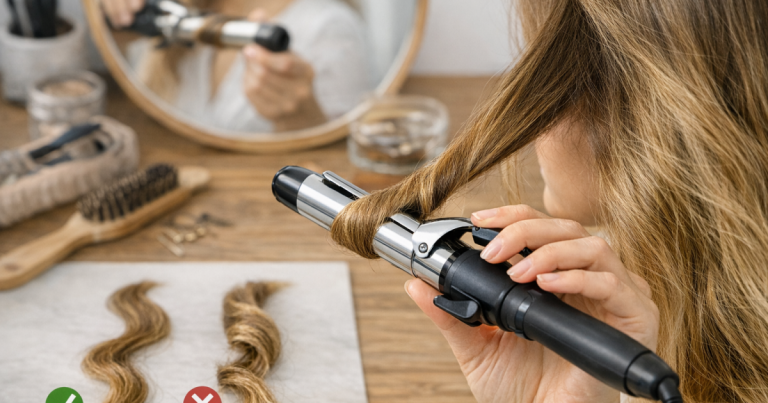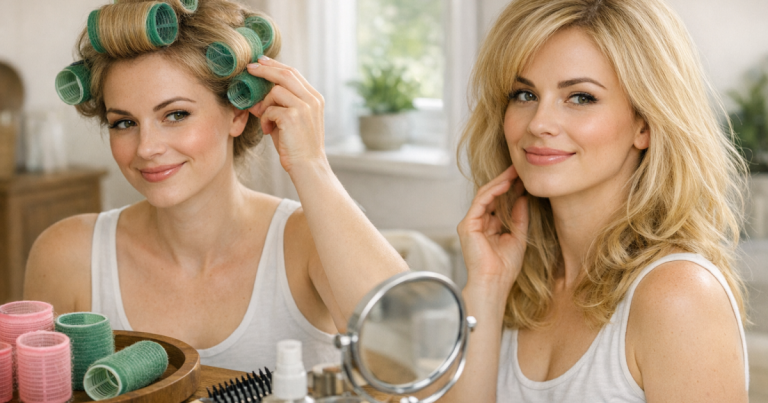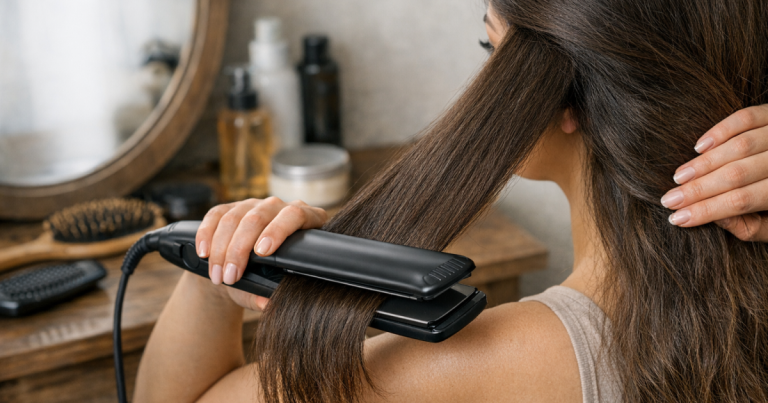
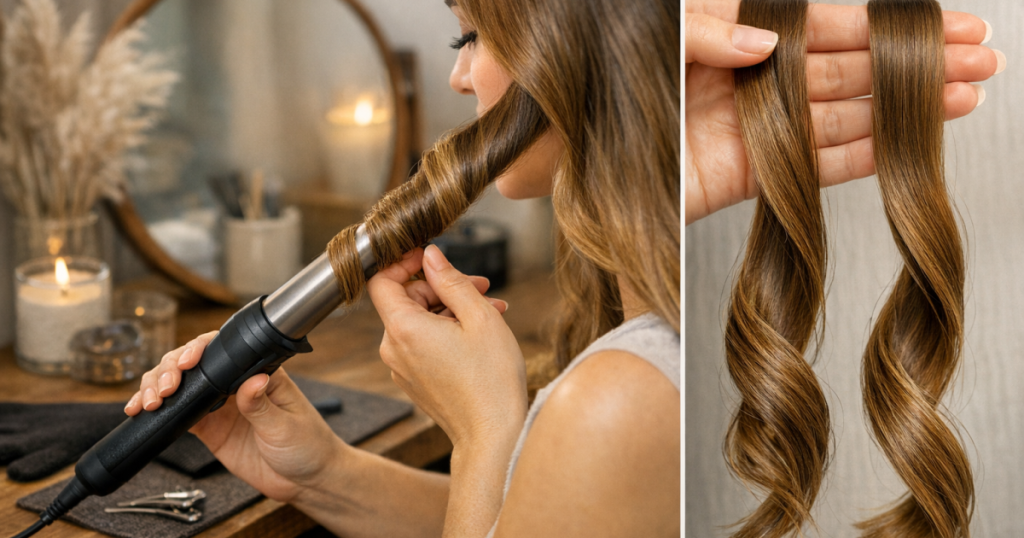
Getting smooth, even curls from a curling tong without clamp marks is mostly about placement, tension and timing. The clamp is not the enemy; it just needs to hold the hair lightly rather than pinch it flat.
The biggest mistake is clamping the end of the section first and winding upwards with too much pressure. That traps the tips, folds the hair against the barrel and leaves a visible dent where the clamp begins or ends.
What to know first
Clamp marks usually happen when the tong is closed too tightly, the section is too thick, or the hair enters the clamp at a sharp angle. Smooth curls come from feeding the hair in cleanly, keeping the clamp slightly relaxed, and releasing the curl without dragging the tong through the finished shape.
- Use smaller sections if the curl looks creased or uneven.
- Hold the tong vertically for softer, modern waves and horizontally for more traditional bounce.
- Keep the ends smooth and untwisted before they go under the clamp.
- Do not clamp over previous kinks, hair grips, roller marks or elastic dents.
- Let the curl cool before brushing, especially on fine or freshly washed hair.
Step 1: Start with hair that will slide cleanly
A curling tong needs enough grip to shape the hair, but the surface should still move smoothly under the clamp. Hair that is overloaded with oil, mousse or dry shampoo can catch, while very fluffy hair can buckle as the clamp closes.
Brush through the lengths first, then check the ends. If the last few centimetres are tangled or dry, the clamp will exaggerate that unevenness. A tiny amount of lightweight serum or styling cream on the ends can help, but keep it minimal on fine hair so the curl does not collapse.
If you use heat regularly, build the routine around protection rather than simply turning the temperature higher. Fine or highlighted hair usually needs a gentler approach than coarse, resistant hair. For more tool-specific protection tips, see how to protect fine hair when using multi-stylers.
Step 2: Choose section sizes that suit your hair type
Section size has a bigger effect on clamp marks than many people realise. When too much hair is squeezed into the clamp, the top layer heats and bends before the inner hair has wrapped smoothly around the barrel. That creates creases, flat spots and inconsistent curl.
Fine hair
Use narrow, clean sections, roughly 2–3 cm wide. Fine hair shows dents quickly because there is less density to disguise them. Keep the clamp pressure light and avoid holding the ends under the clamp for longer than necessary.
Medium-density hair
Work with sections around 3–4 cm wide, adjusting smaller around the face and shorter layers. If your curls look smooth at the front but crimped at the back, your back sections are probably too large or not brushed through evenly.
Thick, coarse or long hair
Split the hair into more layers rather than trying to curl large chunks. Thick hair often needs cleaner sectioning, not more pressure. If the tong struggles to close, the section is too big for a smooth finish.
Step 3: Open the clamp before the hair touches the barrel
For the neatest result, open the clamp first, lay the mid-length of the section against the barrel, then close the clamp lightly over the hair. This avoids trapping the ends at a harsh angle.
Think of the clamp as a guide rather than a clamp-down grip. If you can see a hard line forming straight away, release and reset the section before heat fixes the mark. The hair should curve around the barrel, not fold into it.
For a softer wave, start around the mid-lengths and leave the last 2–4 cm out until the final moment. This gives the ends a more relaxed finish and helps prevent the classic fish-hook bend that appears when the tips are clamped too tightly.
Step 4: Wind the hair without twisting the section
Twisted hair creates uneven contact with the barrel, so the clamp presses some strands harder than others. Before winding, hold the section flat like a ribbon. Keep that ribbon shape as you rotate the tong.
- For polished curls, keep the section flat and smooth as it wraps.
- For beachier waves, allow a slight rope-like twist, but keep the clamp loose to avoid dents.
- For face-framing pieces, angle the tong away from the face and use smaller sections.
- For short layers, clamp closer to the mid-lengths rather than trying to catch every end perfectly.
If using a tong feels too structured for your hair, straighteners can create a softer bend with less clamp pressure. The technique is different, but using straighteners for soft waves on fine hair can be a helpful alternative when you want movement rather than ringlets.
Step 5: Control the clamp pressure
Most clamp marks come from squeezing rather than curling. Once the hair is wrapped, you only need enough pressure to stop the section slipping out. If you press the handle hard, the clamp edge can stamp a line into the hair.
Try this simple check: close the clamp gently, then slightly loosen your grip without opening it fully. The hair should still stay in place, but the clamp should not feel locked down. This is especially important near the ends, where hair is older, drier and more likely to show bends.
If your tong has a strong spring clamp, move slowly and deliberately when closing it. Letting it snap shut is one of the fastest ways to create a dent. On delicate hair, you may get a smoother finish by using the clamp only at the start, then wrapping the rest of the section around the barrel with your fingers kept safely away from the hot surface.
Step 6: Watch the angle at the ends
The ends are where clamp marks often become obvious. If the hair enters the clamp diagonally, the barrel creates one curl direction while the clamp creates another. The result is a kinked end rather than a soft curl.
To avoid this, line the ends up neatly with the barrel and slide them under the clamp in the same direction as the wrap. Do not fold the last few centimetres back on themselves. If the ends are too short to sit neatly, leave them out and smooth them later with the remaining warmth from the curl.
For a modern finish, keep the very tips slightly straighter. This works particularly well on lobs, layered cuts and fine hair because it reduces the over-curled look that can make ends appear thinner.
Step 7: Release the curl without dragging it
How you remove the tong matters as much as how you wrap the hair. If you pull the tong down while the clamp is closed, the clamp edge can mark the curl as it slides out. Instead, open the clamp fully and let the curl fall into your palm or drop gently from the barrel.
For longer-lasting shape, cup the curl for a few seconds while it cools. This is useful for fine hair, heavy hair and freshly washed hair, which can all drop quickly. Avoid brushing immediately; warm hair is still setting, so brushing too soon can stretch the curl and make any small crease more visible.
What to do if you already made a clamp mark
A visible dent does not always mean you need to rewash or start again. Let the section cool first, then decide whether it needs softening, smoothing or re-curling.
- If the mark is small, mist your fingers lightly with water, smooth the dent and let it dry before touching it again.
- If the end has a hook, rewrap only the last few centimetres with lighter clamp pressure.
- If the mid-length is creased, brush out that section and curl it again from a slightly lower starting point.
- If the curl looks too tight after fixing it, blend it with neighbouring sections once everything is fully cool.
Second-day hair is often more forgiving because it has more texture and less freshly washed slip. If your curls mainly need refreshing rather than a full restyle, try these ideas for reviving second-day waves without rewashing.
Small technique changes for different finishes
Soft waves
Hold the tong vertically, start at the mid-lengths and leave the ends slightly out. Use light clamp pressure and curl each section away from the face around the hairline. This gives movement without obvious barrel-shaped curls.
Bouncy curls
Hold the tong more horizontally and wrap from ends to roots with neat, flat sections. The key is to feed the ends smoothly into the clamp rather than trapping them sharply. Pinning each curl while it cools can help, but remove pins carefully so they do not leave extra dents.
Loose bends on short hair
Use smaller sections and avoid over-rotating the tong. Short hair can show clamp lines quickly because there is less length for the curl to blend. Clamp at the mid-length, rotate once or twice, then release rather than trying to wind the whole piece tightly.
Defined curls on thick hair
Work in lower, middle and top layers. Keep the tong moving section by section rather than increasing pressure. If the underneath layers are bulky, curl them in slightly smaller sections so the top layer sits smoothly over them.
Common causes of clamp dents
- The clamp closes too hard: use a lighter grip and avoid snapping it shut.
- The section is too wide: reduce the amount of hair so it wraps evenly around the barrel.
- The ends are folded: feed them in smoothly or leave the final centimetres out.
- The hair is twisted unevenly: brush and flatten the section before wrapping.
- The tong is pulled out while closed: open the clamp fully before releasing the curl.
- The starting point is too high: begin lower on the mid-lengths if root dents are appearing.
Questions people ask
Is a curling wand better than a tong for avoiding marks?
A wand removes clamp marks because there is no clamp, but it requires more hand control. A tong can still give a smooth finish if you use light pressure and clean sectioning.
Why do I get a line near the end of every curl?
The ends are probably being folded under the clamp or held too tightly. Feed them in flatter, leave the last few centimetres out, or release the clamp slightly once the hair is wrapped.
Should I curl clean hair or day-old hair?
Day-old hair often holds shape better and shows fewer dents because it has more natural grip. Freshly washed hair can still work, but it usually needs careful brushing, light product and proper cooling time.
Can clamp marks be brushed out?
Very light marks can soften with brushing once the hair has cooled. Deeper dents usually need a quick reset with water, smoothing or re-curling the affected section with less pressure.
Do clamp marks mean my tong is poor quality?
Not always. Technique is usually the main issue. However, a clamp that catches, closes unevenly or feels overly tight can make dents harder to avoid.
Why it matters
Using a curling tong neatly is less about perfect salon technique and more about reducing the moments where hair gets folded, squeezed or dragged. Smaller sections, lighter clamp pressure and a cleaner release will usually solve the problem faster than changing every product in your routine.
If your curls still look marked, change one variable at a time: section size first, then clamp pressure, then release technique. Once those are working together, the tong should create smooth movement rather than tell-tale clamp dents.