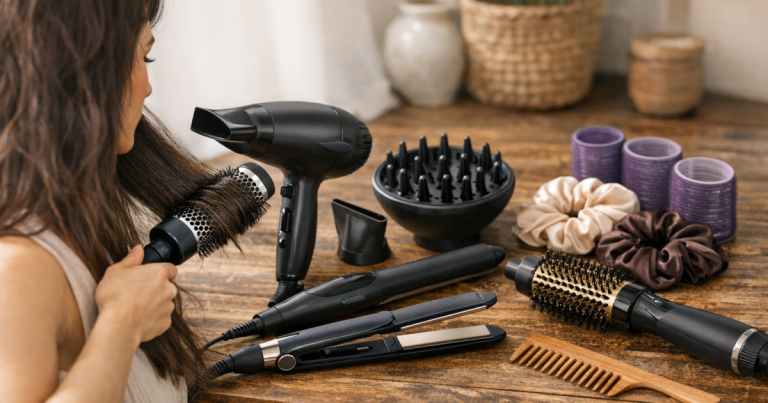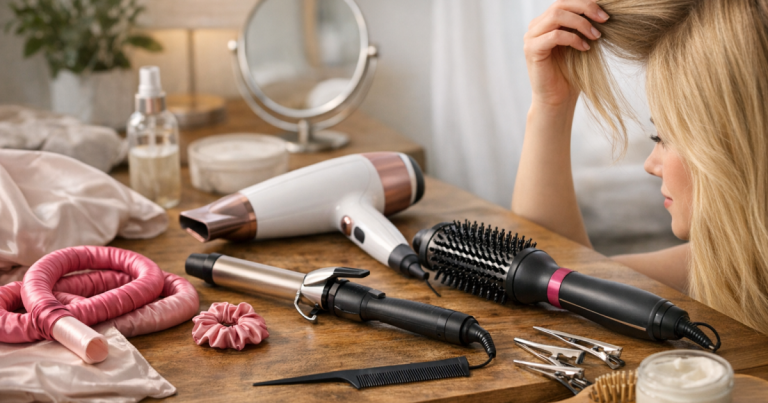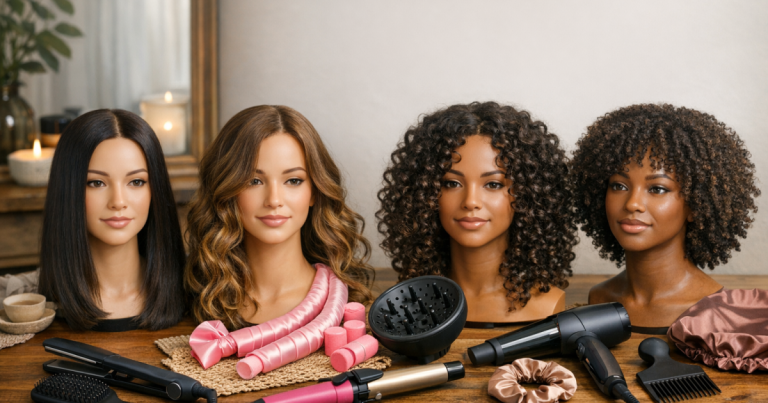
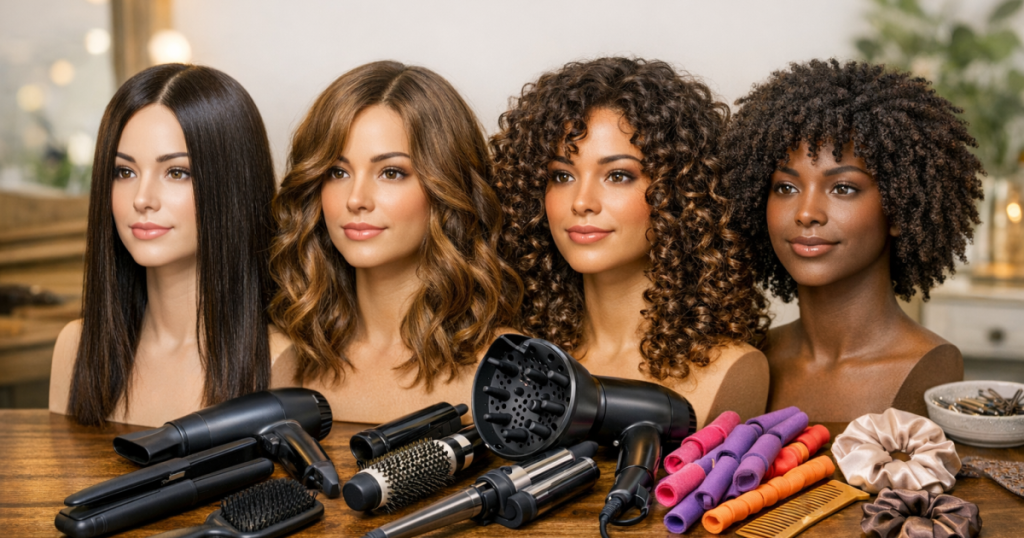
Your curl pattern is useful, but it is not the whole decision. A straight, wavy, curly or coily hair tool guide only works when it also accounts for density, strand thickness, condition and the finish you want that day. Fine hair may need lift without weight; thick hair may need airflow and sectioning; textured hair usually needs tools that preserve shape rather than rough it up.
The short version
- Straight hair usually benefits from tools that add bend, root lift or polish without making the hair limp.
- Wavy hair needs tools that encourage natural bends rather than brushing them into frizz or flattening them out.
- Curly hair does best with controlled detangling, gentle drying and tools that keep curl clumps intact.
- Coily hair often needs section-friendly tools, careful tension and accessories that support stretching, shaping and moisture retention.
- Density changes everything. A low-density curl may need lighter tools than thick straight hair. If that distinction feels blurry, start with this explainer on hair texture vs density.
Why curl pattern is only the starting point
Two people can both have wavy hair and still need completely different tools. One may have fine, low-density waves that collapse under heavy creams and oversized brushes. The other may have dense, coarse waves that need stronger sectioning, more drying time and tools that can reach the roots.
Before choosing a brush, dryer, roller or heatless styler, look at four practical factors. First, consider strand thickness: fine strands mark easily and can lose volume quickly, while coarse strands often need more smoothing and controlled tension. Second, check density: thick hair usually needs smaller sections, stronger clips and better airflow. Third, consider condition: bleached, colour-treated or heat-stressed hair may need gentler routines and fewer high-tension passes. Finally, be honest about your goal. Sleek hair, bouncy hair, defined curls and stretched coils are not achieved with the same tool set.
Straight hair: add shape without dragging it down
Straight hair often looks glossy naturally, but it can struggle to hold bend, root lift or a bouncy finish. The most useful tools are usually the ones that create shape while keeping the cuticle smooth.
- For root lift: Velcro rollers at the crown can add volume while the hair cools or dries. They work best when the section is not too wide and the roller has enough grip without pulling.
- For smoothness: A paddle brush or vent brush can help guide the hair during drying. A flexible vented brush such as Wet Brush Pro Flex Dry is a recognisable example of the type to compare, especially if you want a brush that can move through damp hair without feeling too rigid.
- For soft bend: Satin heatless rods, large rollers or a loose overnight wrap can give straight hair movement without relying on daily hot-tool styling.
- For quick volume: A hot-air brush can help create a salon-style curve at the ends, but straight fine hair can become too smooth and flat if the brush is too large or the product layer is too heavy.
The common mistake with straight hair is choosing tools that are too aggressive for the result. If your hair drops quickly, focus less on hotter styling and more on prep, section size, cooling time and light hold.
Wavy hair: support the bend, then refine it
Wavy hair sits in the middle: it can be encouraged into soft texture or accidentally brushed into puffiness. The tool choice depends on whether you want relaxed movement, defined waves or smoother, stretched-out hair.
- For natural wave definition: Use a wide-tooth comb or fingers after washing, then avoid repeated brushing once the wave pattern has formed.
- For frizz control: A microfibre towel or soft curl towel can reduce rough drying. Only Curls Microfibre Hair Towel is a useful named example of this category, though the key thing to check is size, softness and whether it suits your hair length.
- For loose body: Heatless curling rods or large rollers can make waves look more intentional without turning them into tight curls.
- For drying: A diffuser can help if waves become limp when air-dried, but keep the airflow gentle and avoid moving the hair around too much.
If your waves are fine, avoid stacking too many styling layers before using tools. If your waves are thick, divide the hair into smaller sections so the underneath is not left damp and undefined.
Curly hair: protect the clumps
Curly hair usually looks best when tools work with the curl pattern rather than breaking it apart. The main aim is to detangle safely, define while wet or damp, and dry without disturbing the shape.
- For detangling: Start with conditioner or slip, then use fingers, a wide-tooth comb or a flexible detangling brush in sections. Work from ends upwards rather than pulling from the root.
- For definition: A styling brush can help form curl clumps, but it should glide smoothly and not create too much tension on fragile ends.
- For drying: A diffuser-style dryer such as Bellissima Diffon Supreme is one type of tool curly-haired readers may compare with a standard dryer and diffuser attachment. Check the shape, handling and airflow control rather than assuming one design suits every curl pattern.
- For overnight shape: A silk wrap, satin bonnet or loose pineapple can help reduce friction while preserving the curl pattern.
Curly hair can also respond well to mixed routines: diffusing the roots for lift, then letting the lengths finish drying with minimal touching. For more texture-specific routines, the site’s guide to heatless routines for fine, thick and curly hair is a useful next step.
Coily hair: section, stretch and shape with care
Coily hair can be delicate even when it looks strong, because bends and tight curves create points where strands can snag or break. Tools should make sectioning easier, reduce friction and support the finish you want: defined coils, stretched length, volume, protective styling or a smooth set.
- For detangling: Use generous sections only if your hair is low density. Dense coily hair usually needs smaller sections, clips and a tool that can move through with control.
- For stretching: Banding, threading, large twists or a gentle tension method can stretch the hair without relying on a straightener. The right choice depends on time, comfort and how smooth you want the result.
- For volume: An Afro pick can lift the roots once the hair is dry, but avoid picking through the ends if you want to keep definition.
- For setting: Flexi rods, perm rods or satin-covered heatless tools can create uniform shape. Smaller sections usually give a neater set, while larger sections give a softer finish.
- For protection: Silk or satin wraps reduce friction during sleep and can help preserve stretched or set styles for longer between wash days.
With coily hair, the tool is only part of the routine. Slip, moisture, section size and patience matter just as much. If a tool needs force to work, it is probably the wrong match for that moment.
Match the tool to the finish you actually want
Hair type tells you the starting point; your styling goal tells you the direction. The same head of hair might need a diffuser on wash day, Velcro rollers before an event, a silk wrap at night and a detangling brush only in the shower.
- Sleek finish: Look for smoothing brushes, controlled airflow and sectioning clips. Fine hair needs light tension; thick or coarse hair may need smaller sections.
- Bouncy volume: Rollers, hot-air brushes and round brushes can all help, but the best choice depends on whether your hair holds shape easily or drops quickly.
- Defined texture: Diffusers, curl towels, styling brushes and hands-off drying are usually more helpful than repeated brushing.
- Heatless shape: Satin rods, flexi rods, wraps and rollers can work across hair types, but the size and tension should match your texture and comfort.
For a wider tool-by-goal breakdown, including when a dryer, roller, brush or heatless styler makes the most sense, read the guide to the best hair styling tools by goal and hair type.
Common tool mismatches to avoid
- Using a dense brush on dry waves or curls: This can turn definition into frizz unless you are intentionally brushing out a set style.
- Choosing oversized rollers for short or fine hair: They may add lift but not much bend, especially if the hair cannot wrap securely.
- Drying thick hair in sections that are too large: The surface may look finished while the underneath stays damp and loses shape.
- Applying too much tension to fragile curls or coils: Smooth results are not worth unnecessary stress on the hairline or ends.
- Assuming heatless means effortless: Heatless tools still need the right dampness level, secure placement and enough setting time.
Things readers ask
Can straight hair use curl-focused tools?
Yes, but choose larger, softer tools if you want bend rather than tight ringlets. Satin rods, large rollers and gentle wraps often suit straight hair better than small curl formers.
Should wavy hair be brushed when dry?
Usually only if you want a softer, brushed-out look. For defined waves, detangle when wet or damp, then leave the pattern alone while it sets.
Is a diffuser only for curly hair?
No. Diffusers can help wavy hair keep shape and root lift too. The key is gentle airflow and minimal touching, rather than scrunching constantly.
What tool matters most for coily hair?
A good detangling set-up matters most: sections, slip, clips and a suitable comb or brush. Styling tools work better when detangling is controlled first.
Do I need different tools if my hair is fine but curly?
Often, yes. Fine curls usually need lighter products, gentler brushes and less heavy tension than dense or coarse curls, even when the curl pattern looks similar.
What to remember
The most reliable hair tool guide is not based on curl pattern alone. Straight hair often needs lift and hold, wavy hair needs support without disruption, curly hair needs definition and controlled drying, and coily hair needs section-friendly tools that respect shrinkage and fragility. Start with your natural pattern, adjust for density and strand thickness, then choose the tool that matches the finish you want today.