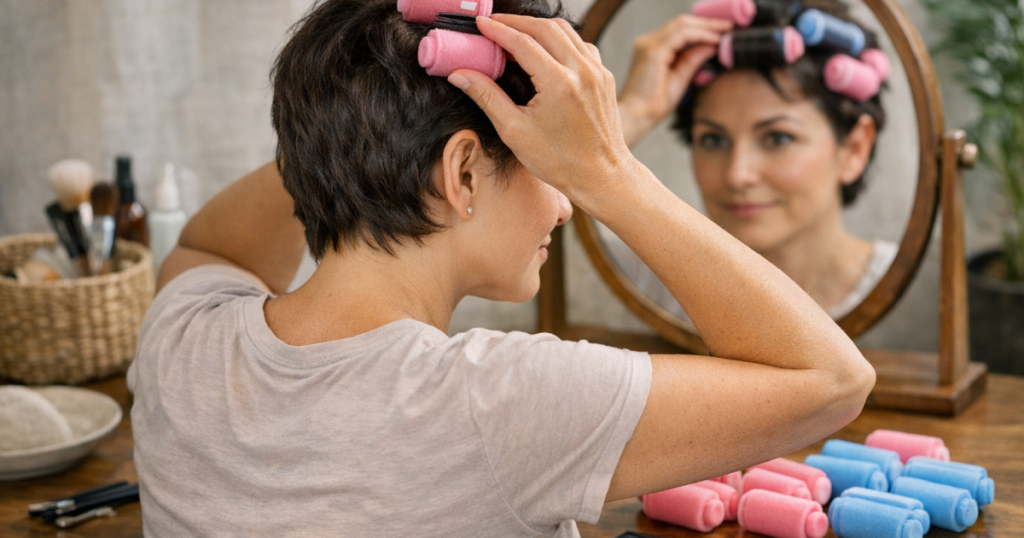
Foam rollers are one of the gentlest ways to add bend, lift and polish to cropped styles, but the technique has to be tighter and more deliberate than it is on long hair. The trick with foam rollers on short hair is using small enough sections, placing the roller where you want the movement to start, and letting the hair dry fully before you unwind.
The short version
For short styles, the roller is not just a curl-maker; it is a shape-setter. A tiny change in direction can mean the difference between soft volume, a rounded vintage curl, a flicked-out bob or a fringe that sticks up awkwardly.
- Use smaller rollers for pixies, crops, short layers and fringes; use medium rollers for bobs and longer top sections.
- Start with damp, not wet, hair so the set dries properly.
- Keep sections narrower than the roller to avoid dents and loose ends.
- Roll under for rounded shape, over for lift, and diagonally for softer movement.
- Do not brush immediately after removing the rollers; separate with fingers first.
If you are not sure what finish you want, pause before sectioning and plan the shape before choosing a tool. Foam rollers work best when they are matched to a specific result rather than placed randomly around the head.
Start with the right level of dampness
Short hair is easy to over-wet because there is less length to absorb product and water. If the hair is dripping or heavy, foam rollers can flatten the root, stretch out natural texture and take far too long to dry. If the hair is completely dry, the set may be weak unless your hair already holds shape easily.
A good starting point is towel-dried or lightly misted hair that feels cool and flexible but not saturated. For fine hair, use less water and very little product. For coarse, resistant or naturally straight hair, a light styling lotion, curl cream or mousse can help the bend last, but avoid loading the roots if you want volume.
How to position foam rollers on short hair
The shorter the cut, the more placement matters. On long hair, the length can soften mistakes; on a crop or bob, every roller affects the visible silhouette. Work from the area you care about most, usually the fringe, crown or face-framing layers, rather than starting at the nape by habit.
For root lift at the crown
Take a narrow section at the top of the head, lift it straight up, place the roller behind the ends and roll down towards the scalp. Keep the section smooth but do not pull so tightly that the roller crushes the root. This works well on fine short hair, soft bobs and layered crops that fall flat by midday.
For a rounded bob shape
Roll the side and back sections under, keeping the ends tucked neatly around the roller. The aim is not a tight ringlet; it is a curved bevel through the ends. Medium foam rollers usually suit this better than very tiny ones, because very small rollers can make a bob look too curled and compact.
For flicks and movement
Roll the ends away from the face or use a diagonal angle through the side sections. This is useful for short layered cuts where you want movement without a full curl set. Diagonal placement also helps if your hair looks too helmet-like when every roller sits in a straight horizontal line.
For fringes and short front pieces
Use a small roller and very light tension. Rolling a fringe too tightly can make it spring up, while using a roller that is too large can leave it flat with a bend only at the end. If your fringe is prone to splitting, set it in the direction you want it to fall while the hair is still slightly damp.
Section sizes that actually work on short cuts
The biggest mistake is taking sections that are too wide. The hair should sit on the roller without spilling over the sides. If the section is wider than the roller, the edges dry unevenly and can create frizz, flat patches or bent ends.
- Pixie crop with longer top: use very small sections across the top and fringe, leaving the shortest sides alone unless they need smoothing.
- Short layered bob: use small to medium sections, rolling the top for lift and the sides under or diagonally for shape.
- Chin-length bob: use medium rollers through the main length and smaller rollers around shorter front layers.
- Short curly or coily hair: roll fewer sections with more care, smoothing each curl group rather than separating the hair into tiny random pieces.
If the ends keep popping out, your section is probably too thick, too dry or not smoothed enough before rolling. Mist the ends lightly, comb through with fingers or a wide-tooth comb, then wrap the very ends around the roller before rolling towards the scalp.
Step-by-step: setting the rollers
Foam rollers are simple, but short hair rewards a tidy routine. Set aside enough time for the hair to dry fully; removing the rollers too early is the main reason the result drops or turns fluffy.
1. Prep the hair lightly
Start with clean or refreshed hair. Add a small amount of styling product only where you need hold. Fine hair may need a light mousse at the roots; thick or dry hair may prefer a small amount of leave-in cream through the lengths. Keep oils and heavy creams away from the scalp if volume is the goal.
2. Decide your direction
Before the first roller goes in, choose whether each area should lift, tuck under, flick out or curl away from the face. For a natural finish, not every section needs to go the same way. The crown can be rolled under for volume, while face-framing pieces can be rolled away for softness.
3. Keep the ends smooth
Short ends are the part most likely to kink. Hold the section flat, place the roller close to the ends and tuck them smoothly around the foam before rolling. If the tips are bent at the start, they will usually stay bent when dry.
4. Secure without squashing
Fasten the roller so it feels stable, not tight. If it pulls at the scalp or leaves a deep mark, loosen it and reset the section. Foam is forgiving, but too much tension can create dents, especially around the hairline.
5. Let the set dry completely
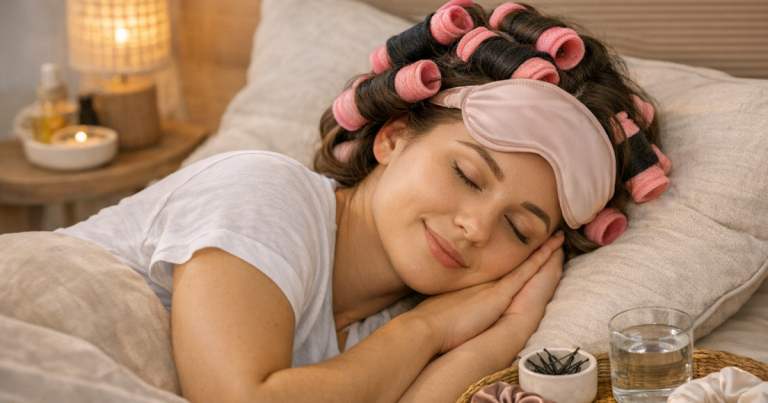
Air drying is the most heatless route, but short hair can still hold moisture at the roots and inside the rolled section. Touch the base of a few rollers before removing them. If the hair feels cool, damp or heavy, give it longer. Sleeping in foam rollers can work, but only if they are comfortable and not pulling at delicate edges or a sensitive scalp.
6. Remove, then shape gently
Unclip each roller and unwind rather than yanking it out. Let the curls settle for a minute, then use your fingers to separate and place them. For a softer finish, brush only after the shape has cooled and relaxed; brushing immediately can turn a neat set into puffiness.
Hair-type adjustments
Fine, straight hair usually needs smaller sections, a little root support and a firmer drying time. Avoid heavy creams, as they can make short hair look greasy or collapse the set. If your curl drops quickly, set the top sections slightly tighter than your intended final look.
Thick or coarse short hair often needs more smoothing before rolling. Work in clean sections, control the ends and avoid overpacking each roller. A larger number of smaller sections usually gives a cleaner result than trying to force too much hair around each roller.
Wavy hair can respond beautifully to foam rollers because they refine the bend without heat. Follow the natural wave pattern where possible and avoid brushing out too much afterwards. For curly hair, think of rollers as a way to stretch, shape or redirect specific areas rather than erase the curl pattern completely.
Coily short hair may need a more intentional prep stage, especially if the goal is a stretched set. Smooth each section with fingers first and keep the roller placement consistent. If your main aim is length and shape rather than curl, banding curly hair without heat may be a better starting method before adding roller detail at the ends.
How foam rollers compare with other heatless methods
Foam rollers are best when you want controlled shape in a small area: a lifted crown, tucked-under ends, soft curls around the face or a more polished bob. They are less ideal if you want long, flowing, uniform waves, because short hair can become too curled when every section is wrapped tightly.
Heatless curling rods tend to create a looser, more continuous wave, but they can be awkward on very short layers that cannot wrap around the rod. Velcro rollers can add strong lift and smoothing, but they may snag if the hair is fragile, very curly or heavily layered. Silk and satin tools create less friction than many basic fabrics, so if frizz is your main problem, it is worth understanding how silk and satin heatless curlers differ before changing your routine.
Fixes for common roller problems
The curls look too tight
Use larger rollers next time, take slightly bigger sections or roll only the mid-lengths and ends rather than all the way to the root. For the current set, soften with fingers first, then use a wide-tooth comb if needed.
The roots are flat
You may have rolled downward with too much moisture at the root. Next time, lift crown sections up and away from the scalp before rolling, and avoid heavy product near the base.
The ends are bent or hooked
The ends were not wrapped smoothly. Dampen just the problem pieces, tuck them flat around a small roller and let them dry again. End papers can help if your hair is very blunt, slippery or freshly trimmed.
The result is fluffy rather than defined
This usually comes from removing the rollers too soon, brushing too quickly or using sections that were too wide. Let the hair dry fully, unwind gently and separate with fingertips. If this keeps happening, your hair type may need a different tool or prep method; the guide to hair-type styling problems and tool choices can help narrow that down.
Common questions
Can foam rollers work on a pixie cut?
Yes, if the top or fringe is long enough to wrap around the roller at least once. Very short sides may be better smoothed with product or left natural rather than rolled.
Should I sleep in foam rollers with short hair?
You can, but comfort and tension matter. Keep the rollers loose enough not to pull at the scalp, and avoid placing bulky rollers exactly where your head rests on the pillow.
Do I need heat to make the set last?
No. The hair needs to dry fully in its rolled shape. A small amount of styling product can help hold, but heat is not essential for a good short-hair roller set.
Why does one side curl better than the other?
Most people have uneven growth patterns, stronger partings or different density on each side. Match the weaker side with smaller sections, a little more drying time and more deliberate roller direction.
Are foam rollers better on clean or second-day hair?
Both can work. Clean hair gives a fresher, bouncier set, while second-day hair may hold better if it is not oily or overloaded with product.
Main points
Foam rollers can be excellent for short hair when you treat them as a precision shaping tool rather than a casual curl shortcut. Keep the hair lightly damp, choose roller sizes that match your length, smooth the ends carefully and let every section dry before removal. For the most flattering result, set the crown, fringe and face-framing layers according to the shape you actually want: lift, tuck, bend or soft curl.